Perspective - (2025) Volume 26, Issue 1
ESWL to the Rescue for Impacted Gall Bladder Fundus Stone After Acute Cholecystitis
Shi Min Lai*
Department of Internal Medicine, University Malaysia Pahang Al-Sultan Abdullah, Pahang, Malaysia
*Correspondence:
Shi Min Lai, Department of Internal Medicine, University Malaysia Pahang Al-Sultan Abdullah, Pahang,
Malaysia,
Received: 05-Aug-2024
Editor assigned: 07-Aug-2024
Reviewed: 21-Aug-2024
Revised: 07-Jan-2025
Published:
14-Jan-2025, DOI: 10.35841/1590-8577-26.1.923
Abstract
Extracorporeal Shock Wave Lithotripsy (ESWL) offers a non-invasive alternative for managing gallstones, particularly in high-risk surgical patients. We present a case of an impacted gallbladder fundus stone following acute cholecystitis, successfully treated with ESWL. The patient, deemed unfit for cholecystectomy due to comorbidities, underwent targeted lithotripsy with subsequent stone fragmentation and symptom resolution. Imaging confirmed clearance of the obstructing stone, and the patient remained asymptomatic during follow-up. This case highlights the potential of ESWL as a safe and effective option for selected patients with impacted gallbladder stones, particularly when surgery poses significant risks. Further studies are warranted to validate outcomes.
Keywords
Gall bladder; Fundus stone; Cholelithiasis; Surgery; Treatment
Introduction
Cholelithiasis, or gallstones, are one of the most prevalent reasons for hospitalization relating to gastrointestinal symptoms, which may occasionally result in chronic or serious morbidity [1]. In the United States, gallstones affect approximately 15% of the population [2]. Each year, the incidence of developing symptoms or consequences in individuals with gallstones is found incidentally 1% to 2%. Cholecystitis, cholangitis, choledocholithiasis, gallstone pancreatitis, and in rare instances, cholangiocarcinoma are amamong the complications associated with cholelithiasis [3-5].
Gallstones can potentially move close to the cystic duct opening and obstruct bile flow. Large stones in the gall bladder fundus may also prevent bile from flowing out. This can lead to tension in the gall bladder, which results in classic biliary colicky pain. An obstruction of the cystic duct that lasts longer than a few hours may cause cholecystitis or inflammation of the gallbladder wall. Abdominal pain and jaundice may occur from a gallstone that has moved into the bile duct and obstructed it [6].
Conventionally, the primary approach to gallstone management has remained predominantly based on surgical intervention with good outcomes [1]. Nevertheless, some patients are not fit for cholecystectomy and some patients prefer a non-surgical approach [2]. In addition, despite advancements in surgical techniques and the optimization of laparoscopic procedures, there is still a small but significant number of people who experienced adverse outcomes. As an alternative, Interventional Radiotherapy (IR) guided gall bladder drain placement serves as a therapy to remove the gallstones. The placement of the percutaneous cholecystostomy tube helps in gall bladder drainage, while gallstones can be extracted percutaneously. Extracorporeal Shockwave Lithotripsy (ESWL) may be introduced to help complete the IR procedure by breaking stones that are too big to be removed by IR.
ESWL procedure offers potential significant benefits in managing pancreatic calculi while mitigating the risk typically associated with invasive procedures, according to recent literature. ESWL involves using a lithotripter to generate shock waves that travel through the body's tissues to fragment the target stones [7]. ESWL offers significant benefits in the treatment of pancreatic stones. Studies have shown that ESWL significantly improves the quality of life of patients by ductal clearance, reduces the need for narcotic pain medications, and potentially enhances endocrine and exocrine functions [8,9]. Additionally, there has been a substantial decrease in the number of patients requiring surgery following ESWL treatment.
The positive results observed from pancreatic stones suggest that similar strategies could be beneficial in managing challenging gallbladder stones/cholelithiasis. ESWL was historically popular for gall bladder stones but lost popularity due to limited lithotripsy that is being achieved as the stones bounce off with the shock waves and other modalities become more popular. Currently, it is only used for bile stones resistant to endoscopic extraction.
Case Presentation
This case report is about a 36-year-old male who opted for a non-invasive option for the removal of a large gall bladder stone stuck in the neck of the gall bladder causing cholecystitis. Here we describe how ESWL was used to the rescue.
He first presented to the emergency department with sudden onset right upper quadrant pain and pyrexia. The patient has a significant BMI. Besides this, there was no other past medical relevant contributing past medical history. The initial blood test and imaging confirmed the diagnosis of calculus of the gallbladder which was determined to be causing acute or chronic course of cholecystitis. The calculus was large and appeared impacted within the neck of the gall bladder. The patient was subsequently managed conservatively with IV fluids and IV antibiotics.
During a clinic assessment, the patient demonstrated a preference to retain his gall bladder and instead opted for a non-surgical procedure. While considering patient preferences, an informed decision was made for the patient to undergo IR-guided cholecystectomy tube placement followed by percutaneous guided mechanical lithotripsy. However, during the IR-guided percutaneous procedure, the guidewire could not be advanced across the stone into the cystic duct, and bile duct, and therefore the mechanical lithotripsy was unsuccessful. The patient was then referred to ESWL to break the stone enough and allow the completion of lithotripsy later by IR when the guidewire can cross the stone into the cystic duct. The patient first underwent an elective ERCP to place a bile duct stent to avoid stone fragments being impacted within the bile duct that may cause biliary obstruction and cholangitis.
ESWL operation procedures: A scout film of the abdomen was obtained, and the bile duct stent was noted. However, as the gall bladder stone was radiolucent this could not be seen on ESWLs fluoroscopy screen. Contrast was then injected into the gall bladder to opacify the stone. Figure 1A with the help of the contrast agent, we observed a large filling defect in the neck of the gall bladder. A 16 mm (about 0.63 in) stone was noted in the neck of the gall bladder, and the contrast agent could not pass through the cystic duct, which was evident in subsequent imaging. ESWL was performed with a total of 3500 shocks given over 2 procedures. The stone position was periodically assessed. There was successful fragmentation of the gall bladder stone with large cracks noted Figure B. The bile duct and cystic duct were now pacified with contrast flow across the stone (Figure 1). Following the ESWL the guidewire could traverse the stone and an IR basket was used to retrieve most of the fragments.
The patient then underwent the 2-month follow-up ERCP for bile duct stent removal. The cholecystectomy drain was also removed uneventfully.
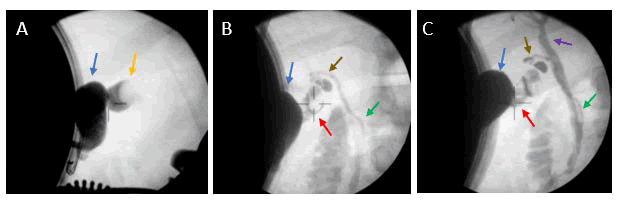
Figure 1. ESWL operation procedure radiology image. Blue arrow: Gall bladder; yellow arrow: Stones stuck in the neck of gall bladder; red arrow: Stone broken by ESWL; brown arrow: Cystic duct; purple arrow: Common hepatic duct; green arrow: cCommon bile duct.
The patient then underwent the 2-month follow-up ERCP for bile duct stent removal. The cholecystostomy drain was also removed uneventfully.
Results and Discussion
It is evident in this case that the patient's journey had a positive outcome while minimizing the risk associated with a surgical procedure. Therefore, there is an indication to suggest that ESWL has an increasing role in the future management of challenging gall bladder stones when the patient is not a candidate for cholecystectomy or not interested in one as in the case here. ESWL can be considered as an effective, non-invasive therapeutic option for treating large pancreatic and common bile duct calculi, and gall bladder stones as there. Due to its high efficacy and low complication rate, ESWL can be offered as first-line therapy for selected patients with large and pancreatic and common bile duct calculi. However, there are certain limitations, particularly in the treatment of multiple gallbladder stones. The major drawback of ESWL is the limited visualization of radiolucent stones and can only supplement another definitive modality. A diseased gallbladder remnant seems incapable of expelling the fragments even when stones are successfully fragmented.
Additionally, there have been reports of rare but serious complications following ESWL in different situations, including perirenal hematoma, biliary obstruction, bowel perforation, splenic rupture, lung trauma, and necrotizing pancreatitis. The cause might be due to impact of shock waves on adjacent organs. Nevertheless, these risks can potentially be offset with appropriate patient selection, during the pre-op assessment. On a positive note, there is no increased incidence of pancreatitis following ESWL combined with ERCP.
Besides, interventional radiology-guided gall bladder drain placement avoids the use of general anesthesia and invasive surgery, reducing the risk for high-risk surgical patients. This procedure allows for percutaneous stone extraction, which can avoid the need for cholecystectomy in some patients. However, significant injury to the biliary system can occur during percutaneous maneuvers, sometimes requiring surgical intervention. Besides, Cystic duct stenting carries a risk of injury and may not provide definitive management in all cases.
Conclusion
In conclusion, this case demonstrates that ESWL can
provide positive outcomes while minimizing surgical risks,
suggesting its potential for rescue gallstone management,
supplementing another definitive modality. As research
progresses, ESWL is likely to play an essential role in the
future, especially for patients who prefer non-invasive
treatments or cannot undergo surgery.
References
- Littlefield A, Lenahan C. Cholelithiasis: presentation and management. J Midwifery Womens Health. 2019;64(3):289-297.
[Crossref] [Google Scholar] [PubMed]
- Kurzweil A, Martin J. Transabdominal ultrasound. 2024. StatPearls Publishing,
[Google Scholar] [PubMed]
- di Ciaula A, Portincasa P. Recent advances in understanding and managing cholesterol gallstones. F1000Res. 2018;7.
[Crossref] [Google Scholar] [PubMed]
- Chen X, Yan XR, Zhang LP. Ursodeoxycholic acid after common bile duct stones removal for prevention of recurrence: A systematic review and meta-analysis of randomized controlled trials. Medicine. 2018;97(45):e13086.
[Crossref] [Google Scholar] [PubMed]
- Lam R, Zakko A, Petrov JC, Kumar P, Duffy AJ, et al. Gallbladder disorders: A comprehensive review. Disease-a-Month. 2021;67(7):101130.
[Crossref] [Google Scholar] [PubMed]
- Watson RR, Parsi MA, Aslanian HR, Goodman AJ, Lichtenstein DR, et al. Biliary and pancreatic lithotripsy devices. VideoGIE. 2018 1;3(11):329-338.
[Crossref] [Google Scholar] [PubMed]
- Dumonceau JM, Costamagna G, Tringali A, Vahedi K, Delhaye M, et al. Treatment for painful calcified chronic pancreatitis: Extracorporeal shock wave lithotripsy versus endoscopic treatment: A randomised controlled trial. Gut. 2007;56(4):545-52.
[Crossref] [Google Scholar] [PubMed]
- Guda NM, Partington S, Freeman ML. Extracorporeal shock wave lithotripsy in the management of chronic calcific pancreatitis: a meta-analysis. JOP. 2005;6(1):6-12.
[Google Scholar] [PubMed]
- Lammert F, Gurusamy K, Ko CW, Miquel JF, Méndez-Sánchez N, et al. Gallstones. Nat Rev Dis Primers. 2016;2(1):1-7.
[Crossref] [Google Scholar] [PubMed]
Citation: Lai SM. (2025) ESWL to the Rescue for Impacted Gall Bladder Fundus Stone After Acute Cholecystitis. JOP. J Pancreas. (2025) 26:923.
Copyright: This is an open access article distributed under the terms of the Creative Commons Attribution License, which permits unrestricted use, distribution, and reproduction in any medium, provided the original work is properly cited.