Case Report - (2025) Volume 26, Issue 6
Erector Spinae Plane Block (ESPB) with or without Intra-Thecal Opioid (ESPITO) analgesia for providing perioperative analgesia in Paediatric Frey’s Surgery for chronic calcific pancreatitis: a case series
G. Niraj1*,
B. Konan2,
N. Charan3,
N. Vamsikrishna2,
M. Ananda2,
K. M. Likhith3 and
J. Singh3
1Department of Anesthesia & Pain Medicine, Sri Madhusudan Sai Institute of Medical Sciences & Researc, Chikkaballapur, Karnataka, India
2Department of General Surgery, Sri Madhusudan Sai Institute of Medical Sciences & Research, Chikkaballapur, Karnataka, India
3Department of Anesthesia, Sri Madhusudan Sai Institute of Medical Sciences & Research, Chikkaballapur, Karnataka, India
*Correspondence:
G. Niraj, Department of Anesthesia & Pain Medicine, Sri Madhusudan Sai Institute of Medical Sciences & Researc, Chikkaballapur, Karnataka,
India,
Email:
Received: 05-Jun-2025, Manuscript No. IPP-25-22723 ;
Editor assigned: 09-Jun-2025, Pre QC No. IPP-25-22723 (PQ);
Reviewed: 30-Jun-2025, QC No. IPP-25-22723 ;
Revised: 21-Jul-2025, Manuscript No. IPP-25-22723 (R);
Published:
28-Jul-2025, DOI: 10.54615/2231-7805.26.6.953
Abstract
Context: Surgery is often indicated for children presenting with intractable abdominal pain secondary to chronic calcific pancreatitis. Frey’s procedure involves an upper abdominal incision that mandates effective perioperative analgesia Although epidural analgesia is considered the gold standard, it has limitations. Erector spinae plane analgesia is a novel technique in children with a favourable risk profile.
Case Report: Eight children undergoing Frey’s surgery for chronic calcific pancreatitis were offered the technique. Additional intrathecal opioid analgesia was performed in five adolescent children to provide enhanced visceral analgesia. Outcomes included numerical rating scale pain scores, surgical outcomes, and parental satisfaction.
Conclusion: Continuous erector spinae plane analgesia with or without intrathecal opioid can provide effective perioperative analgesia in children undergoing surgery for chronic calcific pancreatitis.
Introduction
Chronic Calcific Pancreatitis (CCP) is a progressive inflammatory condition that leads to irreversible structural and functional damage of the pancreas. CCP in children causes significant dysfunction [1]. Intractable episodic pain is often the primary presentation. The aetiology is poorly understood [1]. Children who do not respond to conservative management are offered surgery. Frey’s procedure is a commonly performed surgery in this cohort [2,3]. It involves an upper abdominal subcostal incision, which is known to produce intense postoperative pain (Figure 1). Despite significant progress in perioperative analgesia, ineffective postoperative analgesia in children is not uncommon [4]. Inadequately controlled postsurgical pain can result in negative behaviours, delayed recovery with extended hospital stays [5]. Thus, effective perioperative analgesia is crucial in enhancing recovery and ensuring well-being of the child [6]. Current analgesic options include Thoracic Epidural Analgesia (TEA) and opioid analgesia with or without wound infiltration analgesia. Although TEA provides effective analgesia, there are limitations [7]. Opioids are ineffective in mitigating somatic pain and can impair return of bowel function resulting in prolonged hospital stay [8].
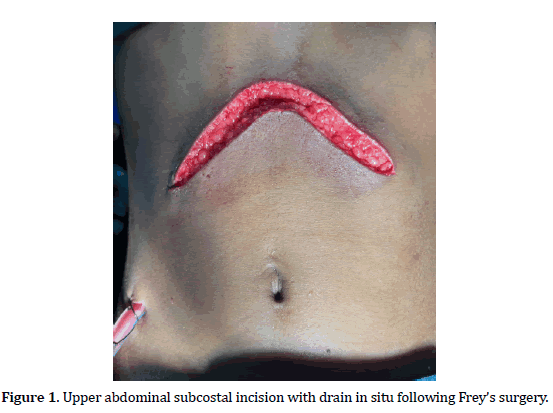
Figure 1: Upper abdominal subcostal incision with drain in situ following Frey’s surgery.
Ultrasound guided Erector Spinae Plane (ESP) block is a recently described technique in the paediatric cohort [4]. ESP block targets the paravertebral nerves and has been shown to provide effective somatic analgesia [8-11]. However, in adults, ESP block may not be as effective for visceral pain that usually peaks within 18-24 hours after surgery [8,9]. Adding intrathecal opioids to ESP infusion is termed ESPITO analgesia [9,10]. The combination of continuous ESP infusion and single shot intrathecal opioid has been reported to provide pre-emptive analgesia, sympathetic blockade and effective peri-operative analgesia [9]. The report describes ESP analgesia in eight children who underwent Frey’s procedure for CCP.
Institutional approval was obtained for performing the service evaluation. Parents were provided an information sheet in the local language detailing the technique and the rationale for offering it. Informed written parental consent was obtained. A separate written consent for their child’s de-identified data to be used for publication in a peer reviewed journal was also taken.
Description of Cases
After informed parental consent, ESP analgesia was offered to children undergoing Frey’s surgery for CCP. The rationale for switching from TEA was based on high failure rates, hypotension, increased postoperative intravenous fluid consumption and the availability of an alternate technique. Adult patients undergoing Frey’s procedure for CCP receive ESPITO analgesia at our centre (CTRI/2023/10/058807).
ESP block and Intrathecal opioid administration
The child was placed in the prone position and intravenous sedation with midazolam (0.01 mg/kg) and ketamine (0.5 mg/kg) administered. The children also received intravenous ondansetron (0.15 mg/kg) and dexamethasone (0.15 mg/kg). The thoracic T7 spinous process was identified. The skin over the thoracic spine was prepared with an antiseptic solution. A high frequency (10-15 Mega Hertz) linear ultrasound probe (Edge 2, Sonosite Inc., Bothell, WA, USA) was placed across the T7 spine. The probe was moved laterally to identify the T7 transverse process. Thereafter, the probe was placed in a vertical alignment and the erector spinae muscle complex identified. After infiltration of the skin and subcutaneous tissue with 2 ml of 1% lidocaine, an 18-G, 8 cm Tuohy needle (Portex, Smiths Medical International Ltd, Kent, UK) was introduced in the plane of the ultrasound beam cranio-caudally. The needle was directed towards the transverse process. Once the needle contacted the T7 transverse process, 5-10 ml of saline 0.9% was injected. The injectate was observed spreading underneath the erector spinae muscle lifting it off the transverse process (saline hydro-dissection). A 20-G catheter (Portex, Smiths Medical International Ltd, Kent, UK) was inserted into the newly created plane. The catheter was secured by subcutaneous tunnelling. The procedure was repeated on the contralateral side.
For the administration of additional intrathecal opioid in older adolescent children, the child was positioned in the lateral decubitus position. Intrathecal opioid administration was performed with a 25-gauge Quincke needle at lumbar L3-4 interspace with 2 ml of 0.5% heavy bupivacaine and 6 micrograms/kg of morphine (maximum 300 microgram).
General Anesthesia
The child was positioned supine and general anesthesia induced with propofol (2 mg/kg), fentanyl (2 microgram/ kg) and atracurium (0.5 mg/kg). After intubation of the trachea, anesthesia maintained with oxygen, air and isoflurane. Intraoperative analgesia included intravenous acetaminophen (15 mg/kg) and ESP analgesia. Following the induction of general anesthesia, each ESP catheter was topped-up with a mixture containing 1.25 mg/ kg bupivacaine with 1:200000 adrenaline. All children received intravenous ondansetron (0.15 mg/kg) and dexamethasone (0.15 mg/kg) prior to extubation of trachea.
Postoperative analgesic regimen included regular intravenous paracetamol (15 mg/kg) every 6-hourly and per rectal diclofenac 50 mg once a day for three days. ESP infusion of 0.2% bupivacaine with 2 mcg/ml adrenaline was commenced at 0.3 mg/kg/hour through a Y connector (Pajunk, GmBH, Medizintechnologie, Geisingen, Germany) for 72 hours. Each child received twice a day bolus of 0.2 mg/kg of the infusion mixture into each ESP catheter for the first two postoperative days.
Rescue analgesia was provided with intravenous tramadol 25 mg as required. All children received an enhanced recovery protocol (Table 1) [12]. They were managed in the surgical postoperative unit for 72 hours. The outcome collected included Numerical Rating pain Scores (NRS) at rest and on coughing at 24 h postsurgery, time to first ambulate, time of removal of urethral catheter, 72-hour tramadol consumption and 72 hour intravenous fluid consumption. Parental satisfaction with pain management was assessed using a categorical scale (excellent, good, fair, poor).
Surgical outcomes included the size of the pancreatic duct, duration of surgery, time to pass flatus, fitness for hospital discharge, 30- and 90-day post-surgical outcomes. A pre-determined discharge criteria was used, which included four parameters: managing adequate oral intake, pain was controlled on oral analgesics, bowel opened and an absence of signs suggestive of an anastomotic leak.
Results
Over a 21-month period between August 2023 – May 2025, eight children underwent Frey’s procedure and received ESP analgesia. Five children also received additional intra thecal opioids (ESPITO analgesia). Demographic data is presented in Table 2.
| Recovery protocol |
| Intravenous fluid restricted to 1.5 ml /kg /h for 48 h |
| Multimodal, opioid sparing analgesia |
| Antiemetic prophylaxis (Ondansetron 4 mg 8 hourly for 72 hours) |
| Early ambulation within first 24 h of surgery |
| Avoidance of nasogastric tube |
| Early removal of surgical drains when feasible |
| Early enteral feeding |
| Early removal of urethral catheter |
| Chest physiotherapy with incentive spirometry |
Table 1. Enhanced recovery protocol for paediatric patients undergoing open abdominal surgery for chronic calcific pancreatitis [12].
S
No. |
Age(years)/
Gender |
Weight
(kg) |
Duration of
Pain (years) |
Pancreatic Duct
Size (mm) |
Tramadol consumption
in 72 h (mg/kg) |
NRS Pain Scores at
rest at 24 h |
NRS Pain Score on
coughing at 24 h |
Fit for
discharge
(days) |
| 1 |
8 / M |
25 |
3 |
6 |
100 |
3 |
5 |
11 |
| 2 |
10 / F |
27 |
5 |
15 |
100 |
3 |
6 |
5 |
| 3 |
12/ M |
24 |
3 |
12 |
75 |
2 |
4 |
8 |
| 4 |
14 / F |
43 |
6 |
6 |
100 |
2 |
4 |
5 |
| 5 |
16 / F |
51 |
3 |
5 |
50 |
1 |
3 |
6 |
| 6 |
16 / F |
60 |
3 |
8 |
50 |
1 |
2 |
8 |
| 7 |
17 / M |
46 |
4 |
5 |
50 |
2 |
4 |
9 |
| 8 |
7 / M |
15 |
3 |
10 |
25 |
0 |
2 |
5 |
Table 2. Demographics and outcomes.
Anesthesia outcomes
Parental satisfaction with postoperative pain management was rated as excellent by 71% (5/6) and as good by 29% of parents (2/7). Children reported effective static and dynamic analgesia at 24 hours after surgery (Table 2). There was no incidence of Postoperative Nausea or Vomiting (PONV). All children were ambulant within 20 hours of surgery. There was no incidence of hypotension during the first 72 hours after surgery. The mean 72-hour intravenous fluid consumption was 3.9 Litres.
Surgical outcomes
The mean duration of surgery was 3.2 hours. All children passed flatus within 48 hours. The urethral catheter was removed within 72 hours. No complications were observed. There was no readmission within 30 days of hospital discharge. At 90-day telephone review in seven children, all children were pain-free. At the time of writing this report, one child had not completed 90 days postsurgery (Table 2).
Discussion
We present an early experience with continuous ESP analgesia for providing effective perioperative analgesia in six children undergoing Frey’s procedure for CCP. To the best of our knowledge, this is the first report on both ESP analgesia and ESPITO analgesia in children undergoing upper abdominal surgery. Effective analgesia is vital to enhance well-being and recovery in children. TEA is considered the gold standard technique in this cohort [13]. However, current evidence reveals that the benefits of TEA are not as impressive as believed in the past, while the risks of adverse effects and serious complications are greater than previously estimated [7]. Limitations include intensive nursing care, common side-effects, high failure rates, and potentially serious adverse effects [7,13,14].
Pain after open upper abdominal surgery has both somatic and visceral components. Somatic pain arises from the thoracic T6-T10 dermatomes. ESP block is a versatile technique that targets the paravertebral nerves and provides effective somatic analgesia [8-11]. Unlike TEA, the technique is performed under real-time ultrasound guidance. In adults, ESP block is reported to provide less effective visceral analgesia, which could last for 24- 36 hours [8]. However, in younger small built children, we have observed that sole ESP analgesia appears to be effective in providing adequate analgesia. However, the youngest child in our cohort was admitted with acute on chronic active pancreatitis one week before the scheduled surgery. Since the visceral pain was poorly controlled, the surgery was not deferred. We anticipated a stormy postoperative period with severe visceral pain in addition to somatic pain. The child received ESPITO analgesia and had a very stable postoperative course with excellent analgesia. The child required just one dose of intravenous tramadol (25 mg) for rescue analgesia in the first 72 hours post-surgery.
In older children, addition of intrathecal opioids provided excellent visceral analgesia for 18-24 hours [9,10]. Our rationale to trial ESPITO analgesia in older children was based on the need to provide effective perioperative opioid-sparing analgesia that enhances recovery. There was no incidence of PONV in children who received intrathecal opioids. The likely reason was the effective pre-emptive anti-emetic treatment with combined ondansetron and dexamethasone.
Parental satisfaction with postoperative pain management was high. The mean 72-hour tramadol use was 1.5 mg/kg mg in the ESPITO group and 3.6 mg/kg in the ESP group. It suggests that the addition of intrathecal opioids provided benefit in this cohort. The children were fit to be discharged within eight days of the surgery. We used a pre-set fitness to hospital discharge criteria instead of the standard length of hospital stay. The reasons include social factors, rural setting of our newly established medical college and parental request for prolonged length of hospital stay. The fitness to discharge criteria met in this series is in concordance with those reported from high volume tertiary centres [2,3].
Both ESP and ESPITO are low-risk techniques, do not warrant intensive nursing care nor causes hemodynamic disturbance [9,10]. None of the children required vasoactive agents to maintain blood pressure and were ambulant within 20 h after surgery. They were managed in a postoperative surgical unit and did not require intensive nursing care. Additionally, our team had expertise with the technique [8-10].
The erector spinae plane is a high-volume plane. We have observed that the patients require additional bolus doses twice a day during the first 48 hours after surgery for enhanced dynamic analgesia [8-10]. We were mindful of keeping the cumulative bupivacaine dose to well within 0.35 mg/kg/hour for 72 hours [15].
Chronic Pancreatitis (CP) in children is not as rare as previously thought [16]. The diagnosis is based on clinical findings, biochemical tests, imaging studies and the presence of exocrine pancreatic dysfunction. The risk factors in children include four categories: genetic mutations, obstructive factors, toxic/metabolic and autoimmune [17]. The research from the International Study Group of Pediatric Pancreatitis: In Search for a Cure (INSPPIRE) found that CP imposes a severe disease burden on the families of children with CP [18]. In children who fail conservative management, surgery can provide some benefit in managing chronic pain. Perioperative pain can be severe, and it is vital to manage it without additional adverse outcomes.
We are aware of the major limitations, which is inherent in this type of study. These include open label, single centre, observational service evaluation in a small cohort. Given the low prevalence of CCP in children, randomized trials may not be feasible.
Conclusion
In conclusion, ESP analgesia with or without intrathecal opioids (ESPITO) could provide effective perioperative analgesia in children undergoing major upper abdominal surgery. Further definitive studies are warranted.
Funding
This article is funded by Sri Madhusudan Sai Institute of Medical Sciences & Research.
Author’s Contribution
G Niraj helped in the concept, design, performed intervention, drafting the manuscript. BR Konan performed Frey’s surgery and helped with drafting the manuscript. N Charan performed intervention, helped with data collection and drafting the manuscript. N Vamsikrishna performed Frey’s surgery, helped with data collection as well as drafting the manuscript. M Ananda performed Frey’s surgery, helped with data collection as well as drafting the manuscript. KM Likhith performed the intervention, helped with data collection and drafting the manuscript. J Singh helped with data collection and drafting the manuscript
Conflict of Interest
All the authors report having no conflicts of interest for this article.
References
- Poddar U, Yachha SK, Borkar V, Srivastava A, Saraswat VA. Clinical profile and treatment outcome of chronic pancreatitis in children: A long-term follow-up study of 156 cases. Scand J Gastroenterol. 2017;52:773-778.
[Crossref], [Google Scholar], [PubMed]
- Ray S, Sanyal S, Ghatak S, Khamrui S, Biswas J, Saha S, et al. Frey procedure for chronic pancreatitis in children: A single center experience. J Pediatr Surg. 2015;50:1850-1853.
[Crossref], [Google Scholar], [PubMed]
- Fuchs J, Loos M, Kinny-Köster B, Hackert T, Schneider M, Mehrabi A, et al. Pancreatic surgery in children: complex, safe, and effective. Ann Surg. 2024;280:332-339.
[Crossref], [Google Scholar], [PubMed]
- Luo R, Tong X, Yan W, Liu H, Yang L, Zuo Y. Effects of erector spinae plane block on postoperative pain in children undergoing surgery: A systematic review and metaâ?�analysis of randomized controlled trials. Pediatr Anesth. 2021;31:1046-1055.
[Crossref], [Google Scholar], [PubMed]
- Joshi GP, Ogunnaike BO. Consequences of inadequate postoperative pain relief and chronic persistent postoperative pain. Anesthesiol Clin North Am. 2005;23(1):21-36.
[Crossref], [Google Scholar], [PubMed]
- Mehl SC, Johnson B, Patel N, Todd H, Vasudevan S, Nuchtern J, et al. Comparison of subcutaneous analgesic system and epidural analgesia for postoperative pain control in open pediatric oncology operations: A randomized controlled trial. J Pediatr Surg. 2023;58:153-160.
[Crossref], [Google Scholar], [PubMed]
- Rawal N. Epidural analgesia for postoperative pain: Improving outcomes or adding risks? Best Pract Res Clin Anaesthesiol. 2021;35:53-65.
[Crossref], [Google Scholar], [PubMed]
- Tariq Z, Niraj G. Continuous Erector Spinae Plane (ESP) Analgesia in different open abdominal surgical procedures: A Case Series. J Anesth Surg. 2018;5:57-60.
[Crossref], [Google Scholar]
- Niraj G, Tariq Z, Ratnayake A, Jackson BL, Ahson M, Kamel Y, et al. Effectiveness of ESPITO analgesia in enhancing recovery in patients undergoing open radical cystectomy when compared to a contemporaneous cohort receiving standard analgesia: an observational study. Scand J Pain. 2021;21:339-344.
[Crossref], [Google Scholar], [PubMed]
- Ratnayake A, Goh L, Woolsey L, Thawale R, Jackson BL, Niraj G. Erector spinae plane and intra thecal opioid (ESPITO) analgesia in radical nephrectomy utilising a rooftop incision: Novel alternative to thoracic epidural analgesia and systemic morphine: A case series. Scand J Pain. 2020;20:847-851.
[Crossref], [Google Scholar], [PubMed]
- Costache I, Pawa A, Abdallah FW. Paravertebral by proxy-time to redefine the paravertebral block. Anaesthesia. 2018;73:1185-1188.
[Crossref], [Google Scholar], [PubMed]
- Hidayah BA, Toh ZA, Cheng LJ, Syahzarin BD, Zhu Y, Pölkki T, et al. Enhanced recovery after surgery in children undergoing abdominal surgery: Meta-analysis. BJS Open. 2023;7:147.
[Crossref], [Google Scholar], [PubMed]
- Wong GK, Arab AA, Chew SC, Naser B, Crawford MW. Major complications related to epidural analgesia in children: A 15-year audit of 3,152 epidurals. Can J Anesth. 2013;60(4):355-363.
[Crossref], [Google Scholar], [PubMed]
- Bravenboer-Monster K, Keyzer-Dekker C, van Dijk M, Staals L, de Leeuw T, Wijnen R. Efficacy of epidural analgesia after laparotomy in children. Eur J Pediatr Surg. 2019;29:209-214.
[Crossref], [Google Scholar], [PubMed]
- Suresh S, Ecoffey C, Bosenberg A, Lonnqvist PA, De Oliveira GS, de Leon Casasola O, et al. The European Society of Regional Anaesthesia and Pain Therapy/American Society of Regional Anesthesia and Pain Medicine recommendations on local anesthetics and adjuvants dosage in pediatric regional anesthesia. Reg Anesth Pain Med. 2018;43:211-216.
[Crossref], [Google Scholar], [PubMed]
- Suzuki M, Minowa K, Isayama H, Shimizu T. Acute recurrent and chronic pancreatitis in children. Pediatr Int. 2021;63:137-149.
[Crossref], [Google Scholar], [PubMed]
- Kumar S, Ooi CY, Werlin S, Abu-El-Haija M, Barth B, Bellin MD, et al. Risk factors associated with pediatric acute recurrent and chronic pancreatitis: Lessons from INSPPIRE. JAMA Pediatr. 2016;170:562-569.
[Crossref], [Google Scholar], [PubMed]
- Ting J, Wilson L, Schwarzenberg SJ, Himes R, Barth B, Bellin MD, et al. Direct costs of acute recurrent and chronic pancreatitis in children in the INSPPIRE registry. J Pediatr Gastroenterol Nutr. 2016;62:443-449.
[Crossref], [Google Scholar], [PubMed]
Citation: Niraj G, Konan B, Charan N, Vamsikrishna N, Ananda M, Likhith KM, et al. Erector Spinae Plane Block (ESPB) with or without Intra-Thecal Opioid (ESPITO) Analgesia for
Providing Perioperative Analgesia in Paediatric Frey�¢??s Surgery for Chronic Calcific Pancreatitis: A Case Series. JOP. J Pancreas. (2025) 26:913.
Copyright: This is an open access article distributed under the terms of the Creative Commons Attribution License, which permits unrestricted use, distribution, and reproduction in any medium, provided the original work is properly cited.