Review Article - (2025) Volume 12, Issue 1
Understanding Sustainability and Innovation in Nature-Based Tourism Business Models: A Systematic Literature Review
Cristina Abreu*
Department of Tourism Management, Europeia University, Lisbon, Portugal
*Correspondence:
Cristina Abreu, Department of Tourism Management, Europeia University, Lisbon,
Portugal,
Email:
Received: 16-Sep-2024, Manuscript No. IPBJR-24-21550;
Editor assigned: 18-Sep-2024, Pre QC No. IPBJR-24-21550 (PQ);
Reviewed: 02-Oct-2024, QC No. IPBJR-24-21550;
Revised: 15-Jan-2025, Manuscript No. IPBJR-24-21550 (R);
Published:
22-Jan-2025, DOI: 10.36648/2394-3718.12.1.129
Abstract
Innovation and the various dimensions of sustainability are essential in companies’ competitiveness in general and tourism. Business Models (BM) show how companies define value creation, sharing, and competitive advantage. There has been no systematic research on the available literature on BM, innovation, sustainability, and the embodiment of these concepts into Nature-Based Tourism (NBT). To address this knowledge gap, we undertook a systematic literature review on the relevance and role of BM, innovation, and sustainability in NBT. After reviewing 74 conceptual and empirical articles, we detected that the literature on tourism and NBT is fragmented and that innovation, sustainability, and BM lack to be effectively considered in NBT. The systematic literature review helped us understand the relevance of introducing these literature streams into NBT research from the theoretical perspective. Further research and managerial implications are outlined, including the possibility of developing Innovative Sustainable Business Models (ISBM) for tourism and NBT and its relevance to NBT companies’ competitiveness and quality improvement.
Keywords
Nature-based tourism; Innovation; Sustainable tourism; Business model; Competitiveness
Introduction
Nature and natural resources generally support tourism development. The role of nature in tourism is widespread. Nature-Based Tourism (NBT) is when companies exploit natural assets directly or indirectly [1]. Contemporary lifestyles compel to acknowledge nature’s value in business and incorporate nature assets by adopting new management initiatives, which may be determinant for companies and nature conservation [1-3]. However, it is unclear how NBT companies use natural assets in their supply and how companies’ initiatives introduce innovation, sustainability standards, and formal or informal Business Models (BMs) [4]. In addition, it remains unclear how formal or informal BMs shape companies’ performance, long-term business potential, and competitive advantage [5,6].
There is an understanding that developing a Business Model (BM) for NBT is relevant to enhancing business performance [7-9]. Nevertheless, literature on BM is frequently unrelated to academic research, which is still unusual in specialized academic tourism publications [10]. BMs in tourism are recent [10]. Research gaps exist in tourism publications on business sustainability and BMs [4,11]. Among these, Boons and Lüdeke-Freund suggested a research agenda on BMs connected with corporate sustainability or sustainable innovation. Innovation in BMs relates to a company’s BM reshaping and is directly associated with knowledge and skills, which are frequently non-existent in small family and countryside companies [8,12]. NBT companies often offer tailor-made experiences, and innovation may trigger radical changes [13]. A lack of research on BMs to be implemented in NBT and design-implementation on Innovative Sustainable Business Models (ISBMs) is evident [14]. Innovation in NBT has not been the focus of investigations [9]. Consequently, BM research in tourism should happen, allowing alternative management actions and innovation to fulfil companies’ strategic objectives [10,15,16].
There is also sparse literature on BMs for NBT, and the concept of BMs in NBT is understood and used in a relatively limited way and adopts a very static perspective [9]. This prompted Geissdoerfer et al., to highlight BMs for NBT and the design implementation of ISBMs as an emergent field of research. The reduced number of theoretically oriented research studies on NBT may also explain the lack of studies on ISBMs for NBT [1]. The innovation should not be understood as a panacea for all the fragilities and needs of tourism; however, the introduction of innovation in BMs for NBT and tourism, in general, can be relevant to reduce obsolete practices and improve business competitiveness and business performance in the long term [4,17/a>-20]. Following Siddaway et al., two research questions were formulated [21]:
RQ 1: To what extent does sustainability in NBT BMs contribute to long-term business?
RQ 2: How do NBT companies incorporate innovation and sustainability in their BMs to achieve competitive advantage?
The formulation of the research questions allowed for the objectives of this study to be established. The first aim of this study is to conduct a literature review of the research published on business models for tourism and nature-based tourism. The study’s second aim is to identify, evaluate, and synthesize research on business models for nature-based tourism. The third aim is to discuss the research themes and trends. The fourth objective of the study is to yield an understanding, based on the studies considered, of how business models in nature-based tourism companies are changing to incorporate innovation and sustainability. Finally, the study aims to stimulate a debate on innovative sustainable business models and their impacts on long-term business performance and competitiveness in nature-based tourism companies.
Furthermore, the study proposes definitions of NBT and ISBMs and conveys our understanding of sustainability. This study contributes to the literature on BMs for NBT companies by presenting an understanding of the evolution of innovation and sustainability in BMs for NBT and suggests avenues for future research.
After establishing the topics’ significance and identifying the literature gaps identified in section 1, section 2 presents the concepts under study, and section 3 describes the methodological approach employed. Section 4 presents our findings with a descriptive analysis of the papers included, and section 5 outlines a literature review of the fundamental research topics. Section 6 provides a discussion and conclusions. After that, section 7 presents the contributions of this review. Finally, section 8 points out research implications, limitations, and directions for further research.
Literature Review
Nature-Based Tourism
Ducarme and Couvet consider ‘nature’ more complex and abstract than it seems, suggesting a ‘wise use’ of the concept, complemented by other scientific concepts such as ‘biodiversity’, ‘evolution’, ‘ecosystem’, ‘landscape’, ‘wildness’, ‘population’, and ‘community’ among others [22]. From a servicescape perspective, nature has a wide range of functions, and its influence on customers and employees is considered an internal response to environmental effects [23]. From an economic point of view, nature is a service provider where ecosystem functions are classified as services with a monetary value, quickly adopted by governments and financial sectors since 1970 [24]. In NBT, nature merges the two previous assumptions, where nature remains the main stage of operations as a servicescape and a product commercialized by suppliers and consumed and experienced by tourists [25].
NBT constitutes a complex area of research, and the relevant literature provides several definitions of NBT [26-29]. NBT includes all forms of tourism based on natural resources, wildness, landscape, and biodiversity to promote environmental conservation and improve local welfare [28-30]. Goodwin and Fennell, emphasize that NBT and ecotourism overlap. Laarman and Durst refer to nature tourism as ‘nature travel’ or ‘nature-oriented tourism’, introducing the definition’s educational, recreational, and adventure aspects. The previous reports express two contradictory perspectives on NBT. The first focuses on NBT as non-intrusive tourism associated with nature conservation, whereas the second considers NBT as dynamic tourism using natural resources for different purposes. Moreover, Lang and O´Leary, define NBT as tourists’ travels to natural areas or destinations. Fennell also designated NBT as Natural Resource-Based Tourism, or Natural Resource Tourism, described as ‘Responsible travel to natural areas that conserves the environment and improves local people’s welfare (p.97). NBT may also be consumptive tourism, such as hunting. Mehmetoglu proposed an NBT segmentation into categories according to outdoor activities. Some scholars focus on NBT’s relevance for conservation and nature interests [29-31]. NBT is also considered a regional development booster based on sites’ unique characteristics, exclusive experiences, and NBT products [3,32].
We highlight the absence of a consensual definition of NBT, which compromises the acceptance of NBT as an identifiable economic sector and makes it difficult to measure the economic impacts [1]. Notwithstanding, NBT contributes significantly to nature conservation [28,33]. NBT occurs in relatively whole and undeveloped natural areas outside one’s home environment [29,34]. This perspective prompted researchers to expand the NBT concept beyond a conservationist and environmentalist vision, introducing tourists’ activities in the NBT definition [35,1]. Fredman et al., define NBT as a broad concept: “Nature-based tourism is human activities occurring when visiting nature areas outside the person’s ordinary neighbourhood” [1]. Fredman and Tyrvainen consider different sub-categories of tourist’ activities according to the purpose and context of tourists’ visits [1]. Tourists’ activities occur in relatively unmodified, undeveloped natural areas outside one’s home [29,34]. Therefore, Fossgard and Fredman consider the NBT to have a minimalist character [36]. The vast diversity of approaches towards NBT can be the reason for the non-existence of a standard definition of NBT, whereby the definitions mentioned above underline nature conservation and environmental conscientiousness [1]. NBT is a way to promote regional development and rural-based economy diversification [3]. Natural resources significantly support and provide raw materials for human activities, and managing nature implies ecosystem services conservation [37]. Ecosystem services and nature conservation, managed effectively, efficiently, and equitably through market-based instruments, contribute to business competitiveness [38].
NBT is frequently associated with Sustainable Tourism (ST). Nevertheless, few NBT articles address sustainability and ecosystem services management [10]. Well-preserved spots positively impact NBT destination attractiveness [39]. Reconciling tourist activities with the basic principles of sustainability should be seen as a fundamental requirement of NBT companies and a differentiation asset that enhances NBT’s competitive advantage.
Sustainable Tourism
Agenda 21 for the Travel and Tourism Industry introduced the concept of sustainable development in tourism [40]. In 1993, the World Tourism Organisation (UNWTO) defined Sustainable Tourism (ST) as promoting economic growth and preserving the environment and heritage with positive repercussions for host communities, visitors, and tourism. Bramwell and Lane articulated ST as “a positive approach intended to reduce the tensions and friction created by the complex interactions between the tourism industry, visitors, the environment, and the communities which are host to holidaymakers” [41,42]. A flexible interpretation of the concept of sustainable development by politicians, decisionmakers, and public and private institutions prompts different perspectives, such as an anthropocentric and utilitarian view, an ecosystem and bioethical perspective, considering continuous economic growth [43]. The absence of indicators compromised the term ‘sustainable’ [44]. Therefore, a limited set of universal, unambiguous indicators focusing on environmental, social, and economic performance are vital to monitoring and assessing ST [45-47]. ST widely considers environmental and economic dimensions, but communities are not always involved [40]. The lack of involvement of local communities led to the implementation of new sustainable development strategies and sustainability monitoring tools [48]. Several authors defend the adoption of ST as a multidimensional concept [49-51]. The last two decades have significantly evolved ST [52]. The first decade was the adoption of the economic, environmental, and social dimensions of sustainability [52]. In contrast, the second decade was dedicated to the evolution of the ST concept, which is associated with efficient partnerships and networks [53]. Other authors have also considered introducing the principle of subsidiarity in tourism [54]. The introduction of a holistic approach provided meaning and value to ST and led to the understanding that sustainability should be the pillar of tourism (Clarke) [46,55].
ST research in testing and applying theory by conducting empirical research brings relevant contributions [56]. Scholars stress the need to serve society and academia better, seeking “clearer connections to the challenges identified by the United Nations Sustainable Development Goals (UN_SDG), the Paris agreement and other global initiatives” [57]. Tourism and sustainable development should be connected, reframing research and teaching, according to the UN_SDG, and introducing critical thinking in tourism [42,58]. Companies should adopt a broader vision involving long-term planning to boost economic benefits, local well-being, environmental protection, and tourist experiences [59,60]. Cucculelli and Goffi, Connell and Nunkoo et al., mention the combination of population empowerment, destinations’ competitiveness improvement, and innovation in ST [60-62]. Efforts to minimize adverse environmental perceptions of tourism are still lacking, such as introducing innovative products and services, applying innovative destination management practices, and integrating sustainable communication and procedures for responsible behavior [63,64].
Innovation
At the beginning of the XX century, critical discussions on innovation emerged in economic publications. Innovation represents a key asset in tourism in hospitality and tourism companies, contributing to tourism growth and long-term business survival by doing things differently, achieving better results, and improving performance [6,65]. However, there is still limited research on tourism innovation and its impacts on destinations and national economies [66].
Innovation has become common in companies, research units, universities, and organizations [67]. The definition of innovation highlights doing something different or new, introducing innovative culture and external knowledge in organizations, and transforming new ideas into successful innovations [6]. Other definitions mention the “implementation of a new or significantly changed product or process” or “the development process and the introduction of new goods or services” [68,69]. To summarize, innovation must consider three common elements: Creativity, a problemsolving approach, and a new way of thinking, meaning that innovation introduces an alternative viewpoint [48].
In tourism, there is scarce innovation related to product, process development, and technology adoption [70]. Most existing tourism companies, such as NBT companies, are small, revealing a lack of knowledge and technological skills [12,72,73]. In general, a lack of appropriate skills and adequate education on innovation remains among tourism entrepreneurs [48,71]. Thus, universities and other institutions are fundamental to enhancing tourism innovation [66,74,75].
In tourism, transformational leadership in hotels contributes to creativity, learning, and internal changes, where top experienced management positively influences product innovation [69,76]. Williams and Shaw, characterized tourism internationalization as innovation, emphasizing that internationalization per se is not innovation and requires highlevel knowledge [77]. Williams and Shaw, also acknowledge that customers can act as co-creators of innovation. International tourism may employ new processes or imitate existing ones to increase economic growth, productivity, and employment [78]. Zach and Hill mention that networking, collaboration, knowledge sharing, and trust are relevant to the innovation of tourism destinations [79]. Dziallas and Blind, suggest the introduction of indicators and measuring tools for innovation assessment. In NBT, innovation is not mainly investigated, and this knowledge gap presents a research opportunity with benefits for both researchers and businesses [9].
Policy uncertainty negatively affects a country’s innovation quantity, quality, and originality, compromising long-term business sustainability and profits [80]. It is up to managers and business owners to introduce the best practices according to the objectives and goals defined by each company. Innovation assumes a leading role for companies and is a common feature in all sectors of activity, including innovative BMs (BMIs).
Business Models
Biloslavo et al., describe business models as interdisciplinary instruments promoting a holistic view of business, where nature, societies, and the economy are considered [4]. BMs are significant in defining an organization and its functioning, explicitly or implicitly, where conceptualizations of BM tend to differ according to organizations’ characteristics and are associated with the epistemological perspectives and methodological approaches of BM researchers [81-89]. Despite the high quantity of literature on BMs, many unsolved problems remain, and a general definition of BMs was not found. Scholars tend to define BMs from different perspectives, such as a tool joining all business elements a strategy, an activity system providing value creation, value share, and competitive advantage or as “how the enterprise delivers value to customers, entices customers to pay for value, and convert those payments to profit” [90-92].
It can be found in the use of BMs and strategy concepts in an interchangeable way, where BMs are considered a tool that joins all business elements, explaining how activities and companies’ strategies are lined up [[90-92]]. Considering BMs as a tool, the perceptions of value proposition, market segment, value chain structure, revenue mechanisms, cost and profit estimation, competitive strategy, and innovation are embedded. According to companies, BMs can play different roles and purposes, except scientific models or scales. BMs are interpreted in multifaceted ways; they can be copied, such as model organisms (as in biology), represent classes of things, and be manipulated like economic models [93]. Teece, emphasizes that implementing a BM may involve elements that are hard to replicate. Magretta, Massa et al., and Ranjith underline the significance of efficient BMs for competitive advantage improvement [94]. A BM can also be interpreted as an activity system, providing value creation, value share, and competitive advantage. Baden-Fuller and Haefliger provide a service ecosystems perspective in BM, which introduces a shift from companycentric production of outputs to activities and processes. Wieland et al., include BMs’ economic and social resources and their role in service exchange [95]. In tourism, BMs should attract customers, their needs, and their satisfaction, providing economic outcomes, knowledge, innovative practices, and promoting customers’ behavior transition. Martins et al., give a different design perspective on IBMs, drawing on cognitive psychology research [96]. The previous authors proposed novelty, analogical reasoning, and conceptual combination, emphasizing combining a modifier concept and the existing BMs. Recent research on BMs detaches BMs from the technological era and engages with the generation of sustainability. Boons and Ludeke-Freund proposed imposing exemplar normative requirements through ISBMs.
A BM represents “a representation of a company underlying core logic and strategic choices for creating and capturing value within a value network”. Summing up, “a BM is a description of an organization and how that organization functions in achieving its goals (e.g. profitability, growth, social impact, …)” or as “how the enterprise delivers value to customers, entices customers to pay for value, and convert those payments to profit”.
BMs are present in companies either explicitly or implicitly and can assume distinct perspectives, such as integrating analogical reasoning and conceptual combination, corporate sustainability, or sustainable innovation . Many unsolved questions remain in the BM literature, such as a general definition of BMs, which would guide efforts to enhance strategies, decision-making, and companies’ performance. Scholars also view BMs as interdisciplinary instruments, in line with the United Nations (UN) global challenges and sustainability agenda, including nature, economy, and society, aiming to develop flexible business models such as BM canvas. BM research in tourism can be advanced by executing alternative management actions and innovation to fulfill companies’ strategic objectives. Foss and Saebi, considered IBMs as “designed, novel, and nontrivial changes to the key elements of a company’s BM and the architecture linking these elements” [97]. Additionally, Schaltegger et al., and Franca et al., argued that an IBM requires interrelating sustainability dimensions and new ways to create and deliver value [98, 99]. Yang et al., supported the introduction of a sustainable strategic design to identify the company’s uncaptured values [100]. Gjerding and Kringelum, described an IBM “as a process by which companies balance exploration through the context of the value network” [101]. Heikkila et al., discussed IBM’s association with the company’s strategic goals and the existent BM [102]. Tidd and Bessant and Andreassen et al., took a system perspective on IBM to demonstrate how companies create, deliver, and capture value [103,104]. Innovation in BMs is no longer focused exclusively on the product or the innovation process, with ISBMs being a new area of interest [105]. Besides, NBT relies on nature and local communities; therefore, exploring new BMs in NBT is relevant to understanding how the NBT BMs should evolve to enhance sustainability. Furthermore, this aligns with new business practices and customer choice improvement.
Methodology
A systematic literature review aims to understand the subject’s complexity, connect past and recent research, and collect relevant scientific data to support the development of new knowledge and future studies [106]. A systematic literature review was deemed to be an appropriate methodology for the current research as it provides (a) the use of explicit and transparent methods; (b) a piece of research and follows a step-by-step process of literature search, collection, and analysis; (c) credible, replicable, scientific, and transparent data that can be updated; and (d) relevant, helpful research that is easily understood by all parties concerned [107]. For the systematic literature review, we followed the four steps proposed by Bryman: (1) define the purpose of the review; (2) seek out studies relevant to the scope and purpose of the review; (3) appraise the studies identified in step two, and (4) analyze each study and synthesize the results. Search terms were defined to find relevant articles addressing the topics of this review.
Considering the aims of this study, a database search in ProQuest, Taylor and Francis, Scopus, Web of Science, and Emerald was initially conducted on BMs for NBT, innovation, ST, and NBT. A limited number of studies discussing BMs in NBT were noticed. Therefore, we decided to expand our search to BMs in tourism in general, innovation, ST, and NBT. The search strings used to scan article titles, abstracts, and keywords were as follows: ‘innovation’, ‘NBT’, ‘innovation’ AND ‘NBT’, ‘sustainable tourism’, ‘sustainable tourism’ AND ’NBT’, ‘business models’, ‘sustainable business models, ‘innovation’ AND ‘business model’, ‘sustainable tourism’ AND ‘business models’, ‘sustainable business models’ AND ‘innovation’, ‘sustainable business models’ AND ‘NBT’ AND ‘innovation’.
As some strings, such as sustainable tourism, business model, and innovation, returned more than 10,000 results each on the Scopus, Taylor and Francis, and the Web of Science databases, it was established considering only the 300 most cited articles for the search. Downloads included articles mentioning at least two search words in the title, abstract, and keywords. We implemented all the actions to ensure that only relevant articles were integrated into a systematic review . After removing duplicate articles, a first-step process consisted of double-checking titles, abstracts, and keywords by two reviewers. Initially, articles were organized chronologically, from the oldest to the most recent, providing a sense of the evolutionary perception of the subjects under analysis. The second step was a double full-text screening of the articles selected for inclusion after the title and abstract screening. We tried to avoid personal bias by implementing discussions, and the final selection was performed. Each step entailed the application of inclusion criteria for the selected articles:
• The study focused on BMs for NBT.
• The study focused on BMs for tourism.
• The study focused on a sustainable business model.
• The study focused on sustainable business model innovation.
• The study focused on sustainable business model innovation in tourism/NBT.
This procedure reduced the sample to 62 articles. A thorough search of the reference list of relevant studies was conducted, including 15 more articles. The final sample contains 77 articles for further analysis, as illustrated in Figure 1. The final sample included BMs, NBT, innovation, and ST articles. The last step was summarizing all the analyzed literature and answering the research questions. The literature search included conceptual and empirical articles, literature reviews, qualitative, quantitative, and mixed-methods articles in English. This study excludes book chapters, executive summaries, conference papers, and viewpoints. The literature search took place between October 2019 and January 2023 and extended to articles published from 2002 until 2023 [108].
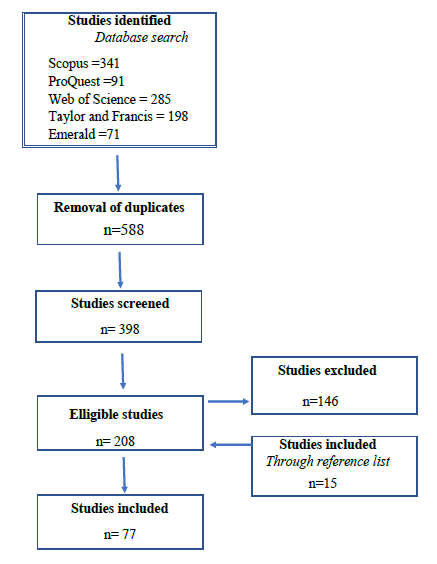
Figure 1: Systematic literature review summary process.
There is no consensus on assessing the quality of articles. Therefore, the study assessment considered several aspects, such as the appropriateness of the study design for addressing the research objectives, quality of reporting, research question, objectives, and year. A quantitative assessment of the selected articles provided a systematic overview of the published research, including geographic and time-related studies and the various methods. The quantitative description of the selected articles reveals BM conceptualization in business, tourism, and NBT. It sums up the relevance of BMs in companies’ long-term business potential and competitive advantage. The information was analyzed, interpreted, and synthesized, providing theoretical contributions and other research directions.
Quantitative Descriptive Analysis of the Selected Articles
Annexe I summarise the articles selected chronologically, identifying three analysis levels: Business, tourism, and NBT. Moreover, Annex I include the authors’ names, publication year, country of publication, research topics, framework, research strategy, and the main findings of each article. In the column ‘level of analysis’, 59 articles explore BM in several sectors of economic activity, discussing BM conceptualization, the utility of BM, sustainability in BM, innovation in BM, and business competitiveness and performance. The same column includes 11 articles on tourism and eight on NBT, exploring innovation on BM in tourism to generate competitive advantages, resilience, and ST. Articles were predominantly published in the UK (39 articles), followed by the Netherlands (21 articles), the USA (10 articles), Switzerland (4 articles), Denmark (2 articles), and Singapore (1 article). All the NBT articles address rural tourism, which includes activities and services in nature. Annex I also show that the consulted articles on tourism and NBT have all been published in European countries since 2008. Moreover, the USA articles included in this study predominantly discuss BM from a conceptual point of view, encompassing innovation and sustainability as relevant assets to companies’ competitiveness.
The research strategy involved classifying the selected literature as quantitative, qualitative, and mixed-methods, as evidenced in Table 1. The majority of articles n=67 (87.0%) undertook a qualitative approach, whereas the remaining articles were divided into quantitative approach n=3 (3.9%) and mixed-methods n=7 (9.1%). Several qualitative articles integrate multiple data sources, combining literature, observations, and interviews. The seven articles categorized as mixed-methods employed questionnaires, surveys, and interviews. It is noticeable that the quantitative method is not relevant to the articles researched.
| Methods |
Total articles |
Percentage breakdown |
| Quantitative |
3 |
3.90% |
| Qualitative |
67 |
87.00% |
| Mixed method approach |
7 |
9.10% |
Table 1: Articles per methodological approach.
The results summarize articles and journals on BM, Innovation, ST, and NBT in the last 21 years. The final sample includes about 40% of articles published between 2008 and 2019, as evidenced in Figure 2. Nonetheless, the number of publications soared between 2016 and 2019. This reflects that BM in tourism and NBT is a recent field of research and that the adoption of BM in the context of tourism and NBT is in its first steps. Our findings are consistent with the results obtained by He and Ortiz., when using the keywords ‘sustainable business model’ and ‘sustainable business model innovation’ in their research.
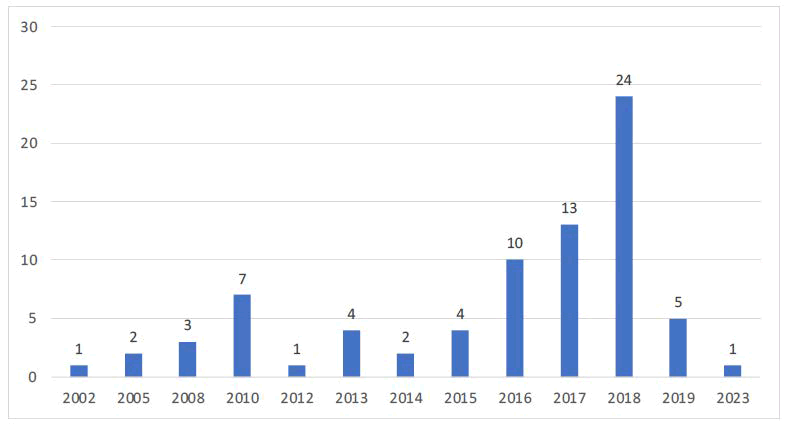
Figure 2: Total of articles per year.
Our research identified 77 articles published in 42 scientific journals, with 10 journals containing the most papers. Figure 3 presents journals with two or more reviewed articles. Journal of cleaner production includes 14 (18.2%) articles, followed by long range planning with 11 (14.3%) articles. The Scandinavian journal of hospitality and tourism comprises 4 (5.2%) articles, and tourism management and sustainability contributes 3 (3.9%) articles. Five journals include two articles each. The ten remaining journals contribute to one article each. The journal of cleaner production and long range planning contains 25 (32.5%) analyzed articles.
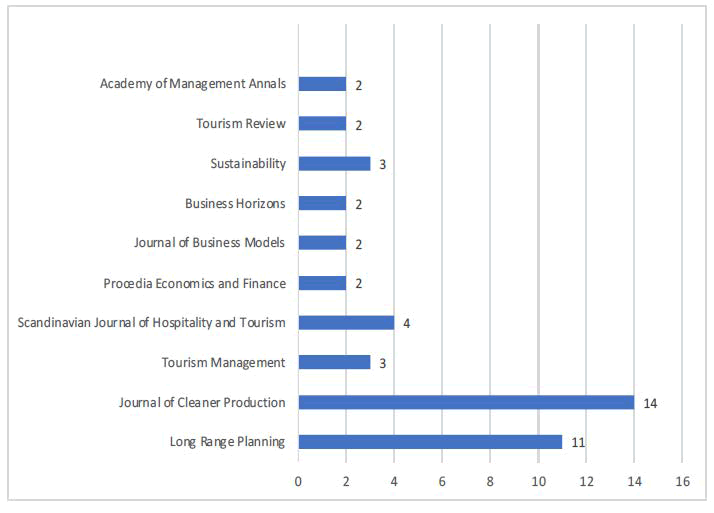
Figure 3: Journals with two or more articles.
Figure 4 summarizes the main research themes addressed. Business Model Innovation (BMI) is the central researched theme with 19 articles (24.8%), followed by BM with 17 articles (22.1%), SBM with 16 articles (20.8%), innovation with 10 articles (13%), ISBM 9 articles (11.7%) and NBT with six articles (7.8%).
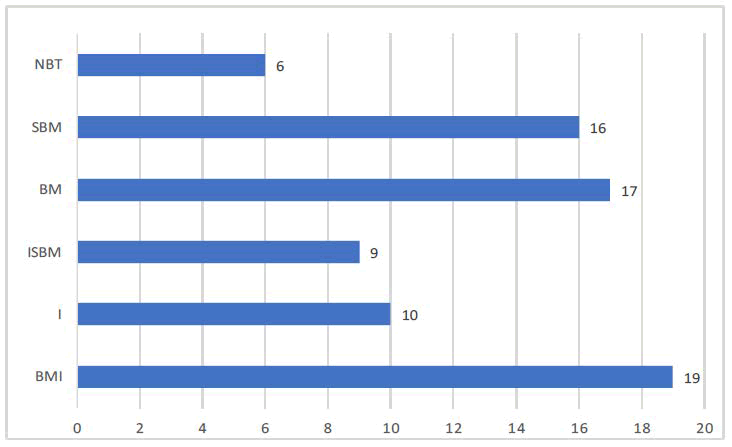
Figure 4: Articles per researched themes.
Figure 5 illustrates the annual variation of the researched themes. Target themes since 2002 were analyzed, and significant growth was revealed, particularly between 2016 and 2019. Accordingly, the theme BM was identified in articles since 2002, NBT, Innovation, and SBM from 2008, IBM from 2010, and ISBM from 2013 until 2023. The concept of sustainable development in tourism was introduced long after the 1992 Earth summit. Therefore, including sustainability principles in tourism took some time, and the selected literature encompasses articles on SBM and Innovation since 2008, evidencing a possible association with the evolution of digital technology. IBM and SBM were the most researched themes in 2018.
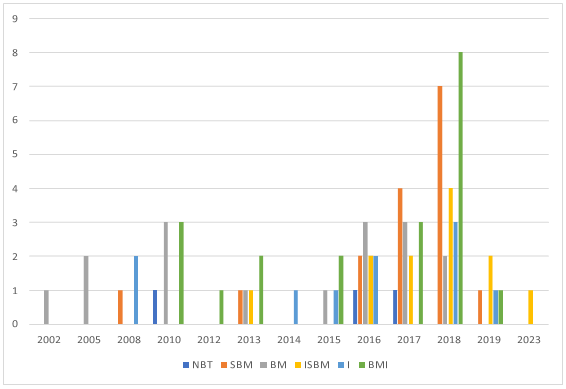
Figure 5: Articles per researched theme and year
Understanding Sustainability and Innovation in NBT BMs
This section discusses how innovation and sustainability in the NBT context may contribute positively: (1) enhancing NBT resilience and long-term business and (2) innovation and sustainability in NBT BMs for competitive business advantage.
Sustainability in NBT business models: Long-term business: A flexible interpretation of the concept of sustainable development by politicians, decision-makers, and public and private institutions prompts different perspectives, such as an anthropocentric and utilitarian view and an ecosystem and bioethical perspective, acknowledging continuous economic growth. As part of agenda 21 for the travel and tourism industry, the concept of sustainable development was extended to tourism. In 1997, the ST concept emerged after the Rio summit in 1992. Tourism growth in the last decade introduced new challenges, leading tourism companies to develop sustainable and innovative offers and sustainable commitment enhancement (environmental, social, and economic) [109-110]. Sustainability in business induces chief executive officers to adopt a stakeholder position with employees, customers, local communities, suppliers, and partners. Companies should comply with legal regulations, meaning legislation must fulfil sustainable requisites. However, sustainability goes beyond legal issues and requires a broad conceptual vision. Introducing sustainability in an NBT BM denotes the intention to embrace innovation, which requires suiting previous BMs In line with this thinking, NBT SBM should integrate sustainable value proposition, innovation, and competitive advantage, helping to simplify business elements and their interrelations. This is reinforced through the first attempt to connect BMs to already established concepts, such as corporate sustainability or sustainable innovation
Integrating new BMs in NBT forces customers, suppliers, and top management to adopt a sustainable commitment subject to profit uncertainty [111]. Moreover, NBT companies’ sustainable value and reliability based on an SBM should satisfy customers’ sustainable suggestions. Nevertheless, several innovative BMs tend to fail, and the reasons for failure are unclear [1]. An SBM is dynamic and integrates sustainable business strategies, including environmental, economic, and social challenges [113,114]. Therefore, including environmental, economic, and social dimensions in NBT is vital in companies’ SBM [115]. Thus, an NBT SBM should be ecologically robust and economically sustainable . Notwithstanding, no specific design for an SBM and no implementation guidelines were found [116]. SBMs and circular business models are familiar in the literature from a conceptual point of view [1,118]. Besides, the mixedmethod approach contributes to knowledge advancement and SBM understanding [119]. Nevertheless, we noticed a lack of literature mentioning the practical application of SBMs in NBT. It was also explicit in the literature that NBT companies coupling NBT ISBMs with the circular economy model can reduce risk, minimize resource use, enhance competitive advantage and long-term business, and shift from efficiency to resilience (Table 2) [120,121].
| Sustainability in business models: The long-term business |
| Sustainability as company's driving force and decision- making. |
Stubbs and Cocklin |
| SBM as innovative and strategic competitive advantage |
Schaltegger et al., Chesbrough, Boons and Ludeke- Freund, Boons et al., Tiemann et al., Geissdoerfer et al., Ludeke-Freund et al. |
| SBM dynamic, integrating the three pillars of sustainability (social, environmental and economic) |
Rauter et al., Evans et al., Joyce and Paquin, Biloslaye et al., Tauscher and Abdelkafi |
| SBM and sustainable commitment |
Lahti et al., Geissdoerfer et al., Schneider and Clauss |
| SBM and circular economy enhancing resilience and Business performance in NBT |
Teece, Boons and Ludeke-Freund, Bocken et al., Bocken et al., Sahebalzamani and Bertella, Ludeke-Freund et al., Pieroni et al., Geissdoerfer. Pelzeter, and Santa-maria. |
| Lack of appropriate design for SBM |
Tauscher and Abdelkafi, Geissdoerfer. Savaget, Bocken. and Hultink; Geissdoerfer et al., Dentchey et al. |
| Gap in literature on business sustainability in tourism and on BMfor NBT |
Biloslavo et al., Sahebalzamani and Bertella, Reinhold et al., Dentchey et al. |
Table 2: Literature discussing sustainability in business models.
Based on this analysis, we can assume that sustainability in NBT ISBM contributes positively to resilient and long-term business [122]. Moreover, the sustainability approach reduces literature dispersion and moves towards innovative research.
Innovation in NBT BMs: Competitive Advantage
A resulting literature overview shows limited research on tourism innovation and its impacts on destinations and national economies. Innovation involves creativity, problem-solving, a new way of thinking, cooperation, and networking. Innovation comprises adaptive advantages, technology, information sharing, providers, customers, authority, productivity, quality, sustainable innovation, and communication [123]. Furthermore, innovation encompasses sustainable competitive advantage, performance improvements, differentiation [124], and long-term business [125,126], both in hospitality and tourism companies. In NBT, innovation and entrepreneurship enhance competitive advantage and performance, and both are influenced by policies [127,128].
BM research has little research in the tourism context. BMs and innovation became essential tools for companies and researchers [129]. Competitive BMs reveal a logical way of doing business [130]. Business Model Innovation (BMI) also means the integration of technology and service ecosystem perspective, entrepreneurship, and collaboration in BMs. Financial results indicate a company’s excellence, the BM adopted, and the level of innovation introduced [131]. Different views on IBMs disclose companies’ idiosyncrasies and market context [132]. Notwithstanding, IBM will not ensure a competitive advantage for companies, as it can be imitated. However, IBM contributes positively to attaining a competitive advantage in the company’s market entrance [133]. IBM is an imperative requirement in destinations’ marketing and planning strategies.
Based on the discussion, we understand that NBT BMs should focus on adapting the existing BM, transforming it into a new tool of novelty, analogy reasoning, and conceptual combination. This aligns with internal corporate reorganization and implementing necessary changes in NBT companies. Therefore, adopting IBMs contributes positively to NBT management and competitive advantage, promoting unique experiences [134]. Another positive contribution of NBT IBMs is their continuous adaptation and modification of character according to changing conditions. These BMs transformations are focused on changes in corporate sustainability strategy, long-term business resilience and adapting to market demands to achieve more sustainable products [135]. In addition, NBT companies tend to be small or medium-sized, family-owned enterprises where IBMs reduce business risk and improve sustainable strategic development. Besides, ISBMs lend to cooperative sustainability and sustainable innovation to sustainable value and reliability . Finally, improving BM research in tourism and on ISBM for NBT goes beyond economic and financial dimensions, contributing to project research into sustainability dimensions such as environment, sociocultural and corporate sustainability [136]. Moreover, NBT companies are sustainably committed to benefiting from ISBM, are ecologically robust, and are economically sustainable. Table 3 summarizes the literature discussing innovation and sustainability to achieve competitive advantage in NBT BMs.
| Innovation in business models: Competitive advantage |
| Limited research on tourism innovation |
Hialager, Jensen and Prebensen, Reinhold et al., Reinhold et al. |
| Innovation, problem solving, cooperation |
Moscardo, ROnningen, Maglio and Spohrer |
| Innovation, NBT and sustainable business |
Maglio and Spohrer, Jensen and Prebensen, Prange and Schlegelmilch, Ortiz- villajos and Sotoca, Divisekera and Nguyen, Pikkemaat et al., Nybakk and Hansen, Rodriguez et al., Geissdoerfer et al. |
| BMI and competitive advantage |
Ludeke-Freund and Dembek, Teecem, Broekhuizen et al., Baden-Fuller and Haefliger, Ghicajanu et al., Martins et al., Omerzel, Fieldstad and Snow, Geissdoerfer et al., Souto, Debarliey and Prof, Hossain, Foss and Saebi |
| BMI and sustainability for competitive advantage |
Schaltegger et al., FranÃÂ?§a et al., Yang et al., Gjerding and Kringelum, Heikkila et al., Tidd and Bessant, Andreassen et al., Broekhuizen et al., Wirtz and Daiser, Teece; Massa et al., Tiemann et al., Gardiner and Scott |
Table 3: Literature discussing innovation and sustainability in business models.
Discussion
This study presents a systematic literature review of 77 articles on the established research areas, yielding new knowledge and future research paths. The study summarizes relevant articles published between 2002 and 2023. The comprehensive review unveils the understanding of innovation and sustainability in NBT BMs and its repercussions on long-term business and competitiveness. We overview the reviewed articles and propose definitions of the key underlying concepts-sustainability, NBT and BM. The research also identified several research gaps.
The literature review demonstrates the need to conduct proper research in tourism, namely NBT , pointing to innovation, sustainability, and ISBMs in NBT, vital to understanding NBT supply. Additionally, the literature on IBM in tourism is scarce, and the introduction of innovation in tourism BMs is considered very relevant, impacting sustainability progress and companies’ performance. Moreover, the research showed that sustainability and companies’ performance improvements are essential in reshaping tourism management and responding to highdemand customers and markets. However, NBT companies commit poorly to sustainability. Rantala et al., pointed out that more companies are sustainably engaged as more companies develop IBMs [137]. Notwithstanding, NBT companies lack business management literacy, as evidenced by poor entrepreneur training and inadequately qualified labor, exhibiting feeble adherence to new technologies.
The most appropriate design for an SBM is unknown, and the embodiment of explicit sustainability dimensions in a BM is still missing. However, innovation, BM, and IBM disclose a relationship with innovative digital tools, which can be instrumental in developing a new ISBM for NBT.
The literature acknowledges sustainability in BMs as a driving force, supporting companies’ decision-making commitment, and dynamism. Introducing sustainability in BMs enhances long-term business and resilience. The findings also evidenced that innovation in BMs supports problem solving and business cooperation . Innovation in BMs brings creativity and new ways of thinking and enhances business performance and competitive advantage. The literature explains an inter-relationship between sustainability and innovation in NBT BMs both contributing to improving NBT companies’ competitive advantage, resilience and long-term business . Therefore, the results enabled us to identify the fundamental drivers of an ISBM NBT, as illustrated in Figure 6.
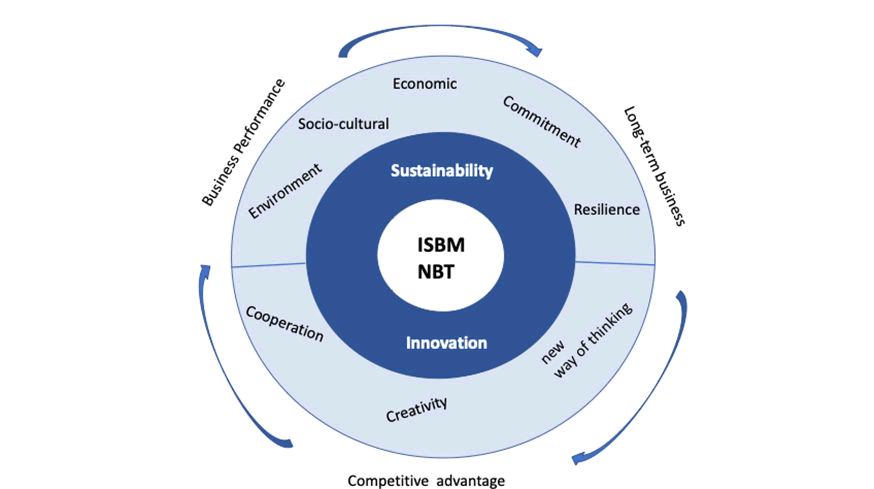
Figure 6: Driving factors of ISBMs for NBT.
However, only the drivers of the NBT ISBM were analyzed in this paper. The following steps design and implementation were not considered and should be introduced in future research. The findings lead to understanding how and in which direction NBT BMs should evolve, providing specific contributions, and highlighting the current literature on NBT BMs and their possible future developments. The literature review evidenced limited research on tourism innovation , the lack of appropriate design for SBM , on business sustainability and BMs for NBT . There is a trend towards the development of SBM and the introduction of circular economy models, which are vital for the resilience and performance of NBT businesses . Besides its contribution to the understanding that ISBM for NBT materializes the interconnection between innovation and sustainability , this work reveals comprehensive advantages that ISBMs for NBT should integrate the identified driving factors, to reduce risk, improve creativity and a new way of thinking, minimize resource use, and enhance business performance, promote cooperation, competitiveness and resilient business, as demonstrated in previous sections . Consequently, we propose that NBT BMs research should evolve from the existing BMs to new and emerging BMs configurations such as ISBMs. We assume that innovation in BM implies a holistic change in BMs, incorporating socio-cultural and environmental dimensions of sustainability, and NBT BMs research should be oriented to ISBMs development as a new field of research.
Based on this analysis, we propose a definition of ISBM, “a representation of the elements, and the interrelations between the set of elements, that an organization uses to capture, create, and deliver value, explicitly incorporating innovation, the conservation of nature and natural resources, providing sustainable economic growth, and benefits to society”.
In addition, a definition of NBT is proposed. The literature suggests different definitions of NBT, emphasizing contradictions and different perspectives between them. Therefore, we propose a definition of NBT as “a responsible tourism, with an overnight stay, in protected areas or not, to enjoy biodiversity, landscapes, recreation, silence, culture, gastronomy, slow living, supported by local production, contributing for fair jobs, heritage and nature conservation, population settlement and promoting circular economy”.
There is a consensus that tourism activities directly impact the environment, the economy and the sociocultural dimension of sustainability [138]. The adoption of the ST concept in 1997 and the information accessed indicate that the approval of the UN_SDG and the 2030 agenda for sustainable development in 2015 raised awareness of the importance of introducing sustainability dimensions in tourism. We define sustainability as replacing the traditional vision of balance between the various dimensions of sustainability (environmental, economic, and socio-cultural) since qualitatively different dimensions should not be treated equally. Supporting the perspective of Bramwell et al., and Baum et al. [139], we define sustainability more as a philosophy than a concept, where the socio-cultural dimension supports the economy, and both are supported by the environment, as represented in Figure 7. Moreover, our findings enable us to state that sustainability in tourism is constrained by knowledge, education and culture [140-147].
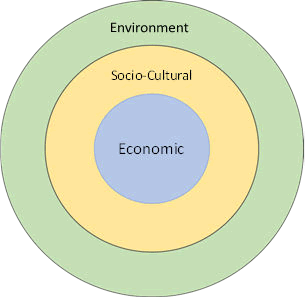
Figure 7: Sustainability approach.
Conclusion
Finally, several research gaps were identified in the literature reviewed, generally related to a need for the appropriate design for SBM, business sustainability in NBT, and limited NBT innovation. We summarize the research gaps, which lend themselves to exciting directions for further research. The first is the fragmented knowledge in NBT, specifically regarding innovation, business constraints, and economic impacts. Second, there is a gap in tourism and NBT publications. The third is the absence of sustainability in NBT, considering all the sustainability dimensions, including developing sustainable products. Fourth, the knowledge deficiency of NBT suppliers to better understand NBT as a commercial setting, its role in nature protection, and the sustainable management of natural resources. Fifth, only some studies related to NBT addressed sustainability aspects. A sixth research gap relates to the absence of an appropriate design for an SBM, integrating all sustainability dimensions. A seventh gap points to consistent research using primary and quantitative data on BMs for NBT. An eight-research gap relates to adopting a BM without a precise definition, such as sustainability-related concerns, particularly regarding the environmental dimension and innovation, which are barely addressed and viewed from a static perspective. Finally, a ninth research gap was identified on how SBM in NBT can contribute to sustainability.
The analysis and discussion undertaken in this literature review, complemented by the research gaps identified, legitimate the importance of furthering knowledge on BM, sustainability, and innovation in NBT. The UNTWO recommendations highlight sustainable and resilient tourism development, calling for sustainability and innovation in tourism. Introducing innovation and sustainability in NBT companies through the adoption of ISBM could be the basis for improving the performance of NBT companies and, consequently, with implications for society. Hence, research should focus on consistent research fields on tourism BMs, using primary and quantitative data instead of new BM propositions.
Research Contribution and Achievement
Considering the theoretical perspective and the research gaps identified, this article conveys an integrated discussion, yielding a theoretical framework on BMs for NBT. The research identified managerial implications, and the report unveils relevant insights on BMs and ISBMs and their relevance to NBT companies’ competitiveness, resilience, and quality improvement. This study contributes to NBT literature by providing new insights into the role of sustainability and innovation in BMs on companies’ performance, resilience, risk reduction, resource use minimization, business performance, and long-term business enhancement. Accordingly, this study unveils the recent challenges to ST, stressing the importance of strengthening sustainable NBT business through dynamic ISBMs. Additionally, the study presents working definitions of nature-based tourism and innovative sustainable business models and conveys an understanding of sustainability.
Limitations
The present systematic literature review performed article research. Relevant articles were identified, providing significant insights on the subjects under discussion, such as sustainability and innovation in NBT BMs and the importance of competitiveness and long-term business in NBT business. However, the systematic literature review likely comprises only some pertinent scientific publications, considering the high number of academic journals and articles available. Our research showed that the adoption of ISBMs in tourism, particularly in NBT companies, is still missing. An in-depth analysis is required to address this gap, enhance knowledge, and provide guidance for the development of innovative BMs in tourism and NBT companies. Therefore, we suggest further research using primary and quantitative data on the suitable design of ISBMs in tourism and NBT. Additional studies should be conducted to validate the role of innovation and sustainability dimensions in ISBMs for NBT.
References
- Fredman P, Tyrvainen L (2010) Frontiers in Nature-Based Tourism. Scand J Hosp Tour. 10(3):177–189.
[Crossref] [Google Scholar]
- Margaryan L (2016) Nature as a commercial setting: The case of nature-based tourism providers in Sweden. Curr Issues Tour. 21(16):1893–1911.
[Crossref] [Google Scholar]
- Margaryan L, Fredman P (2017) Natural amenities and the regional distribution of nature-based tourism supply in Sweden. Scand J Hosp Tour. 17(2):145–159.
[Crossref] [Google Scholar]
- Biloslavo R, Bagnoli C, Edgar D (2018) An eco-critical perspective on business models: The value triangle as an approach to closing the sustainability gap. J Clean Prod. 174:746–752.
[Crossref] [Google Scholar]
- Boons F, Montalvo C, Quist J, Wagner M (2013) Sustainable innovation, business models and economic performance: An overview. J Clean Prod. 45:1–8.
[Crossref] [Google Scholar]
- Rajapathirana RPJ, Hui Y (2018) Relationship between innovation capability, innovation type, and company performance. J Innov Knowl. 3(1):44–55.
[Crossref] [Google Scholar]
- Teece DJ (2010) Business models, business strategy and innovation. Long Range Plan. 43(2–3):172–194.
[Crossref] [Google Scholar]
- Boons F, Lüdeke-Freund F (2013) Business models for sustainable innovation: State-of-the-art and steps towards a research agenda. J Clean Prod. 45:9–19.
[Crossref] [Google Scholar]
- Sahebalzamani S, Bertella G (2018) Business models and sustainability in nature tourism: A systematic review of the literature. Sustainability. 10(9):1–15.
[Crossref] [Google Scholar]
- Reinhold S, Zach FJ, Krizaj D (2017) Business models in tourism: A review and research agenda. Tour Rev. 72(4):462–482.
[Google Scholar]
- Reinhold S, Zach FJ, Krizaj D (2018) Business models in tourism – state of the art. Tour Rev. 74(6):1120–1134.
[Google Scholar]
- Omerzel DG (2016) A systematic review of research on innovation in hospitality and tourism. Int J Contemp Hosp Manag. 28(3):516–558.
[Google Scholar]
- Jensen O, Prebensen N (2015) Innovation and Value Creation in Experience-based Tourism. Scand J Hosp Tour. 15(Suppl. 1):1–8.
- Geissdoerfer M, Morioka SN, de Carvalho MM, Evans S (2018a) Business models and supply chains for the circular economy. J Clean Prod. 190:712–721.
[Crossref] [Google Scholar]
- Cosenz F, Noto G (2018) A dynamic business modelling approach to design and experiment new business venture strategies. Long Range Plan. 51(1):127–140.
[Crossref] [Google Scholar]
- Teece DJ (2018) Business models and dynamic capabilities. Long Range Plan. 51(1):40–49.
[Crossref] [Google Scholar]
- Breuer H, Fitcher K, Tiemann I (2018) Sustainability-oriented business model development: Principles, criteria and tools. Int J Entrepreneurial Venturing. 10(2):256–286.
[Google Scholar]
- Geissdoerfer M, Bocken NMP, Hultink EJ (2016) Design thinking to enhance the sustainable business modelling process – A workshop based on a value mapping process. J Clean Prod. 135:1218–1232.
[Crossref] [Google Scholar]
- Ludeke-Freund F, Carroux S, Joyce A, Massa L, Breuer H (2018) The sustainable business model pattern taxonomy 45 patterns to support sustainability-oriented business model innovation. Sustain Prod Consum. 15:145–162.
[Crossref] [Google Scholar]
- Täuscher K, Abdelkafi N (2018) Scalability and robustness of business models for sustainability: A simulation experiment. J Clean Prod. 170:654–664.
[Crossref] [Google Scholar]
- Siddaway A, Wood A, Hedges L (2019) How to do a systematic review: A best practice guide for conducting and reporting narrative reviews, meta-analyses, and meta-syntheses. Annu Rev Psychol. 70:747–770.
[Crossref] [Google Scholar] [PubMed]
- Ducarme F, Couvet D (2020) What does ‘nature’ mean?. Palgrave Commun. 6(1):1–8.
[Google Scholar]
- Bitner MJ (1992) Serviescapes: The impact of physical surroundings on customers and employees. J Mark. 56(2):57–71.
[Google Scholar]
- Gómez-Baggethun E, de Groot R, Lomas PL, Montes C (2010) The history of ecosystem services in economic theory and practice: From early notions to markets and payment schemes. Ecol Econ. 69(6):1209–1218.
[Crossref] [Google Scholar]
- Fredman P, Wall-Reinius S, Grundén A (2012) The nature of nature in nature-based tourism. Scand J Hosp Tour. 12(4):289–309.
[Crossref] [Google Scholar]
- Laarman J, Durst P (1987) Nature travel in the tropics. J For. 5:43–46.
[Google Scholar]
- Lang CT, O'leary JT (1997) Motivation, participation, and preference: A multi-segmentation approach of the Australian nature travel market. J Travel Tour Mark. 6(3-4):159-180.
[Google Scholar]
- Goodwin H (1996) In pursuit of ecotourism. Biodivers Conserv. 5(3):277–291.
[Google Scholar]
- Fennell DA (2000) What’s in a name? Conceptualizing natural resource-based tourism. Tour Recreat Res. 25(1):97–100.
[Crossref] [Google Scholar]
- Lundmark L, Müller DK (2010) The supply of nature-based tourism activities in Sweden. Tour Rev. 58(4):379–393.
[Google Scholar]
- Mehmetoglu M (2005) A case study of nature-based tourists: Specialists versus generalists. J Vacat Mark. 11(4):357–369.
[Crossref] [Google Scholar]
- Soleimani S, Bruwer J, Gross MJ, Lee R (2019) Astro-tourism conceptualization as special-interest tourism (SIT) field: A phenomenological approach. Curr Issues Tour. 22(18):2299–2314.
[Crossref] [Google Scholar]
- Steven R, Castley JG, Buckley R (2013) Tourism revenue as a conservation tool for threatened birds in protected areas. PLoS ONE. 8(5):1–8.
[Crossref] [Google Scholar] [PubMed]
- Saarinen J (2014) Critical sustainability: Setting the limits to growth and responsibility in tourism. Sustainability. 6(1):1–17.
[Google Scholar]
- Tyrväinen L, Silvennoinen H, Nousiainen I, Tahvanainen L (2001) Rural tourism in Finland: Tourists’ expectation of landscape and environment. Scand J Hosp Tour. 1(2):133–149.
[Crossref] [Google Scholar]
- Fossgard K, Fredman P (2019) Dimensions in the nature-based tourism experiencescape: An explorative analysis. J Outdoor Recreat Tour. 28:100219.
[Crossref] [Google Scholar]
- Karp DS, Mendenhall CD, Callaway E, Frishkoff LO, Kareiva PM, et al. (2015) Confronting and resolving competing values behind conservation objectives. Proc Natl Acad Sci U S A. 112(35):11132–11137.
[Crossref] [Google Scholar] [PubMed]
- Bishop J, Kapila S, Hicks F, Mitchell P, Vorhies F (2009) New business models for biodiversity conservation. J Sustain For. 28(3–5):285–303.
[Crossref] [Google Scholar]
- Chung MG, Dietz T, Liu J (2018) Global relationships between biodiversity and nature-based tourism in protected areas. Ecosyst Serv. 34:11–23.
[Crossref] [Google Scholar]
- Hardy A, Beeton RJS, Pearson L (2002) Sustainable tourism: An overview of the concept and its position in relation to conceptualizations of tourism. J Sustain Tour. 10(6):475–496.
[Crossref] [Google Scholar]
- Bramwell B, Lane B (1993) Sustainable tourism: An evolving global approach. J Sustain Tour. 1(1):1–5.
[Google Scholar]
- Boluk KA, Cavaliere CT, Higgins-Desbiolles F (2019) A critical framework for interrogating the United Nations sustainable development goals 2030 Agenda in tourism. J Sustain Tour. 27(7):847–854.
[Crossref] [Google Scholar]
- Hunter C (1997) Sustainable tourism as an adaptive paradigm. Ann Tour Res. 24(4):850–867.
[Crossref] [Google Scholar]
- Butler RW (1999) Sustainable tourism: A state-of-the-art review. Tour Geogr. 1(1):7–25.
[Crossref] [Google Scholar]
- Agyeiwaah E, McKercher B, Suntikul W (2017) Identifying core indicators of sustainable tourism: A path forward?. Tour Manag Perspect. 24:26–33.
[Crossref] [Google Scholar]
- Lu J, Nepal SK (2009) Sustainable tourism research: An analysis of papers published in the Journal of Sustainable Tourism. J Sustain Tour. 17(1):5–16.
[Crossref] [Google Scholar]
- Kristjánsdóttir KR, Ólafsdóttir R, Ragnarsdóttir KV (2017) Reviewing integrated sustainability indicators for tourism. J Sustain Tour. 26(4):583–599.
[Crossref] [Google Scholar]
- Moscardo G (2008) Sustainable tourism innovation: Challenging basic assumptions. Tour Hosp Res. 8(1):4–13.
[Google Scholar]
- Liu Z (2003) Sustainable tourism development: A critique. J Sustain Tour.
[Crossref] [Google Scholar]
- Lane B (2018) Will sustainable tourism research be sustainable in the future? An opinion piece. Tour Manag Perspect. 25:161–164.
[Crossref] [Google Scholar]
- Tokmak C, DoÄ?antekıÌ?n A, Kiliç Ä° (2018) A bibliometric analysis on sustainable tourism studies: A review of 8 years. Turizm Akademik Dergisi. 5(2):63–72.
[Google Scholar]
- Buckley R (2012) Sustainable tourism: Research and reality. Ann Tour Res. 39(2):528–546.
[Google Scholar]
- Albrecht JN (2013) Networking for sustainable tourism—Towards a research agenda. J Sustain Tour. 21(5):639–657.
[Google Scholar]
- Higgins-Desbiolles F (2018) Sustainable tourism: Sustaining tourism or something more?. Tour Manag Perspect. 25(November 2017):157–160.
[Crossref] [Google Scholar]
- Torres-Delgado A, López Palomeque F (2012) The growth and spread of the concept of sustainable tourism: The contribution of institutional initiatives to tourism policy. Tour Manag Perspect. 4:1–10.
[Crossref] [Google Scholar]
- Ruhanen L, Weiler B, Moyle BD, McLennan C, Lee J (2015) Trends and patterns in sustainable tourism research: A 25-year bibliometric analysis. J Sustain Tour. 23(4):517–535.
[Google Scholar]
- Bramwell B, Higham J, Lane B, Miller G (2017) Twenty-five years of sustainable tourism and the Journal of Sustainable Tourism: Looking back and moving forward. J Sustain Tour. 25(1):1–9.
[Google Scholar]
- Scheyvens R (2018) Linking tourism to the sustainable development goals: A geographical perspective. Tour Geogr. 20(2):341–342.
[Crossref] [Google Scholar]
- Zolfani SH, Sedaghat M, Maknoon R, Zavadskas EK (2015) Sustainable tourism: A comprehensive literature review on frameworks and applications. Econ Res-Ekon Istraz. 28(1):1–30.
[Google Scholar]
- Connell A (2018) Islands: Balancing development and sustainability?. Environ Conserv. 45(2):111–124.
[Google Scholar]
- Cucculelli M, Goffi G (2016) Does sustainability enhance tourism destination competitiveness? Evidence from Italian destinations of excellence. J Clean Prod. 111:370–382.
[Crossref] [Google Scholar]
- Nunkoo R, Seetanah B, Agrawal S (2019) Guest editorial. Tour Rev. 74(2):129–137.
[Google Scholar]
- Lane B (2017) Sustainable tourism: Its evolution and its future. Cuadernos Económicos de ICE. 93:9–28.
[Google Scholar]
- Tölkes C (2018) Sustainability communication in tourism: A literature review. Tour Manag Perspect. 27:10–21.
[Crossref] [Google Scholar]
- Pikkemaat B, Peters M, Bichler BF (2019) Innovation research in tourism: Research streams and actions for the future. J Hosp Tour Manag. 41:184–196.
[Google Scholar]
- Hjalager AM (2010) A review of innovation research in tourism. Tour Manag. 31(1):1–12.
[Google Scholar]
- Kahn KB (2018) Understanding innovation. Bus Horiz. 61(3):453–460.
[Crossref] [Google Scholar]
- Gault F (2018) Defining and measuring innovation in all sectors of the economy. Res Policy. 47(3):617–622.
[Crossref] [Google Scholar]
- Kuzman T, Bellos SK, Ä�uliÄ? K (2019) Determinants of innovation-based sustainability in transition and developing economies. Econ Themes. 56(3):413–438.
[Google Scholar]
- Camisón C, Monfort-Mir VM (2012) Measuring innovation in tourism from the Schumpeterian and the dynamic-capabilities perspectives. Tour Manag. 33(4):776–789.
[Crossref] [Google Scholar]
- Ronningen M (2010) Innovative processes in a nature-based tourism case: The role of a tour operator as the driver of innovation. Scand J Hosp Tour. 10(3):190–206.
[Crossref] [Google Scholar]
- Souto JE (2015) Business model innovation and business concept innovation as the context of incremental innovation and radical innovation. Tour Manag. 51:142–155.
[Crossref] [Google Scholar]
- Hossain M (2017) Business model innovation: Past research, current debates, and future directions. J Strateg Manag. 10(3):342–359.
[Google Scholar]
- Gardiner S, Scott N (2018) Destination innovation matrix: A framework for new tourism experience and market development. J Destin Mark Manag. 10:122–131.
[Crossref] [Google Scholar]
- Dziallas M, Blind K (2019) Innovation indicators throughout the innovation process: An extensive literature analysis. Technovation. 80:3–29.
[Crossref] [Google Scholar]
- Vukovic A, Damnjanovic J, Papic-BlagojevicN, Josanov-Vrgovic I, Gagic S (2018) Impact of leadership on innovation: Evidence from the hotel industry. J Sustain Bus Manag Solut Emerg Econ. 23(3):57–66.
[Google Scholar]
- Williams AM, Shaw G (2011) Internationalization and innovation in tourism. Ann Tour Res. 38(1):27–51.
[Crossref] [Google Scholar]
- Hjalager AM (2015) 100 innovations that transformed tourism. J Travel Res. 54(1):3–21.
[Google Scholar]
- Zach FJ, Hill TL (2017) Network, knowledge and relationship impacts on innovation in tourism destinations. Tour Manag. 62:196–207.
[Crossref] [Google Scholar]
- Bhattacharya U, Hsu PH, Tian X, Xu Y (2017) What affects innovation more: Policy or policy uncertainty? J Financ Quant Anal. 52(5):1869–1901.
[Google Scholar]
- Chesbrough H (2010) Business model innovation: Opportunities and barriers. Long Range Plan. 43(2–3):354–363.
[Crossref] [Google Scholar]
- Ritter T, Lettl C (2018) The wider implications of business-model research. Long Range Plan. 51(1):1–8.
[Crossref] [Google Scholar]
- Baden-Fuller C, Haefliger S (2013) Business models and technological innovation. Long Range Plan. 46(6):419–426.
[Google Scholar]
- Zott C, Amit R (2010) Business model design: An activity system perspective. Long Range Plan. 43(2–3):216–226.
[Crossref] [Google Scholar]
- Wirtz BW, Pistoia A, Ullrich S, Gottel V (2016) Business models: Origin, development and future research perspectives. Long Range Plan. 49(1):36–54.
[Crossref] [Google Scholar]
- Shafer SM, Smith HJ, Linder JC (2005) The power of business models. Bus Horiz. 48(3):199–207.
[Google Scholar]
- Massa L, Tucci C, Afuah A (2014) A critical assessment of business model research. Acad Manag Ann. 11(1):73–104. [Google Scholar]
- Foss NJ, Saebi T (2018) Business models and business model innovation: Between wicked and paradigmatic problems. Long Range Plan. 51(1):9–21.
[Crossref] [Google Scholar]
- Fjeldstad OD, Snow CC (2018) Business models and organization design. Long Range Plan. 51(1):32–39.
[Crossref] [Google Scholar]
- Magretta J (2002) Why business models matter. Harv Bus Rev. 3–8.
- Schneider S, Clauss T (2019) Business models for sustainability: Choices and consequences. Org Environ. 33(3):384–407.
[Crossref] [Google Scholar]
- Richardson JE (2005) The business model: An integrative framework for strategy execution. Strateg Change. 17(5).
[Google Scholar]
- Baden-Fuller C, Morgan MS (2010) Business models as models. Long range planning. 201043(2-3):156-171.
[Crossref] [Google Scholar]
- Ranjith VK (2016) Business models and competitive advantage. Procedia Econ Finance. 37(16):203–207.
[Google Scholar]
- Wieland H, Hartmann NN, Vargo SL (2017) Business models as service strategy. J Acad Mark Sci. 45(6):925–943.
[Google Scholar]
- Martins LL, Rindova VP, Greenbaum BE (2015) Unlocking the hidden value of concepts: A cognitive approach to business model innovation. Strateg Entrep J. 9(1):99–117.
[Crossref] [Google Scholar]
- Foss NJ, Saebi T (2017) Fifteen years of research on business model innovation: How far have we come, and where should we go?. J Manag. 43(1):200–227.
[Crossref] [Google Scholar]
- Schaltegger S, Lüdeke-Freund F, Hansen EG (2012) Business cases for sustainability: The role of business model innovation for corporate sustainability. Int J Innov Sustain Dev. 6(2):95–119.
[Google Scholar]
- França CL, Broman G, Robert KH, Basile G, Trygg L (2017) An approach to business model innovation and design for strategic sustainable development. J Clean Prod. 140:155–166.
[Crossref] [Google Scholar]
- Yang M, Evans S, Vladimirova D, Rana P (2017) Value uncaptured perspective for sustainable business model innovation. J Clean Prod. 140:1794–1804.
[Crossref] [Google Scholar]
- Gjerding AN, Kringelum LB (2019) Identifying contexts of business model innovation for exploration and exploitation across value networks. J Bus Models. 3(6):45–62.
[Google Scholar]
- Heikkilä M, Bouwman H, Heikkilä J (2018) From strategic goals to business model innovation paths: an exploratory study. J Small Bus Enterp Dev. 25(1):107–128.
[Google Scholar]
- Tidd J, Bessant J (2018) Innovation management challenges: From fads to fundamentals. Int J Innov Manag 22(5):1840007.
[Google Scholar]
- Andreassen TW, Lervik-Olsen L, Snyder H, Van Riel ACR, Sweeney JC, et al. (2018) Business model innovation and value-creation: The triadic way. J Serv Manag. 29(5):883–906.
[Google Scholar]
- Geissdoerfer M, Savaget P, Evans S (2017b) The Cambridge business model innovation process. Procedia Manuf. 8:262–269.
[Crossref] [Google Scholar]
- Furunes T (2019) Reflections on systematic reviews: Moving golden standards?. Scand J Hosp Tour. 19(3):227–231.
[Crossref] [Google Scholar]
- Bryman A (2012) Social research methods. 4th Edition. Oxford, New York: Oxford University Press Inc.
[Google Scholar]
- UNWTO Tourism Highlights: 2017 Edition. World Tourism Organization (UNWTO).
- Stubbs W, Cocklin C (2008) Conceptualizing a “sustainability business model.” Organ Environ. 21(2):103–127.
[Google Scholar]
- Lahti T, Wincent J, Parida V (2018) A definition and theoretical review of the circular economy, value creation, and sustainable business models: Where are we now and where should research move in the future? Sustainability. 10(8):2799.
[Google Scholar]
- Geissdoerfer M, Vladimirova D, Evans S (2018b) Sustainable business model innovation: A review. J Clean Prod 198:401–416.
[Google Scholar]
- Rauter R, Jonker J, Baumgartner RJ (2017) Going one’s own way: Drivers in developing business models for sustainability. J Clean Prod. 140:144–154.
[Crossref] [Google Scholar]
- Evans S, Vladimirova D, Holgado M, Van Fossen K, Yang M, Silva EA, Barlow CY (2017) Business model innovation for sustainability: Towards a unified perspective for creation of sustainable business models. Bus Strategy Environ. 26(5):597–608.
[Google Scholar]
- Joyce A, Paquin RL (2016) The triple layered business model canvas: A tool to design more sustainable business models. J Clean Prod. 135:1474–1486.
[Crossref] [Google Scholar] [PubMed]
- Geissdoerfer M, Savaget P, Bocken NMP, Hultink EJ (2017a) The circular economy–A new sustainability paradigm?. J Clean Prod. 143:757–768.
[Crossref] [Google Scholar]
- Bocken NMP, de Pauw I, Bakker C, van der Grinten B (2016) Product design and business model strategies for a circular economy. J Ind Prod Eng. 1015:1–12.
[Crossref] [Google Scholar]
- Lüdeke-Freund F, Gold S, Bocken NMP (2019) A review and typology of circular economy business model patterns. J Ind Ecol. 23(1):36–61.
[Google Scholar]
- Dentchev N, Rauter R, Johannsdottir L, Snihur Y, Rosano M, et al. (2018) Embracing the variety of sustainable business models: A prolific field of research and a future research agenda. J Clean Prod. 194:695–703.
[Crossref] [Google Scholar]
- Bocken NMP, Schuit CSC, Kraaijenhagen C (2018) Experimenting with a circular business model: Lessons from eight cases. Environ Innov Soc Transitions. 28(Jul 2017):79–95.
[Crossref] [Google Scholar]
- Pieroni MPP, McAloone TC, Pigosso DCA (2019) Business model innovation for circular economy and sustainability: A review of approaches. J Clean Prod. 215:198–216.
[Crossref] [Google Scholar]
- Espiner S, Orchiston C, Higham J (2017) Resilience and sustainability: A complementary relationship? Towards a practical conceptual model for the sustainability–resilience nexus in tourism. J Sustain Tourism. 25(10):1385–1400.
[Crossref] [Google Scholar]
- Maglio PP, Spohrer J (2013) A service science perspective on business model innovation. Ind Mark Manag. 42:665–670.
[Crossref] [Google Scholar]
- Prange C, Schlegelmilch BB (2016) Towards a balanced view of innovations. Manag Decis. 54(2):441–454.
[Google Scholar]
- Ortiz-Villajos JM, Sotoca S (2018) Innovation and business survival: A long-term approach. Res Policy. 47(8):1418–1436.
[Google Scholar]
- Divisekera S, Nguyen VK (2018) Determinants of innovation in tourism evidence from Australia. Tour Manag. 67:157–167.
[Google Scholar]
- Nybakk E, Hansen E (2008) Entrepreneurial attitude, innovation and performance among Norwegian nature-based tourism enterprises. For Policy Econ. 10(7–8):473–479.
[Crossref] [Google Scholar]
- Rodríguez I, Williams AM, Hall CM (2014) Tourism innovation policy: Implementation and outcomes. Ann Tour Res. 49:76–93.
[Google Scholar]
- Lüdeke-Freund F, Dembek K (2017) Sustainable business model research and practice: Emerging field or passing fancy?. J Clean Prod. 168:1668–1678.
[Crossref] [Google Scholar]
- Broekhuizen TLJ, Bakker T, Postma TJBM (2018) Implementing new business models: What challenges lie ahead?. Bus Horiz. 61(4):555–566.
[Google Scholar]
- Ghicajanu M, Irimie S, Marica L, Munteanu R (2015) Criteria for excellence in business. Procedia Econ Finance. 23(Oct 2014):445–452.
[Google Scholar]
- Wirtz BW, Daiser P (2018) Business model innovation processes: A systematic literature review. J Bus Models. 6(1):40–58.
[Google Scholar]
- Massa L, Tucci CL, Afuah A (2017) A critical assessment of business model research. Acad Manag Ann. 11(1):73–104.
[Google Scholar]
- Debarliev S, Prof A (2016) Creating distinctive value proposition in tourism by business model tools: Case study of the city of Ohrid. Eur J Sci Res. 12(35):82–104.
[Google Scholar]
- Geissdoerfer M, Pelzeter C, Santa-Maria T (2023) Drivers and barriers for circular business model innovation. (Nov 2022):1–19.
[Crossref] [Google Scholar]
- Schaltegger S, Hansen EG, Lüdeke-Freund F (2016) Business models for sustainability: Origins, present research, and future avenues. Organ Environ. 29(1):3–10.
[Crossref] [Google Scholar]
- Rantala T, Ukko J, Saunila M, Havukainen J (2018) The effect of sustainability in the adoption of technological, service, and business model innovations. J Clean Prod. 172:46–55.
[Crossref] [Google Scholar]
- Abreu C, Tardieu F, Abreu AD (2022) Conservation tourism in Pangatalan island, Palawan UNESCO Biosphere Reserve. InHandbook of Niche Tourism. Edward Elgar Publishing. 38-48.
[Google Scholar]
- Baum J, Cumming GS, De Vos A (2017) Understanding spatial variation in the drivers of nature-based tourism and their influence on the sustainability of private land conservation. Ecol Econ. 140:225–234.
[Google Scholar]
- Frontiers in Nature-Based Tourism
- Bocken N, Short S, Rana P, Evans S (2013) A value mapping tool for sustainable business modelling. Corp Gov (Bingley). 13(5):482–497.
[Google Scholar]
- Bramwell B, Lane B (2011) Critical research on the governance of tourism and sustainability. J Sustain Tourism. 19(4–5):411–421.
[Google Scholar]
- Lankoski L (2016) Alternative conceptions of sustainability in a business context. J Clean Prod. 139:847–857.
[Crossref] [Google Scholar]
- Maxim C, Morrison A (2022) Crisis in the city? A systematic literature review of crises and tourism cities. Tour Recreat Res. 1–13.
[Crossref] [Google Scholar]
- Osterwalder A, Pigneur Y, Clark T (2010) Business model generation: A handbook for visionaries, game changers, and challengers. Wiley.
[Google Scholar]
- Presenza A, Petruzzelli AM, Natalicchio A (2019) Business model innovation for sustainability. Highlights from the tourism and hospitality industry. Sustainability. 11(1):1–5.
[Google Scholar]
- Pope J, Bond A, Hugé J, Morrison-Saunders A (2017) Reconceptualizing sustainability assessment. Environ Impact Assess Rev. 62:205–215.
[Crossref] [Google Scholar]
- USA (2015) Institutional relations and resource mobilization.
Citation: Abreu C (2025) Understanding Sustainability and Innovation in Nature-Based Tourism Business Models: A Systematic Literature Review. Br J Res. 12:129.
Copyright: © 2025 Abreu C. This is an open-access article distributed under the terms of the Creative Commons Attribution License, which permits unrestricted use, distribution, and reproduction in any medium, provided the original author and source are credited.