Research Article - (2025) Volume 12, Issue 2
Linking Banking Innovation, Financial Literacy and Customers Satisfaction in Cameroon
Ayuk Takemeyang*
Department of Business Management and Sustainability, ICT University, Yaounde, Cameroon
*Correspondence:
Ayuk Takemeyang, Department of Business Management and Sustainability, ICT University, Yaounde,
Cameroon,
Email:
Received: 07-Oct-2024, Manuscript No. IPBJR-24-21703;
Editor assigned: 10-Oct-2024, Pre QC No. IPBJR-24-21703 (PQ);
Reviewed: 24-Oct-2024, QC No. IPBJR-24-21703;
Revised: 12-Feb-2025, Manuscript No. IPBJR-24-21703 (R);
Published:
19-Feb-2025, DOI: 10.36648/2394-3718.12.2.140
Abstract
The aim of digitalization of banks is providing broad benefits to their customers. Technology based innovations will be the important determinant in offering customized and diversified banking services to their varied customers, at a reduced cost. Innovation is an important variable in the banking sector but it has received less attention from scholars in Cameroon. The purpose of this study is to examine the effect of banking innovation on customer satisfaction and the mediating role of financial literacy in the relationship between banking innovation and customer’s satisfaction in Cameroon. The study is based on the positivism epistemology and the ontology of objectivism. The study adopted a crosssectional research design and quantitative method. Data was collected using questionnaire. A total of 387 responses were collected and analyzed using SPSS and AMOS. The findings show that banking innovation positively affected customer satisfaction in Cameroon and financial literacy mediated the relationship between banking innovation and customer satisfaction. Based on these findings, we therefore recommend that decision makers in the Cameroonian banking industry should increase the level of innovation in order to improve customer satisfaction and also to promote education and enhance financial literacy.
Keywords
Banking innovations; Financial literacy; Customers satisfaction
Introduction
With the fast evolution of technology, information and communication technology is becoming more of a necessity in every sector of business rather than an option and the banking sector is not left behind. Also, with the high level of competition noticed in the Cameroon banking sector and the development of E-banking and other institutional setbacks facing banks and other financial institutions in Cameroon and due to the importance of customer’s satisfaction in maximizing shareholder’s wealth and enhancing bank performance, banking innovation which is the implementation of advanced solutions to meet the evolving needs of customers is of prime importance to the banking industry. Banking institutions had also recently been pushed to operate in a modern world and therefore become highly inventive, achieve superior value as well as adjust very optimally to both the needs and desires of customers. Moreover, the value of the innovative products also maximizes from the view of the customer. Once some company makes innovative products, it can achieve customer satisfaction and can increase the reliability of the customers concerning their product. Currently, customer satisfaction is one of the elementary necessities of industrial companies in developing countries [1].
Banking innovation indicates the introduction of new ideas, strategies and technologies in the banking industry. It encompasses the development and implementation of advanced solutions to meet the ever-changing needs of customers. Banks are introducing something novel and useful that can improve or even exceed their levels of consumer fulfilment. Because innovation involves putting something unique up, and this should contribute to increased customer satisfaction excluding key competitors. This is indeed the essence behind innovation, which “attracts customers and satisfies them”. Customer satisfaction, after all, is a business concept for assessing how well a product, as well as services provided by an institution, can satisfy the customer and even attract and return that customer and other customers.
Many scholars had also established various concepts across multiple points of view in reviewing and updating the studies concerning innovation. Banking innovation could well be defined as “a product, process, marketing method or institutional method that is new (or significantly improved) to the banking industry, including implementation of advanced solutions, and methods that banks are the first to develop and those that have been adopted from other institutions”. Although this focuses on customer satisfaction by strengthening greater relationships that may further promote a bank ' performance, there seem to be unforeseen consequences due to higher concern for potential customers, as the decreased willingness of a bank to engage in innovation.
Today’s banks implement several combinations and innovative ideas, strategies and technologies which seek to gain as well as delight customers. Furthermore, executives become better off investing in innovation if they believe that the customers’ expectations weren't fully satisfied with its present products. After all, an investigation that examines customer satisfaction tends to examine innovation.
The current study takes into consideration the services sector using commercial banks rather than other sectors because banks are very important in every country and the failure of a bank is more catastrophic than the failure of a retail store. This study illustrates the value of bank innovation for longlasting partnerships in the context of customer’s satisfaction and the mediating role of financial literacy.
Problem Statement
Many researchers have argued that competitors can easily copy non-innovative programs. Therefore, they do not offer businesses with a continued competitive advantage. They declared that banking businesses need to advance their unique innovative abilities to enable them to improve their performance and attain a competitive advantage in such a method that would be hard for competitors to copy but with no idea whether customers have the necessary financial education to understand this innovation and whether it will make customers better satisfy. This is in accord with many theories that focus on capabilities and their implications to maximize bank shareholder’s wealth. According to these theories, and to contribute to the continued competitive advantage, innovative ideas should be appreciated, unique, incorrectly imitable, and hard to copy. Other capabilities include management skills, routine and organizational procedure and information and knowledge of the firm controls [2].
Prete, have also identified the problem of limited financial literacy. Despite the effective management of banks in Cameroon, the rate of financial literacy is still low which has a bearing on customer’s satisfaction. Also, have indicated that banks in Cameroon have done much through the creation of electronic banking services such as ATMs, mobile banking services and electronic money transfer which are all innovations taking place in the banking industry in Cameroon aim at satisfying customers but customer turn-over, account closure, the number of dormant accounts is still high which is an indication that customer’s satisfaction is still a major challenge.
Based on this, it is beneficial to study the effect of banking innovation in enhancing customer’s satisfaction and at the same time the mediating role of financial literacy in the relationship between banking innovation and customer’s satisfaction. Moreover, the main issue highlighted in this research is the lack of enough studies linking banking innovation and customer satisfaction through financial literacy. This study is therefore structure to answer the question: What is the effect of banking innovation on customer satisfaction through financial literacy as a mediating variable?
Contribution of the Study
The purpose of this study is to enrich the literature as it is exclusively focusing on the commercial banks sector in Cameroon. In addition, there exists a clear lack of previous studies considering the effect of banking innovation on customer satisfaction in different industries in the CEMAC countries (Economic and Monetary Community for Central Africa States). It also examines the mediating of financial literacy in this relationship. The data collection process focuses on different categories of participants within the town of Yaounde and Douala given the high concentration of the commercial banks in these areas [3]. This study develops and tests a model to link banking innovation and customer satisfaction mediated by financial literacy. The source of the model’s framework is presented as well as the research design and methodology for empirical testing is exhibited.
Ethical Considerations
In this research, there are 10 key points essential for ethical considerations in dissertations need to be followed. The researcher will adhere to ethical considerations by maintaining the confidentiality of the information and used solely for the purpose of this research, seeking consent from respondents before obtaining information, avoiding falsification and manipulation of data by concentrating only on data that will be obtained from respondents, acknowledging sources of information to avoid plagiarism, avoid distortion of data, ensure that the participants are protected from any damage that may arise from the research and declaring conflict of interest while carrying out the research and also ensuring that, the identity of the respondents will be kept anonymous. Bryman and Bell disapproved of using discriminatory and aggressive wording when putting together questionnaires. The researcher will clearly explain the research topic, the purpose of the work; as well as the importance and applicability of the research work to commercial banks and Cameroon in general. The researcher will assure all the participants that their feedback will be used strictly for this research. The researcher will avoid any form of misbehavior, inappropriate conduct, and unethical attitudes.
Materials and Methods
Conceptual Research
The concept of innovation has been discussed by a great number of authors in literature; some of them defined innovation as creating new ideas, products, or services. Besides, Naveed et al. defined it as having something new by the firm to obtain and maintain its customer satisfaction. The concept of innovation was not limited to a specific field, Wikhamn affirmed that innovation will take the form of new products or new services. Naveed et al. emphasized that innovation could be just a new idea.
Technology is the application of new solutions that will meet the new and existing requirement. This will accomplish through new effective products, services, processes, technologies, ideas that are readily available to markets, society and governments. Currently, the technological innovation is considered as one of the most important tools that can affect the banking sector and the economic sector. The technological development will destroy the models used in delivering and developing services in banks and it will replace with new and original ones. Therefore, banks should develop and adopt the new technological innovation to perform in this highly competitive environment. For the past few years, the banking sector in India has a lot of changes. Information technology is helpful to the banking and financial industries for new innovations in the product designing and their delivery. Paramasivan and Ravichandiran, technology is one of the major parts of banking sector which decide the quality and effectiveness of banking services. Inclusive banking services to un banked people will be possible only with the help of innovative business practices. With this view, this study will provide an output to understand the impact of innovative business practices of banking with respect to socio-economic development [4].
The latest technologies offer a chance for the banks to build a new system that address a wide range of customer needs. The financial innovations are associated with the technological change and it is totally changed the banking philosophy and further it tuned by the competition in the banking industry.
Most of the banks started to take an innovative approach towards their services with the objective of creating more value for their customers. Now, we have the electronic payment system as well as currency notes. The competition is compelling everyone to move forward and faster. The banking sector plays an important role in the development of the country’s economy. Banking innovation, driven by technological advancements, has brought several benefits to both banks and their customers. Here are some of the benefits of banking innovation.
The next concept which this study is based on is financial literacy. Financial literacy just like banking innovation can mean different thing to different people. According to Organization for Economic Co-operation and Development, financial literacy refers to the process by which financial consumers/investors improve their understanding of financial products, concepts and risks, and through education develop the skills, knowledge and behaviors to be more informed to make rational financial decisions. It is the ability to gain knowledge and effectively use various financial skills, including personal financial management, budgeting and investing. Financial literacy is the ability to become familiar and or knowledgeable with financial markets product such that individuals can make informed decisions.
According to Remund who develop a definition of financial literacy, “it is the ability to use knowledge and skills to manage financial resources effectively for a lifetime of financial wellbeing”, talk of the need for a more consistent conceptual definition and provided the following: “financial literacy is the measure of the degree one understand free financial and processes the ability to manage finance through short term decision making, and sound, long rang financial planning, while mindful of life event and chancing economic condition.”
According to Alessie, financial literacy is “a combination of awareness, knowledge, skill, attitude and behaviour necessary to make sound financial decisions necessary to achieve individual financial well-being”. Previous research work on FI and its relationship with economic activities agree with the fact that financial literacy is very necessary for any meaningful growth and development of a country [5]. It helps people to understand the various financial products and services and their implications. It helps entrepreneurs to acquire knowledge that help them select and use financial products that meet their financial requirements profitably.
Financial literacy has a close relationship with the field of personal finance. Garman and Forgue said that in personal finance, financial literacy refers to tools that are the basis for making someone smart about money. Financial literacy is often considered the same and can be exchanged with financial knowledge. However, the OECD defines broader financial literacy as a combination of the awareness, knowledge, skills, attitudes, and behaviors needed to make financial decisions that ultimately achieve economic prosperity. There are several levels of financial literacy which include: Well literate, sufficient literate, less literate, and not literate.
Financial literacy is very important for entrepreneurs because financial literacy can empower entrepreneurs about funding sources and skills that will equip them to weigh their options in finding financing to optimize their financial structure. Financial literacy will also help institutions to avoid offering financing that indicates fraud. Financial literacy is knowledge, skills and beliefs, which influence attitudes and behavior to enhance the quality of decision making and financial management in order to achieve prosperity.
The third concept which this study is based on is customer’s satisfaction. The customer is the king and the success of the banking business depends on the customers. Customer’s satisfaction is regarded as the primary criterion used to assess the relationship of banks with the market. Customer’s satisfaction is one of the most important factors in business that determine business success [6]. When it comes to commercial banks, customer’s satisfaction level differentiates one bank from another, thus, measuring customer’s satisfaction is extremely important. This is the reason why banks listen to customer’s requirements and complains because profitable business cannot exist without satisfied customers. When customers are satisfied their turn over will reduce, a reduction in the rate of account closure, complaints and even the number of dormant accounts.
Empirical Research
The influence of banking innovation on customer’s satisfaction: Prior research suggested that many banks are interested in innovation because of its impact on customer’s satisfaction; if the banks give priority to innovation, worked to motivate its employees to produce new products and services, and finding suitable marketing strategies to present these products and services, certainly, the bank will achieve customer’s satisfaction and faster growth. Uriah, et al. have suggested that banking businesses can use innovation as a means to make the customers satisfy. On the other hand, Georgellis, et al. mentioned that not all banks can be competitive unless they rely on innovation. In comparison to entrepreneur companies that focus on creativity and preparation to grow and thrive.
Previous studies have shown that innovation has a strong effect on competition in business. In order to satisfy the demands of consumers and their different requirements, and after the spread of competition between companies within one industry, the need for innovation emerged to maintain their customers. Former research has shown that the relationship between innovation and competitive advantage is a direct relationship; the more innovation, the more competitive advantage is reflected in company business performance. In the end, Naveed et al., believed that the goal of innovation is to find something new and unparalleled to differentiate one company from its competitors in the same industry.
Several authors have recognized the importance of banking innovation to obtain customer satisfaction. Naveed et al. considered customer satisfaction as the goal for all companies so these companies work to find products that satisfy their customers. Kiumarsi, et al. focused on one of the most significant aspects impacting customer satisfaction, which is the business's ability to integrate the quality of service or product with innovation.
Consumer satisfaction was perceived to be one of the most critical factors for the continuity of the business, also it considers the way to reach customer loyalty and increasing the company market share.
As for innovation within the banking sector, in particular, Apak, et al. examined the emergence of innovation in this sector to improve the services provided. In their research, Abou-Moghli, et al. talked about the importance of banks working to support innovation because of its positive impact on their sector. Besides, innovation allowed banks to offer high-quality and lower-cost products and services.
The previous studies revealed that considering the competition between banks is one of the most important factors that work on developing the bank and achieving better performance. Furthermore, in his study, stressed that innovation worked to create intense competition between banks to reach and maintain customer satisfaction.
Abou-Moghli and Al-Abdallah talked about using innovation in banks; they studied its effect on four dimensions namely time, quality, cost, and flexibility. The result showed that all dimensions were positively affected by innovation; innovation affected the time required to create new products and services in banks. Innovation also is reducing the time it takes to service customers. Besides, banks that use innovation have products and services with good quality. The cost also is affected by innovation because it is allowing banks to have lower-cost products and services. As for flexibility, the implementation of new methods in products and processes helps banks to create goods and services according to customer needs [7].
Many studies dealt with banking innovation and its relationship with financial literacy, while others have studied its effect on customer satisfaction. As for this study, it will link the three concepts of banking innovation, financial literacy, and customer satisfaction. Also, we encounter how these concepts are related to the bank sector.
Naveed, et al. described innovation by way of an invention for something revolutionary through a company that enriches customer experience, leading to an increase in earnings. Moreover, the definition indicated by Chen, et al. was endorsed since it acknowledges that it does not merely offer a quite common definition of innovation but, more critical to understand, where innovation was represented by Chen, et al. as a special product, service, or automation that is legitimate as well as revolutionary for the venture who introduce it. This interpretation appears particularly suitable for the study, although it can be verified throughout the banking sector. Several authors have long argued that people need to be actively engaged through innovation for firms to maintain everyone's comparative benefit. It advises that the boost in groundbreaking activities of the firm should be introduced, with more creative outcomes that are of interest to the firm.
Therefore, innovation was figured related to the current research as it identifies an important factor in business performance. Hence, the innovation concept has led customers to participate more in the Jordanian banking sector since the customer has used several innovative solutions to save their time in a complementary way. Researchers need to adopt new ways to intellectualize innovation. Additionally, up to our knowledge, limited studies conducted in the Cameroonian banking sector found that innovation has a positive and direct influence on customer’s satisfaction, therefore, the findings may not be generalized to other sectors like telecommunication, restaurant, and others. Therefore, and based on the reviewed literature, we propose our first hypothesis:
H1: Banking innovation has a positive and direct influence on customer’s satisfaction in Cameroon.
The influence of banking innovation on financial literacy: Ferreira, Ramos et al., examined that the new technologies are most important for every banking industry for their development and for financially educating their customers. The new technologies have both advantages and disadvantages. So, the banking sectors give proper training to their employees for updating with new innovative technology and these help to promote the financial literacy of their customers. The important in clarifying that the new electronic distribution channels are carry both advantages and disadvantages. Serna, ascertained that an analysis devoted to the main effects of latest technological innovation on banking sector at the bank branch level looks to be of great relevance. The bank branches are the primary place in which the consumers have access to the products for either building assets or obtaining the credit. Beltratti and Stulz, stated that the technological innovation, banking sector and the financial sectors are essential in achieving the competitive advantage. The technological innovation not only allows for the lower costs, but it also opens up a set of new opportunities that will allow the businesses to perform better in separated ways.
Pinto and Ferreira found that there is a general consensus that the technological innovation and customer’s financial literacy that are essential in achieving the competitive advantage. It is clear that technological innovation motivates the customers to understand and engage with the particular branch and it opens up a set of new opportunities that allows financial education and customers satisfaction. Paramasivan and Ravichandiran, technology is one of the major parts of banking sector which decide the quality and effectiveness of banking services. Inclusive banking services to un banked people will be possible only with the help of innovative business practices. Therefore, and based on the reviewed literature, we propose our first hypothesis:
H2: Banking innovation has a positive and direct influence on customers financial litercy in Cameroon.
The influence of financial literacy on customer’s satisfaction: Financial literacy can have a positive impact on educational outcomes and customer’s satisfaction. The source of knowledge and identity brought to the interaction of the society individually and collectively is the source of available innovative technology. People with high financial literacy will be more confident in carrying out their banking transactions. The impact of financial literacy on customer’s satisfaction increases when social capital is used as a mediating variable, implying that the impact of financial literacy on customer’s satisfaction is maximized when social capital is used as a mediating variable. Based on the explanation, therefore it is hypothesized:
H3: Financial literacy has a significant influence on customer’s satisfaction.
The mediating role of financial literacy in the relationship between banking innovation and customer’s satisfaction: Literature on the mediating role of financial literacy in the relationship between banking innovation and customer’s satisfaction is still limited and still growing given that much interest on this topic has been developed using modern and sophisticated financial instruments which are constantly changing and with different attributes. Customer satisfaction is the business terminology required to accurately determine that the product or service provided was well understood and has been able to fulfil the customer's standards and satisfy each customer's needs and wants. Although, if the business produces the product or service personalized and suited to customer preferences, the customer would be highly satisfied. Lacobucci, et al. have mentioned that customers can become dissatisfied when the company provides a high value of products or services that they consider less important from their point of view, which causes failure for the firm to attain customer satisfaction. This problem arises because of weak communication with customers. Therefore, Chu and Dosai mentioned retailers play a major role to solve the lack of interaction with customers to attain their satisfaction [8]. In this line, Anderson and Sullivam argued that customer satisfaction rests on the repurchase of a service or product. Unless firms handle a quick response to customer feedback and complaints efficiently, customer satisfaction will increase. It gives the impression that customer satisfaction is strongly influenced by innovation, for instance, the newer products and innovations a business can deliver, the higher customer satisfaction can improve, which results in an improvement in the company's revenues.
In fact, it has been found that the main path to succeed and thrive on the market is through the willingness of the company to offer products or services designed to suit the desires of its customers and the customers being able to understand these products. Previous research has shown that financial literacy creates information channels, facilitates transactions, and help customers understand the various innovative products and services. Through financial education programmes organized by banks customers can have a good understanding of the various innovative products and services offer by banks to better themselves. Financial literacy helps customers learn from each other to be able to enjoy existing innovative services. Financial literacy could be a contributing factor to bring about customer’s satisfaction and can also help to informed the bank about their various innovative products and services.
Going by Khan et al., states that banking innovation combined with financial literacy as a mediating variable will have an impact on customer’s satisfaction. Banks facilitates financial education in knowledge and skills through network interactions, which is critical for increasing innovation and customer’s satisfaction. As a driver of customer’s satisfaction, financial literacy plays an essential role in mediating and increasing various banking innovations, through knowledge and skills acquired by the customers to ensure their satisfaction. Financial literacy and customer’s satisfaction can gradually increase if banks carry out innovate new products and services. Financial literacy mediates the relationship between banking innovation and customer’s satisfaction to some extent. Based on the explanation, the following hypothesis was developed:
H2: Banking innovation significantly mediate the relationship between banking innovation and customer’s satisfaction.
Conceptual Framework
Mediation could be either justified or selective. The idea of a mediating relationship recognizes the existence of different variables between any of the independent variables and the dependent variable. Further, research upon this relationship between banking innovation and customer satisfaction are less well-developed, as previously described. To our knowledge, the role of financial literacy in mediating the relationship between banking innovation and customer’s satisfaction is still not completely obvious owing to the unavailability of academic research throughout the Cameroonian banking sector. However, our research focuses on establishing an indirect relationship between banking innovation and customer satisfaction, mediated through financial literacy. As a consequence, financial literacy contributes to a higher level of banking innovation and thus customer’s satisfaction. Therefore, to investigate the mediating role of financial literacy in the relationship between banking innovation and customer’s satisfaction, we suggest the following conceptual framework as seen in Figure 1.
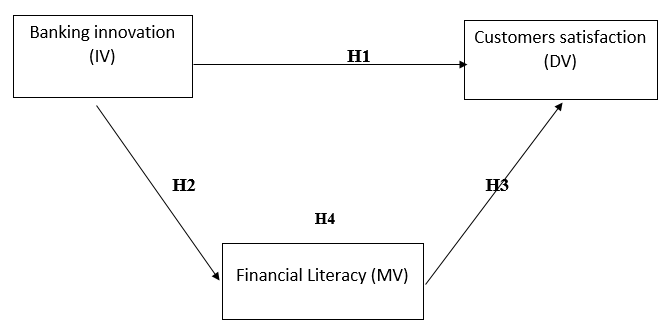
Figure 1: Conceptual framework.
Methods
A survey has been used to test the conceptual model. These quantitative research methods predict individual responses and examine the interrelationship between constructs.
Previous research by Malik and Ahsan used the survey approach to examine respondent’s feedback. We have collected data from 387 respondents within the town of Yaounde and Douala given the high concentration of the commercial banks in these areas using an online questionnaire. The target population are clients of commercial banks in Cameroon. The online survey has many benefits including wide-ranging, it can also sustain continuity between research and data collection environments. In addition, an online survey was used in previous research such as. Therefore, we believe that the best approach to this analysis is the survey process.
The scale measures were selected as rating questions with a weight ranging from 1 to 5 corresponding respectively to “Completely disagree”, “Disagree”, “Neutral”, “Agree” and “Completely agree” to be able to understand how people feel about survey questions considering model constructs. The five Likert scales were chosen in previous studies.
Data analysis, reliability and validity: To study the relations between the constructs and to test the hypotheses, a structured questionnaire was designed. In general, the study includes questions related to financial literacy, banking innovation, and customer’s satisfaction. The questionnaire will be topically organized, and the constructs will be measured.
The theoretical model finds an important provision based on the experimental study. This study aims to identify the type of the relationship between innovation and customer satisfaction in banks. Innovation consists of process innovation, organization innovation, and marketing innovation.
Data Analysis
In this section, we provide an exhibition of the results obtained by analyzing data collected by a questionnaire which is developed in this study. We show a descriptive analysis of respondents, descriptive analysis of constructs, reliability coefficient for variables, and simple and multiple regressions.
Descriptive analysis: Research data were collected by an online questionnaire using a sample of 410 participants, 23 of respondents’ answers were ignored. As a result, we have 387 respondents analyzed. The necessary data cleaning and management was done.
Results analysis shows that 68% of participants were males, while females accounted for 32%. With regard to status, 43% were singles, and 57% were married. Concerning the age of the participants, the category 16-24 years represented 5% and the category 25-34 years represented 62% and the following category 35-44 represented 23%, and the category 45-54 represented 9%, and above 54 represented 1%. The results also show participants' education level was .3 high schools, college 14%, and bachelor’s degree 67%, which was the highest, master’s 14% and PhD holder 4%.
The analysis shows means and standard deviation for measurement statements related to innovation influence towards business performance, results reveal that the bank regularly addresses new, unmet customer needs with (Mean 3.84, STD 1.097), and respondents who found that bank products or services are very innovative in relation to competitors with (Mean 3.14, STD 1.69), further, respondents who believe that our products or services regularly solve customer needs, which were not solved by competitors (Mean 3.18, STD 1.145), lastly respondents who found that the bank regularly utilizes new distribution channels for their products and services (Mean 3.73, STD 1.085).
Analysis shows means and standard deviation for measurement statements related to innovation influence towards customer satisfaction, results reveal customers who feel satisfactory of bank’s overall performance with (Mean 3.03, STD 1.179), and respondents who found that bank overall performance has met their expectation with (Mean 3.76, STD 1.036), further, respondents who believe that the satisfaction level of the bank is quite close to their ideal bank (Mean 3.53, STD 1.138). Analysis also shows means and standard deviation for measurement statements related to business performance influence towards customer satisfaction, results reveal customers who feel procedures and activities are completed on time with (Mean 3.56, STD 1.105), and respondents who believe that work or approval steps are short with (Mean 3.69, STD 1.030), and respondents who are satisfied with the image of workflow processes after radically changing processes with (Mean 3.53, STD 1.049), further, respondents who believe that bank employees are transparent to client’s in terms of all issues and processes with (Mean 3.55, STD 1.127). All the results of the reliability coefficients are acceptable and within the range as following, Innovation influence towards financial literacy is 0.84, then Innovation influence towards customer satisfaction is 0.78, financial literacy influence towards customer satisfaction.is 0.87, and all variables scale together is 0.92 [9].
AMOS analysis: The measurement model and structural model were conducted to ensure that the data is ready for testing the hypotheses.
Figure 2 shows the structural model. It shows that the value of relative Chi-sq (3.912) is less than 5. In addition, other indices such as GFI (.902), CFI (0.931), and IFI (.930) are greater than 0.90 which indicates that these indices are accepted. For the RMSEA, the value is 0.071 which is less than 0.08 and this indicates that these values are accepted. As shown also in Figure 2 and supported with Table 1 below, all the proposed hypotheses are accepted. For the effect of banking innovation on financial literacy, it can be seen that the beta is 0.77 with significance level of less than 0.01. Thus, H1 is supported. For H2, innovation also affected the customer satisfaction with a beta of 0.37 and significance level of less than 0.01. The third hypothesis showed that financial literacy affected the customer satisfaction with a beta of 0.45 and significance level of less than 0.01. Lastly, the mediating role of financial literacy was confirmed as the direct and the indirect effect are significant. The beta coefficient of the relationship of the indirect effect is 0.231 with significance level of less than 0.01 (Table 1).

Figure 2: The results of testing the hypotheses.
| Hypotheses |
|
Estimate |
S.E. |
C.R. |
P |
Label |
| H1 |
Banking innovation has a significant influence on financial literacy |
0.77 |
0.032 |
23.813 |
*** |
Significant |
| H2 |
Banking innovation has a significant influence on customers satisfaction |
0.37 |
0.05 |
7.331 |
*** |
Significant |
| H3 |
Financial literacy has a significant influence on customers satisfaction |
0.45 |
0.05 |
8.909 |
*** |
Significant |
| H4 |
Financial literacy mediates the relationship between banking innovation and customers satisfaction |
0.231 |
0.058 |
3.965 |
*** |
Significant |
Table 1: Regression weights: (Group number 1-Default model).
Results and Discussion
The concept of banking innovation has been discussed by a great number of authors. Innovation means that institution is making novel things to raise their customers and serve their requirements. In this study, we focus on studying three concepts; banking innovation, financial literacy, and customer satisfaction together. The result indicates that banking innovation takes a direct positive effect on financial literacy, and this result is consistent with Prajogo and Sohal study which showed that a positive impact of banking innovation on financial literacy of bank customers. The second result confirms that banking innovation has a direct influence on customer satisfaction. This result coincides with Anderson and Sullivan result which confirmed that customer satisfaction was strongly impacted by banking innovation. It also ensured the results of Daragahi which emphasized the positive and direct impact of banking innovation on customer satisfaction. The third result demonstrated that financial literacy takes a positive and direct efffect on customer satisfaction as several authors such as Lee and Chu Chokesikarin, and Sun and Kim have explored the direct relationship between customer satisfaction with financial literacy. The fourth and last result suggested that financial literacy mediates the relationship between banking innovations and customer satisfaction. We emphasize the priority of innovation in the Cameroon banking sector, banking innovation can help to motivate employees to produce new banking products and services and finding suitable literacy programmes and marketing strategies to get better customers satisfaction and fast growth.
The researchers can conclude the result from Cronbach alpha above 70%, which means that all hypotheses are strong. H3 which provides that: In a banking context, financial literacy has a positive and direct influence on customer satisfaction, and it was very strongly supported, then comes H1: In a banking innovation has a positive and direct influence on financial literacy, and the last one H2: In a banking context, innovation has a positive and direct effect on customer satisfaction. In addition, the researchers conclude that the results for Cronbach alpha are within the range and the hypothesis presented strongly as following: Cronbach alpha for the 11 measurement scale items were 0.92, then followed by H3 which stated that financial literacy influence towards customer satisfaction is 0.87, then followed by H2 which stated that banking innovation influence towards financial literacy is 0.84, and then H1 which stated that banking Innovation influence towards customer satisfaction is 0.78.
Conclusion
The outcomes of the study show that there is a strong and positive correlation that exists between banking innovation and financial literacy and banking innovation have a significant influence on customer’s satisfaction. It means that financial literacy mediates the relationship between banking innovation and customer’s satisfaction. It helps us understand the various innovations taking place and the future potential of using these innovative tools and resources on customer’s satisfaction. The results of this paper can be useful particularly for banks in Cameroon to explain the relationship between banking Innovation and its influence on financial literacy of the bank and customer’s satisfaction. In practice, financial literacy can be realized through several training courses and financial education and customer satisfaction will be fruitful. Although there are certain boundaries to our research (i.e., random selection of respondents by gender), we think that our research provides inspiring results and new motivations for more research.
Practical Implication
Based on the findings, bank managers can understand the role of innovative implications in managing financial literacy programmes in the Cameroonian banking sectors. In order to enhance the financial literacy and customer satisfaction, bank managers should adopt these practices to become more innovative, offer more quality products and services, and respond more efficiently to consumers’ requirements and preferences. Bank managers should also improve their practices in communication and involvement in career success by linking these practices to career and promotion and improving employees' understanding of their career requirement and increasing their involvement with them. Decision makers in the Cameroonian banking industry should increase the level of innovation in order to improve customer satisfaction and also to promote education and enhance financial literacy.
References
- Albert MO, Nora L (2003) Market orientation and business economic performance. A mediated model. Int J Serv Ind Manag. 14(3):284–309.
[Crossref] [Google Scholar]
- Al Hawari M, Hartley N, Ward T (2005) Measuring banks' automated service quality: a confirmatory factor analysis approach. Mark Bull.
[Google Scholar]
- Anderson EW, Sullivan MW (1993) The antecedents and consequences of customer satisfaction for firms. Mark Sci. 12(2):125–143.
[Crossref] [Google Scholar]
- Bhattacherjee A (2001) An empirical analysis of the antecedents of electronic commerce service continuance. Decis Support Syst. 32(2):201–214.
[Crossref] [Google Scholar]
- Bhattacherjee A, Premkumar G (2004) Understanding changes in belief and attitude toward information technology usage: A theoretical model and longitudinal test. MIS Q. 28(2):229–254.
[Crossref] [Google Scholar]
- Bongomin GOC, Ntayi JM (2020) Mobile money adoption and usage and financial inclusion: Mediating effect of digital consumer protection. Digit Policy Regul Gov. 22(2):157–176.
[Google Scholar]
- Boulding W, Kirmani A (1993) A consumer-side experimental examination of signaling theory: Do consumers perceive warranties as signals of quality? J Consum Res. 20(1):111–123.
[Crossref] [Google Scholar]
- Brehm J, Festinger L (1957) Pressures toward uniformity of performance in groups. Hum Relat. 10(1):85–91.
[Crossref] [Google Scholar]
- Camison C, Villar Lopez A (2014) Organizational innovation as an enabler of technological innovation capabilities and firm performance. J Bus Res. 67(1):2891–2902.
[Crossref] [Google Scholar]
Citation: Takemeyang A (2025) Linking Banking Innovation, Financial Literacy and Customers Satisfaction in Cameroon. Br J
Res. 12:140.
Copyright: © 2025 Takemeyang A. This is an open-access article distributed under the terms of the Creative Commons Attribution
License, which permits unrestricted use, distribution, and reproduction in any medium, provided the original author and source
are credited.