Research Article - (2025) Volume 12, Issue 1
Analyzing Public Policy in Terms of Political Theory: The Case of Information Policy
Manaf Bagirzade*
Department of Public Administration, Baku State University, Baku, Azerbaijan
*Correspondence:
Manaf Bagirzade, Department of Public Administration, Baku State University, Baku,
Azerbaijan,
Email:
Received: 13-Jul-2024, Manuscript No. IPBJR-24-20773;
Editor assigned: 16-Jul-2024, Pre QC No. IPBJR-24-20773 (PQ);
Reviewed: 30-Jul-2024, QC No. IPBJR-24-20773;
Revised: 12-Jan-2025, Manuscript No. IPBJR-24-20773 (R);
Published:
19-Jan-2025, DOI: 10.35841/2394-3718-12.1.117
Abstract
One of the important developmental features of the modern world community, as well as nationstates, is the active and rapid development of the information space. The emerging new informational realities have a significant impact on the characteristics and character of interpersonal, social, intrastate and inter-state relations. In particular, the dynamics of the information society has led to the emergence of new theoretical approaches in management and political sciences.
Developments in the perspective of political science also affect public policy. For example, the fact that the state is seen as the determining factor in political theories determines the centre of public policy as the state. When we talk about public policy, it is insufficient to consider it only as the process of preparing policies by state institutions. This is because the term public in public policy characterises the level of the policy, not the quality of the subject that carries out the policy. Especially in the periods before the 1970's, it was envisaged that only state institutions would take part in the determination and implementation of public policy working processes. The emergence of postpositivist, post-modern, post-structuralist, post-industrial, post-ethatist and other similar paradigms has had an impact on theoretical political analysis and later on applied policy analysis.
The aim of the study is to conceptualise the relationship between the effective realisation of public policy and political theory. Within the framework of this aim, the netocratic approach as a political theory is evaluated in terms of information policy.
Starting from 2001, the netocracy theory, which has gained currency and is directly related to information policy, is characterised as a post-modernist approach. Miller Hugh, in his study "Postmodern public policy", presents proposals for resolving the obstacles faced by the public sector in terms of public policy through new methods. According to him, the post-modernist approach enables the possibility of producing well-thought pragmatic solutions based on political pluralism and social interaction. In this respect, it is necessary to apply new theoretical approaches in public policy.
The study is characterised by an abstract-oriented, interdisciplinary, theoretical-methodological, complex phenomenon-examining, theoretical-to-practical approach. Therefore, abstract-logical and hypothetical deductive methods are used in the study.
Public policy, like any interdisciplinary research, consists of a wide range of complex understandings and concepts that draw fundamentally from disciplines such as political communication, sociology and economics. A number of theoretical formations in public policy are concerned with the problems of the state and public administration, the interaction of sovereignty structures with society, the acceptance and realisation of government decisions.
In short, netocracy as a political theory can be summarised as a theory explaining the new social formation in which the basic value shifts from material products to information, the new social formation in which netocrats become the elite class, the vertical hierarchical interaction is replaced by horizontal communicative interaction, a new form of governance is formed, the new (post-modernmobilistic) paradigm of power becomes current.
The study of public policy, from the point of view of the abstract theory of netocracy, leads to the establishment of interconnections between the objects of research necessary for the study of concrete information policy practice. The results of the synthesis of information policy and netocracy in policy analysis are the main findings of the study. The model built within the framework of the findings is characterised by the analysis of the applicability of netocratic theories in information policy. At the same time, it is shown that the abstract theoretical validity of netocracy is possible in the form of the use of the theoretical mechanisms through the creation of a concrete practical model of information policy.
Keywords
Public policy; Policy analysis; Netocracy; Information policy
Introduction
Policy is a system of conscious principles that determine decision-making and rationally achieve outcomes. As a declaration of intentions, policy consists of specific protocols and processes. According to James Anderson, policy is the study of a problem and the direction of action pursued by the actor or actors with a purpose [1]. Usually procedures and processes are drafted and developed by senior managers and civil servants and approved in the form of policies by the council or top governing body. These policies determine both subjective and objective decision-making [2]. Unlike laws and rules, which provide for the coercion or prohibition of behaviour, policy directs actions to achieve necessary results. This understanding is also associated with the identification of alternatives and priorities for decision-making in important organisations, selecting them according to their impact. Policy can be perceived as a political, managerial, financial and administrative mechanism for achieving certain objectives [3].
Materials and Methods
The anticipated problems of policy vary widely according to the institutions and circumstances that realise it. It is sometimes possible for policy to have unintended consequences or effects different from those envisaged. This is because the environment, which consists of complex systems such as the state, society, large corporations, etc. that policy seeks to influence or manipulate, is in a constant state of dynamic change. Therefore, it is theoretical to endeavour to assess the potential to influence the relevant target objects and subjects in the process of policy formulation. This is particularly difficult to realise in adaptive and complex systems such as society and government.
Theodore Lowi, an American scholar of public policy, divides policy into four stages: Distributive, redistributive, regulatory and constructive [4]. Distributive policies consist of the expansion of a particular product or service and the determination of its corresponding value. Regulatory policies, on the other hand, consist of restricting the independence of certain individuals and institutions or forcing them to operate in a certain type of behaviour. Such policies can take place when positive behaviour can be easily detected and negative behaviour can be easily regulated by fines. Constitutive policies, on the other hand, constitute elements of executive dominance. Theodore Lowi, an American scholar of public policy, divides policy into four phases: Distributive, redistributive, regulatory and constitutive [4]. Distributive policies consist of the expansion of a particular product or service and the determination of its corresponding value. Regulatory policies, on the other hand, consist of restricting the independence of certain individuals and institutions or forcing them to operate in a certain type of behaviour. Such policies can take place when positive behaviour can be easily detected and negative behaviour can be easily regulated by fines. Constitutive policies, on the other hand, constitute elements of executive dominance.
As a result of competitive struggle, policy subjects use public power to take actions that reflect the demands of the most active and largest part of society. In this case, the state,through legal and institutional mechanisms, provides a balance of dialogue between public policy subjects, enabling the formulation and implementation of policies. The state consists in influencing the social information space in order to resolve political and socio-economic contradictions through the subjective nature of information policy and attracting policy subjects.
Policy Analysis
The mention of policy analysis as an independent discipline coincides with the 1950's. The history of political analysis, which is similar to this discipline, can be traced back to the early formation of the state, when governance and administrative processes were taking place. At that time, political skills were based on practical experience. The acquired knowledge was transmitted through traditions and customs. Over time, with the development of the state apparatus, certain class formations of society emerged, which responded to the characteristic of the carrier of political knowledge. In the later stages of social transformation, industrialisation, urbanisation and the mass concentration of the population on small plots of land created a demand for more precise political and administrative decisions based on accurate economic and social information. This has led to the development of statistical and empirical methods in political analyses. Especially since the beginning of the 20th century, applied policy analysis has entered a new phase and started a process of specialisation and institutionalisation. The most widespread development trend of policy analysis was during the nuclear stand-off between the USA and the Soviet Union. For this resistance, analytical centres such as "brain trusts" and "think tanks" were established. Examples of these organisations are: "RAND Corporation" in 1948 and later "Brookings Institution", "Heritage Foundation", "Urban Institute". In the activities of these organisations, many mechanisms such as Planning-Programming-Budgeting- System Analysis (PPBS), Delphi analysis, cost-benefit analysis, cost-effectiveness analysis were prepared to help political analysis. According to Yehezkel Dror, who evaluates these trends, the development of such mechanisms and the spread of the analycentric movement leads to the danger of technocratism [5]. In this respect, in many studies, public policy is also considered as a form of private domination, and we are witnessing an increase in this situation.
The official institutional history of political analysis began with the collective work "The policy sciences: Recent developments in scope and method", edited by Harold Lasswell, Daniel Lerner, Harold Fisher, published in 1951: Recent developments in scope and method" (The policy sciences: Recent developments in scope and method) [6], published in 1951. This beginning, called the "policy movement" in English, was characterised by the application of humanist values and democratic principles and the aim of increasing the effectiveness of social decisions. Thus, political science was given a pragmatic and applied orientation, combining democratic theories with the practice of governance. In European countries, the history of applied politics as an academic discipline dates back to the 1980's [7].
Political analysis offers an alternative to the impulsive and intuitive acceptance of the consequences of decisions made in complex systems without reflection. This alternative proposes to approach political analysis from an academic perspective, as distinct from the analyses of TV pundits and newspapers, image makers and election technologies, columnists and others. According to the American political scientist Aaron Wildavsky, the activity of political analysis is the activity of identifying and then analysing social problems [8]. A similar statement is made by the Canadian scholar Leslie Pal. According to him, applied policy analysis is the directed use of intelligence in solving social problems [9]. When we look at many similar definitions, we see that there is a partial consensus in explaining the phenomenon of policy analysis. In general, this phenomenon belongs to the science of politics and management and prepares general principles and specific modelling methods for the adoption and realisation of public decisions. In today's literature, the concept of political analysis is used in three senses: theoretical-basic, instrumental-empirical and practicalapplied.
Results and Discussion
Theoretical-foundational political analysis covers the basic conceptual work, structure and dynamics of the political sphere. This can be seen in Robert Dahl's "Modern Political Analysis" and David Easton's "Analysis of Political Structure". Political analysis in the instrumental-empirical sense involves the collection, systematization, processing and explanation of initial data. If the main vector of analysis in the theoreticalfoundational sense focuses on deductive conclusions, analysis in the instrumental-empirical sense has the character of inductive generalization. Examples of literatures characterizing political analyses in the second sense are the "Empirical Political Analysis: Research Methods in Political Science" by Manheim Jarol, Rich Richard, Bahry Donna, "Introduction to Political Analysis" by Alan Tsukerman and "Political Analysis: Techniques and Practices". In the practicalapplied form of political analysis, the priority is not simply the establishment of valid theories or the collection of data. Basically, the priority of political analysis is the assessment and solution of public (social) problems. Although practicalapplied political analysis often involves a combination of deductive and inductive thinking, retroductive thinking is fundamental. The retroductive research strategy proposes the construction of hypothesised models in order to learn about real structures and mechanisms that require the preparation of empirical facts. If the model operates in the hypothesised way, the result will be in accordance with the model under consideration. Unlike the theoretical-foundational approach, which builds an abstract model of policy, and the instrumental-empirical approach, which involves the use of models at the level of empirical data, the practical-applied approach draws on both approaches to develop a unique and valid model appropriate to the problematic situation. Therefore, the prescriptive function applies to the practical approach, the expository function applies to the theoretical approach and the descriptive function applies to the empirical approach (Table 1).
| |
Form (measurement) of political analysis |
| Parameters |
Theoretical-basic |
Instrumental-ampirical |
Practical-applied |
| Determinant vectors |
Deduction |
Induction |
Retroduction |
| Character of information |
Abstract and theoretical |
Concrete and realistic |
Synthetic-projective |
| The role of modelling |
Development of conceptual meta-models |
Operational use of features of models |
Design of situational-problem models |
| Basic analytical unit |
Concepts |
Data |
Problems |
| Basic feature |
Explicative (narrator) |
Descriptive (explanatory) |
Prescriptive (normative) |
Table 1: Major types of political analyses and their parameter characteristics.
The English term "political analysis" is used for political analysis at the basic level and "policy analysis" for the applied level. In Turkish, it is possible to use the term "political analysis" for political analysis and "policy analysis" for political analysis. When we take into account that political analyses themselves are studied at the theoretical-foundational level, the boundaries between these two terms lose their validity. According to Harold Lasswell, basic science focuses on the analysis of the nature of policy, while applied science focuses on the analysis within the policy framework. From this point of view, we can determine that the first object of his study, the understanding of netocracy, covers the theoretical-basic level, while the second object, "information policy", covers the applied level. Thus, we can conclude that netocratic theories will play a supporting role in the analysis of information policy. At the same time, the abstract theoretical validity of netocracy is possible through the creation of a concrete practical model of information policy and the use of theoretical mechanisms.
In the joint work by Edward Quade and Grace Carter, "Analysis for public decisions", it is stated that political analysis is not a precise science, since it does not seek scientific truth, but instead focuses on ensuring the optimal choice for the decision-maker. In this case, two points struck me: Firstly, that political analysis is an analytical rather than a scientific activity and secondly, that it is not impartial since it assists the decision-maker. For this reason, it is understandable that in making the right decisions in terms of determining and implementing information policy, it focuses on issues such as conflict of interest, stakeholder relationship, winning and losing side related to the relevant field and problem, rather than scientific principles, theories and values. The phenomenon of netocracy determines new qualities related to these issues that will shape information policy. In the next section, after analysing the nature, elements and main subjects of information policy, we will examine these qualities in the context of the characteristics of the phenomenon of netocracy.
Public Policy: The Relationship between Netocracy and Information Policy
The concept of netocracy was first proposed in 2000 by two Swedish scholars, Alexander Bard and Jan Söderqvist. The concept was included in the study "Netocracy-The New Ruling Elite in Post-Capitalist Life" at the Stockholm School of Economics. also characterises the social-political regime envisaged as an expression of the information society. In short, netocracy can be summarised as follows:
• The core value shifts from material goods to knowledge.
• Access to and manipulation of the necessary information ensures dominance over others.
• The sovereignty of those with material capital is gradually passing into the hands of active actors in information networks.
• The capitalist order of society, in which the bourgeoisie rules, is abolished.
• A new social formation is taking place in which the netocrats have become the elite class.
• The biggest source of demand is "attention".
• Vertical hierarchical interaction is replaced by horizontal communicative interaction.
• Information pollution increases.
• A new form of government is formed.
• There is a new social formation.
• The new (post-modern-mobilistic) paradigm of power is gaining currency.
• For the first time in human history, networks have created an interactive communication environment.
• The media is leaving the control of the bourgeoisie and turning into an autonomous area.
Let us examine the applicability of public policy towards the above-mentioned phenomena through information policy. In their joint work, Overman Sam and Cahill Anthony consider information policy as a set of public rules, laws and policies that regulate, encourage or inhibit the transfer, storage, use and production of information.
According to Terrance Maxwell, information policy encompasses the roles of information in social, economic, political, legal and technological solutions and how the production, use, storage and dissemination of information at the instrumental level affects society. In another definition of Maxwell, information policy is depicted as socio-political arrangements, economic and technological decisions regarding the role of information in society. Sandra Braman, in the first issue of the journal "Information Policy", states that "information policy consists of laws, rules and doctrines concerning the production, processing, flow, access and use of information and other decisions and practices of structural influence throughout society". In my opinion, information policy is the regulation and management of informational activity in general.
Since information policy has a social character and since the analysis of information policy is kept in mind in the netocratic political theory, public policy is treated as reciprocal. Information policy has much in common with the understanding of public policy, as it provides the interrelationship between political activity and governance. According to May Jochim, public policy shapes political activity and determines winners and losers. Public policy is a direction of activity realised by the organs of sovereignty, involving a large number of people, with stable goals. It consists of a system of actions to achieve given goals and results in a given period of time. Public policy includes not only decision-making on laws in any field, but also decisions on the practical implementation of these laws. Public policy occurs when any action is taken or not taken in response to political demands or in solving specific problems.
These demands are also channelled by citizens, group representatives, legislators and other different participants in social political life. Participating groups receive partisan support in the realisation of policy. In short, public policy is a kind of private activity of public and private institutions of the state aimed at satisfying society. Public policy as a science is a system of scientific concepts, theories, understandings and methods that allow analysing the processes and phenomena taking place in society, understanding their causes, forecasting the scenario of the development of future events and including priority problems in decision-making in the preparation of the development strategy of society.
Public policy is the purposeful actions of individuals in society, reflecting their demands and aspirations. Voters, pressure groups, bureaucrats, bureaucrats, political parties, the government and parliament (in some countries the military) who have a direct and indirect contribution to the public policy decision-making process (or the process of public policy formulation) are called public policy actors. In a democratic country, it is pressure groups, voters, government and parliament that actually play a role in this process.
Today, public policy transcends the boundaries of policy and management realised by the state. The government is under strong pressure from citizens who demand efficiency, transparency and precision. Contemporary public policy is an indicator of the degree of democracy of the political system and it is considered that without democracy the existence of this discipline is impossible. Especially in democratic countries, the implementation of public policy is unthinkable without the participation of citizens and public institutions (non-governmental organisations). Participants are involved at all stages, from the preparation of the policy direction to its realisation, monitoring and evaluation. In open societies, there is a two-way communication channel that allows citizens to make their own proposals on ways of solving the problem, as well as to make demands. In this case, the government not only listens and informs, but also carries out the decision-making process with the participation of citizens.
The absence of public policy means that there is no dialogue between society and the sovereignty, which leads to disorganisation of bilateral relations. Public policy is a complex process involving various interests, roles and resources. It involves negotiation, consensus, stakeholder agreement and intersectoral partnership. Intersectoral cooperation is the interaction of state, private and civil society with punctually defined roles and responsibilities to achieve common goals.
Given the post-industrial nature of the object of study, a traditional state-centred, rationality-based, hierarchical analysis of knowledge policy alone would be insufficient. For this reason, a particularly complex, multi-actor, multi-centred and synthetic analysis is accepted as a requirement of the nature of the research.
According to Maria Kondrashina, public policy is a synthesis of two well-known and productive approaches. The first is the study of public policy within the framework of Jürgen Habermas' concept of the public sphere. The public sphere enables private interests to realise the common good. By performing the function of interaction between the government and society, it enables the formation of policies that express public interests. Currently, most of the theoretical studies on the problematic of information policy are related to the nature of the public sphere. In the public sphere, which is considered as a field of communication, social opinions that function as criticism and control are formed. Jürgen Habermas gives public policy a non-state characterisation and forms the basis for associating it with the phenomenon of social opinion. Thus, the function of public policy can include open deliberation, which constitutes an endeavour to realise social interests.
The second is Pierre Bourdieu's concept of social space. In his work he divides social space into partially closed functional areas. Regardless of the fact that these spaces are realised according to their own laws of functionality, these spaces are also in the process of interaction among themselves. On the one hand, these spaces are the means for the realisation of certain social games that create an environment of possibilities for "agents". On the other hand, the "agents" form space structures according to their position, capital and interaction characteristics. Such an approach helps to analyse and learn about the objective structures of social space. For Pierre Bourdieu's approach, what is important in public policy is not only the importance of "agents" and their communication characteristics, but also their interaction and the resources they use. In this case, the behaviour of "agents" in space determines public policy. Thus, the concept of public space helps to grasp the content and ontological characteristics of public policy. The concept of social space (field), on the other hand, helps to deconstruct and outline the space of public policy and to define the framework of methods of analysing its "agents". Such a specific approach of Maria Kondrashina to public policy can lead to the elaboration of public policy tools and processes of general relevance.
When the phenomenon of netocracy foretells social transformation, it speaks of a change in the elite structure. When we look at public policy within the framework of elite theory, we see that decisions and practices reflecting the values and preferences of elites are predominant in policies. The main argument of elite theory is that public policy is determined by the preferences of ruling elites rather than by the demands of the masses or the people. These preferences are realised through state officials and institutions. The idea that elites manage public policy is not easily provable. According to Robert Dahl, the author of the concept of polyarchy, it is possible to prove this view by determining the validity of the ideas of individuals who are in the minority among the group that is not the product of democratic processes and the different ideas involved in solving basic political problems. Unlike the traditional understanding of elites, the elite in netocracy does not speak of elites who subordinate the masses to their interests through state, economic and political power. In the netocratic elite theory, what makes a small group superior to the mass depends on information sources and information processes. Netocratic elites, if they wish, either present their own preferences by ignoring the mass demand in determining the policy or they shape the mass demand in accordance with their own preferences. This is because netocratic elites are the main actors in the management of mass perception through networks.
Public policy, from the point of view of the abstract theory of netocracy, helps to establish mutual links between the research objects necessary for the study of concrete information policy implementation. The results of the synthesis of information policy and netocracy in policy analysis are summarised in the diagram in Figure 1.
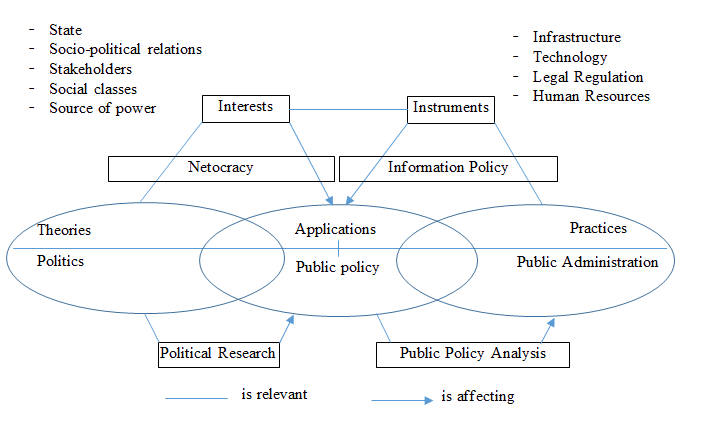
Figure 1: The position of netocracy and information policy in terms of analysis.
Conclusion
While analysing political analysis in this study, we have identified two types of analyses that are relevant and necessary for our research. The first one is the theoreticalbased political analysis, which is closer to netocracy. The second one is public policy analysis, which belongs more to information politics and is based on practice. Political science analyses power, political interests, social structure, power relations, ideology, reflection and other similar issues. The impact of developments in this field and the results of analyses have an impact on public policy (implementation). Since policy analysis is related to public policy, the results have an impact on public administration practices. As we can see in the diagram, there is a development from theories to practices through practice. If the application of any theory does not manifest itself in practice, it means that the theory lacks validity and applicability. For this reason, the diagram shows that instead of practices determining practices, on the contrary, practices determine or influence practices. The model shown in this diagram is characterised by an analysis of the applicability of netocratic theories in information policy. At the same time, the abstract theoretical validity of netocracy is shown to be possible in the form of the use of the theoretical mechanisms through the construction of a concrete practical model of information policy.
References
- Lasswell HD (1970) The emerging conception of the policy sciences. Policy Sci. 1(1):3-14.
[Crossref] [Google Scholar]
- Overman ES, Cahill AG (1990) Information policy: A study of values in the policy process. Rev Policy Res. 9(4):803-818.
[Crossref] [Google Scholar]
- Braman S (2011) Defining information policy. J Inf Policy. 1:1-5.
[Crossref] [Google Scholar]
- May PJ, Jochim AE (2013) Policy regime perspectives: Policies, politics, and governing. J Inf Policy. 41(3):426-452.
[Crossref] [Google Scholar]
- McDougal MS, Reisman WM, Willard AR (1987) The world community: A planetary social process. UC Davis L Rev. 21:807.
[Google Scholar]
- Thomas G (2011) What is political development? A constitutional perspective. Rev Polit. 73(2):275-294.
[Google Scholar]
- Thornhill C, van Dijk G (2010) Public administration theory: Justification for conceptualisation. J Public Admin. 45:95-110.
[Google Scholar]
- Feitsma J, Whitehead M (2022) Bounded interdisciplinarity: Critical interdisciplinary perspectives on context and evidence in behavioural public policies. Behav Publ Pol. 6(3):358-384.
[Google Scholar]
- Wagner CS, Roessner JD, Bobb K, Klein JT, Boyack KW, et al. (2011) Approaches to understanding and measuring interdisciplinary scientific research (IDR): A review of the literature. J Inform. 5(1):14-26.
[Crossref] [Google Scholar]
Citation: Bagirzade M (2025) Analyzing Public Policy in Terms of Political Theory: The Case of Information Policy. Br J Res. 12:117.
Copyright: © 2025 Bagirzade M. This is an open-access article distributed under the terms of the Creative Commons Attribution License, which permits unrestricted use, distribution, and reproduction in any medium, provided the original author and source are credited.