Research Article - (2025) Volume 12, Issue 2
A Bibliometric Analysis of the Ethics of Social and Commercial Entrepreneur
Azucena Martin-Quevedo1*,
Elena Urquia-Grande2 and
David Pascual-Ezama2
1Department of Business and Administration, Nebrija university, Madrid, Spain
2Department of Financial Administration and Accounting, Complutense University, Madrid, Spain
*Correspondence:
Azucena Martin-Quevedo, Department of Business and Administration, Nebrija university, Madrid,
Spain,
Email:
Received: 15-Oct-2024, Manuscript No. IPBJR-24-21768;
Editor assigned: 17-Oct-2024, Pre QC No. IPBJR-24-21768 (PQ);
Reviewed: 31-Oct-2024, QC No. IPBJR-24-21768;
Revised: 12-Feb-2025, Manuscript No. IPBJR-24-21768 (R);
Published:
19-Feb-2025, DOI: 10.36648/2394-3718.12.2.142
Abstract
The analysis of the ethical behavior of entrepreneurs has been addressed by many authors, especially in recent years. The link between ethics and entrepreneur gives rise to different theories and a large number of empirical studies. This article performs a bibliometric analysis that investigates the connection between the concepts of ethics and entrepreneur, separating the figures of social entrepreneur and commercial entrepreneur. We analyzed 1343 articles extracted from Web of Science, from 1987 to 2021, to provide a scientific map of journals, co-occurrence of keywords, authors, areas of knowledge and countries in the analysis of ethics and entrepreneur.
Keywords
Entrepreneurship; Entrepreneur; Ethics; Dishonesty; Bibliometrics
Introduction
This bibliometric analysis, based on Web of Science, will allow us to determine the main keywords in this area of research and also the co-occurrence between the different records reviewed. We also make visible the main research areas with the highest research production, as well as the authors, countries and main journals responsible for most of the research on entrepreneur and ethics. Some of the unethical practices within the entrepreneur may be related to unfair competition, breach of agreements and unfair attitudes towards stakeholders. All of these are generally carried out through the abuse of power or as a consequence of a conflict of interest. The lack of ethical values in entrepreneurs can lead to loss of reputation and cause them difficulties in their environment [1].
The difficulty and controversy that can result from this phenomenon has led to results that lack consensus. Under certain circumstances the entrepreneur will have to face business decisions in which his ethical behavior may be questioned. Ethical behavior can be understood as those principles and rules that define what is right or wrong. These circumstances can condition the positioning of the entrepreneur in his business relationships, whether in his network of contacts or in the possibilities of obtaining financing. The essence of the organization will be influenced by the ethical behavior of the entrepreneur.
In this paper we aim to expand the knowledge and connection between ethics and the entrepreneur by analyzing 1343 articles related to this topic. To do so, we conducted a search panel with the following list of terms in WOS: Business entrepreneurs and social entrepreneur and their relationship with ethics, dishonesty, behavior, deception and lying. This bibliometric analysis is part of the first phase of a future research, as we will later delve into analyzing ethical behavior in entrepreneurs and those factors that may affect the development of this type of behavior [2].
Concept of Commercial and Social Entrepreneur and It's Relation to Ethics
After a brief introduction on the current state of ethics and entrepreneur, we will now contextualize its theoretical framework, which will allow us to understand what type of relationship is established between the two phenomena and how the characteristics of each type of entrepreneur can affect their ethical behavior.
Commercial entrepreneur: The concept of the entrepreneur has been studied from different sources of knowledge, and there is no consensus regarding its conceptualization. This term comes from the French "entrepreneur". It was introduced by Cantillon in the first half of the 18th century, and identifies the individual who assumes the responsibility and execution of a business project. Contrary to what may be expected from such a representative figure within the economy and society, it can also tend to develop unethical behaviors [3]. This may be due to the entrepreneur’s own characteristics or also to the competitive pressures to which he or she is subjected. According to Gilder, the entrepreneur tries to satisfy third-party needs and states that entrepreneurs have an acceptable moral behavior in society. However, Griffiths and Lucas highlight the fact that entrepreneurs have a natural ambition that leads them to greed, which would be morally reprehensible.
The lack of consensus about the phenomenon of the entrepreneur is widely noted. The importance of the characteristics or attributes of the entrepreneur, are not only relevant to forming a company but are a conditioning factor for its success, characterized by creation and innovation. The figure of the entrepreneur is key to social change and economic development.
Social entrepreneur: The figure of social entrepreneur, in addition to having many of the attributes or characteristics in common with the commercial entrepreneur, has unique and exclusive attributes. The social entrepreneur has a key function in the world, that of creating social value and prioritizing help to others chaneled through altruism in their actions. Altruism is a value that means that the individual makes a personal sacrifice for the benefit of others. Altruism implies reciprocity and is, therefore, the basis of the solidarity of this type of entrepreneur [4].
Several authors described the social entrepreneur as an individual who is in search of changes, relying on innovative ideas and, in order to provide solutions to social and environmental problems, uses resources that have previously been used, giving them a second chance. The purpose is to balance the interests of all the agents involved in society, highlighting their ability to recognize and take advantage of opportunities. Social entrepreneurs are also defined by their altruistic and optimistic character [5]. Catford highlighted the importance of the social entrepreneur’s ethical behavior as a tactical element, i.e., they see opportunities where others only see problems, prioritizing the social mission over all.
We can say that the main characteristics of the social entrepreneur focus on the search for the welfare of others, with the aim of achieving social change. In addition, they address neglected social problems that have a positive impact on the lives of people or the social problem they are trying to solve.
Ethics and the entrepreneur: The behavior of the entrepreneur plays an important role in the success or failure of a venture since a positive relationship is established between the behavior of the entrepreneur and the results obtained in terms of the growth and profitability of the project. The entrepreneur will comply with ethical standards to what he or she considers to be appropriate or inappropriate, sometimes applying certain types of behaviors such as lying, dishonesty, greed, incompetence or impulses without reasoning. This conduct can question the entrepreneur as a whole. This lack of self-regulation when the entrepreneur is faced with an ethical dilemma can lead to unlawful or harmful behaviors that may undermine the economic and social welfare of his or her environment, and thus harm their entrepreneurial project.
Due to the scarcity of relevant analyses in this area of research, this type of bibliometric analysis allows us to organize and visualize the information in this field of research, generating clusters and scientific maps, and identifying the main connections and structures between the selected keywords.
Materials and Methods
To carry out this bibliometric analysis we rely on the methodology used by Rey-Martí et al. It allows us to establish the profile of publications and the area of research, as well as to identify new lines within the area of study. We have used the Web of Science (WOS) database, which includes scientific articles and informs about scientific production in this area of research. This is a novel technique that makes it possible to identify the main research topics as well as the evolution of a field of research. Specifically, it is based on statistical methods that make it possible to identify both quantitatively and qualitatively the scientific production.
Search criteria: In total, 1752 records were considered that matched the search criteria of this study. The search performed was as follows: Record types “article” and “review,” in the category of “business” and “management.” All articles were open access. They were included to determine which journals were the main catalysts in this field of research. This search was adjusted to English language articles and reviews, since that is the language of the main countries where this research field is concentrated. We have also eliminated from our sources those that did not deal with the main topic of this field of research, thus obtaining a total of 1343 publications. Table 1 shows the battery of terms that will allow us to investigate with greater precision the main existing topics.
The tool we have used to identify the keywords is VOS viewer. This tool allows us to identify the structure and production of a research field, making us able to identify the co-ocurrence of the chosen keywords. Docking is a citation analysis technique proposed by Kessler, based on the principle that two documents are closely related to the extent that they have a greater number of bibliographic references in common.
In this way, bibliographic coupling becomes an interrelation criterion that makes it possible to obtain groups of articles with a high degree of similarity, which constitutes a field of research [6]. On the other hand, the concept of co-occurrence of references indicates the proximity relationship between two or more keywords within a document; it is represented by the graphs of linking networks between terms (nodes). This biblimetric analysis allowed us to determine the main clusters and, as a consequence, the keywords of this research field.
| Searches performed |
No. publications |
Filtered records |
| Entrepreneur and ethic |
1133 |
736 |
| Entrepreneur and dishonesty |
5 |
3 |
| Entrepreneur and behavior |
178 |
178 |
| Entrepreneur and cheat |
11 |
1 |
| Entrepreneur and lie |
1 |
1 |
| Social entrepreneur and ethic |
173 |
173 |
| Social entrepreneur and dishonesty |
0 |
0 |
| Social entrepreneur and behavior |
251 |
251 |
| Social entrepreneur and cheat |
0 |
0 |
| Social entrepreneur and lie |
0 |
0 |
| Total records |
1752 |
1343 |
Table 1: Panel of searches performed in Web of Science 1987–2021.
Results and Discussion
Evolution of the Research Field
In order to determine the general evolution of this research area, we have based the qualitative procedure on the study conducted by Vallester et al., extending the period to the present time. This procedure has also been performed by other researchers.
The evolution of this field of research in the period under study is shown in Figure 1. The first registered publication on entrepreneur and ethics took place in 1987. From that moment on, the number of publications increased notably, especially since 2005. In 2009, the European Business Ethics Network (EBEN) conference took place. From this moment on, three journals began to take interest in this phenomenon. As an example, the Journal of Business Venturing published a special issue linking ethics and entrepreneur. Likewise, the Journal of Business Ethics began to devote more attention to this topic, becoming years later the main catalyst for this field of research. A Business Ethics-European Review increased the number of publications from 2009 as well.
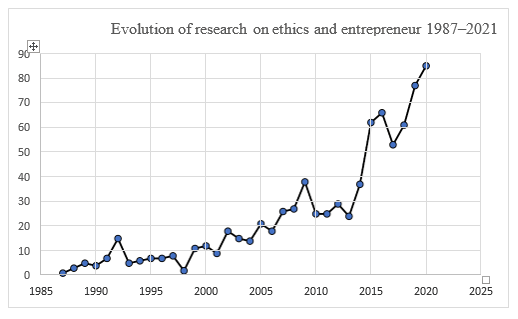
Figure 1: Evolution of research on ethics and entrepreneur.
Our research corroborates that according to the study by Vallester et al., this upward trend continues, with an increasing number of publications dealing with the subject of entrepreneur and its relationship with ethics.
Identification of Keywords: Co-occurrence
The search for this analysis was conducted in 2021 and used records available in the Web of Science core collection from 1987 to 2021. The quantitative approach shows the cooccurrence and the strength of connection that exist between the different keywords that appear throughout the literature review. To obtain this ranking, we set a threshold of 10 (each keyword had to appear at least 10 times in an article). Within the top ten of the ranking, analysis reveals that the main topics in this field of research are entrepreneur, social entrepreneur, and in third place, the term “ethics.” The keywords that follow this ranking are performance, behavior, management, ethical business, innovation, business and sustainability, and morality (Table 2).
| Ranking |
Keywords |
Co-ocurrence |
Link strength |
| 1 |
Entrepreneurship |
254 |
1046 |
| 2 |
Social entrepreneurship |
206 |
810 |
| 3 |
Ethics |
188 |
735 |
| 4 |
Performance |
125 |
658 |
| 5 |
Behavior |
108 |
544 |
| 6 |
Management |
100 |
485 |
| 7 |
Business ethics |
101 |
437 |
| 8 |
Innovation |
73 |
355 |
| 9 |
Business |
69 |
327 |
| 10 |
Sustainability |
65 |
306 |
| 11 |
Values |
50 |
253 |
| 12 |
Self-efficacy |
47 |
252 |
| 13 |
Attitudes |
35 |
191 |
| 14 |
Gender |
42 |
187 |
| 15 |
Personality |
32 |
175 |
| 16 |
Stakeholders theory |
29 |
172 |
| 17 |
Corporate social responsibility |
36 |
161 |
| 18 |
Legitimacy |
29 |
153 |
| 19 |
Perceptions |
26 |
142 |
| 20 |
Motivation |
24 |
129 |
| 21 |
Leadership |
25 |
123 |
| 22 |
Entrepreneurs |
29 |
122 |
| 23 |
Intentions |
23 |
120 |
| 24 |
Ethical decision making |
22 |
114 |
| 25 |
Corruption |
17 |
97 |
| 26 |
Creativity |
16 |
94 |
| 27 |
Ethical leadership |
20 |
92 |
| 28 |
Planned behavior |
17 |
84 |
| 29 |
Value creation |
14 |
83 |
| 30 |
Empathy |
17 |
81 |
| 31 |
Trust |
18 |
78 |
| 32 |
Networks |
15 |
56 |
| 33 |
Compassion |
10 |
54 |
| 34 |
Morality |
11 |
45 |
Table 2: Keywords co-occurrence.
Subsequently, the scientific map of the research field was constructed with the main topics from the records obtained in the WOS search. Figure 2 allows us to classify the keywords into six main groups and the existing connections between them. Figure 2 allows us to observe the largest nodes, i.e., the area in which the largest number of terms within this field of research are grouped or concentrated, and also those with the most connections between them. These are the terms: Social entrepreneurship; entrepreneurship; ethics; performance; behavior; and management. This allows us to identify the main terms related to the research area and therefore to focus precisely on the line of investigation on which we are going to work. Our work is revealing how the theoretical framework of the ethical behavior of entrepreneurs considered a dynamic element of the economy and progress of society is constructed [7-9].
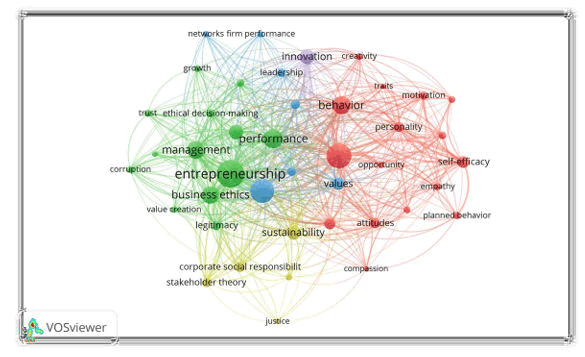
Figure 2: Scientific keyword map.
Research Area
Table 3 shows the number of articles published in different areas of knowledge. The selected WOS database contains 1343 articles, distributed as follows: 598 in business; 375 in ethics; 157 in management; 148 in economics; and the rest in other areas related to sociology and psychology. Consequently, ethics and entrepreneur is an outstanding topic in business reviews (Figure 3).
| Ranking |
Research areas |
Number of publications |
% |
| 1 |
Business |
598 |
44 |
| 2 |
Ethics |
375 |
29 |
| 3 |
Management |
157 |
12 |
| 4 |
Economics |
148 |
11 |
| 5 |
Sociology |
28 |
2 |
| 6 |
Applied psychology |
37 |
2 |
Table 3: Research areas.
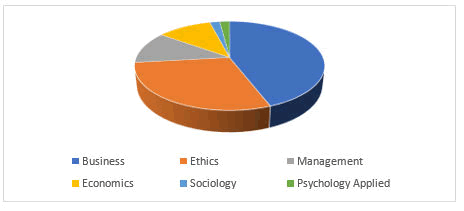
Figure 3: Research area.
Journals
Our aim is also to identify the journals that channel the main publications in this field of research. The analysis is based on the Journal Citation Reports (JCR), which is the best known and most rigorous indicator in terms of its structuring and evaluation by the scientific community (Table 4).
| Ranking |
Journals |
No. publications |
Impact factor |
| 1 |
Journal of Business Ethics |
178 |
4.141 |
| 2 |
Journal of Business Venturing |
17 |
7.59 |
| 3 |
Business Ethics A European Review |
14 |
7 |
| 4 |
Management Decision |
11 |
2.723 |
| 5 |
Business Society |
8 |
5.03 |
| 6 |
Harvard Business Review |
8 |
5.694 |
| 7 |
Small Business Economics |
8 |
4.803 |
| 8 |
International Small Business Journal Researching Entrepreneurship |
7 |
7.22 |
| 9 |
Organization |
7 |
2.619 |
| 10 |
Technological Forecasting and Social Change |
7 |
5.84 |
| 11 |
Business Ethics Quarterly |
6 |
2.625 |
| 12 |
Journal of Business Research |
6 |
4.874 |
| 13 |
Journal of Management |
5 |
8.852 |
| 14 |
Journal of Small business Management |
5 |
3.461 |
| 15 |
Journal of Small Business Management |
5 |
3.461 |
Table 4: Journals that have published research on ethics and entrepreneur.
We have collected the top 15 journals that, according to WOS, are the main catalysts of this field of research. We highlight the three magazines at the top of this ranking, the first one is the Journal Business Ethics, with 178 publications and an impact factor of 4.141. Secondly, the Journal of Business Venturing, with 17 publications and an impact factor of 7.590. In third place, Business Ethics-A European Review, with 7 publications and an impact factor of 7.
The Journal of Business Ethics currently publishes articles with methodological and disciplinary perspectives on ethical issues related to business that contribute with something new or unique to the field of research. Our analysis demonstrate that this journal is the main catalyst for ethics and entrepreneur, since it contains the largest number of publications.
Authors
In this section we will identify the main authors who are leading research in this research area, according to the WOS search panel.
Table 5 shows the main authors, with the number of citations and the H-index (h-index). Table 5 shows the main authors, with the number of citations and the H-index (h-index). This index allows us to measure the scientific production of the authors, in first place we find Kraus, Sascha (h=41, meaning that the 41 published articles have been cited at least 41 times), in second place we have Wincent, Joakim (h=34) and in third place we have Linan, Francisco (h=24). In our study the author with the highest Hirsch index is Kraus, Sascha; nevertheless, Fassin Yves has the highest number of citations.
This author but does not occupy the first position in the H index, this may be due to the fact that Kraus, Sascha also publishes in other research areas.
| Ranking |
Authors |
No. publications |
Total citations |
H-index |
| 1 |
Fassin, Yves |
6 |
338 |
14 |
| 2 |
Wincent, Joakim |
6 |
155 |
34 |
| 3 |
Kraus, Sascha |
6 |
111 |
41 |
| 4 |
Linan, Francisco |
6 |
88 |
24 |
| 5 |
Muralidaharan, Etayankara |
6 |
77 |
3 |
| 6 |
Pathak, Saurav |
6 |
77 |
14 |
| 7 |
Liang, Chaoyun |
3 |
64 |
15 |
Table 5: Authors and publications in ethics and entrepreneur.
Countries
Figure 4 shows that from 1987 to the present time, the USA occupies the first position concerning the number of publications in this area of research, followed by the United Kingdom and Australia. The difference in the number of publications concerning the other countries is probably because most of the JCR journals are from the USA or the UK.
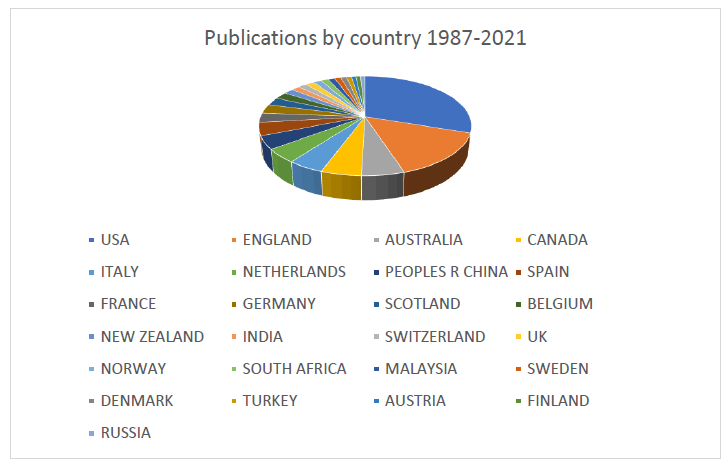
Figure 4: Countries in which research on ethics and entrepreneur has been published.
Conclusion
This bibliometric analysis confirms that the evolution of this area of knowledge is increasing as demonstrated by Vallester et al., in similar studies. In addition, after analyzing 1343 publications, we have shown the main keywords that predominate in the existing literature regarding the link between ethics and entrepreneur during the period under study. We can highlight five major groups of research: Entrepreneurship (growth, trust, ethical decision making, performance, corruption, business ethics, value creation, management, legitimacy), behavior (personality, creativity, traits, motivation, opportunity, self-efficacy, empathy, attitudes, compassion, planned-behavior), stakeholder’s theory (corporate social responsibility, sustainability, justice), networks (networks firm performance, leadership, values) and innovation. We have also identified the main journals, authors, publication area, and countries. We found that the Journal Business Ethics is the publication with the highest number of articles about ethics and entrepreneur. Yves Fassin is the most prolific author. Regarding the publication area, business is the one with the highest number of articles. Finally, the country where most of the publications are concentrated is USA, followed by the United Kingdom and Australia. We expect that all this information may be relevant for those researchers who investigate this field of research.
Limitations and Future Lines of Research
The present investigation has some limitations. Firstly, the analysis of the keywords considered in this study could be expanded to a larger number, due to the high dispersion about entrepreneur that exists in the literature. The second limitation is related to the time period. Effectively, given the growing interest in the topic and the number of contributions, the results of this study should be updated frequently.
Having in mind the main topics on which this field of research is concentrated, it would be interesting to investigate in greater depth the study of the ethics of entrepreneurs (morality, ethics and (dis)honesty), since we have detected that this knowledge area is in an emerging state, so there are many research possibilities.
Author Contributions
Azucena Martín-Quevedo performed writing-original draft and conceptualization. Elena Urquía-Grande and David Pascual-Ezama performed writing-review.
References
- Barirani A, Garofalo O (2018) Entrepreneurship and dishonesty: An experimental study. J Bus Ethics Res.
- Baron R, Zhao H, Miao Q (2015) Personal motives, moral disengagement, and unethical decisions by entrepreneurs: Cognitive mechanisms on the ‘Slippery Slope.’ J Bus Ethics. 128:107–118.
[Google Scholar]
- Baucus MS, Cochran PL (2009) An overview of empirical research on ethics in entrepreneurial firms within the United States. Afr J Bus Ethics. 4:56–68.
[Crossref] [Google Scholar]
- Bornstein D (1998) Changing the world: Social entrepreneurs and the power of new ideas. Soc Entrep. Oxford University Press.
- Boschee J, McClurg J (2003) Toward a better understanding of social entrepreneurship: Some important distinctions. Soc Entrep Rev.
- Brouard F, Larivet S (2010) Essay of clarifications and definitions of the related concepts of social enterprise, social entrepreneur and social entrepreneurship. InHandbook of Research on Social Entrepreneurship.
[Crossref] [Google Scholar]
- Bull I, Willard GE (1993) Towards a theory of entrepreneurship. J Bus Ventur. 8(3):183–195.
[Crossref] [Google Scholar]
- Cassis Y, Minoglou I P (eds.) (2005) Entrepreneurship in theory and history. Palgrave Macmillan.
- Catford J (1998) Social entrepreneurs are vital for health promotion but they need supportive environments too. Health Promot Int. 13:95.
[Google Scholar]
Citation: Quevedo AM, Grande EU, Ezama DP (2025) A Bibliometric Analysis of the Ethics of Social and Commercial Entrepreneur.
Br J Res. 12:142.
Copyright: © 2025 Quevedo AM, et al. This is an open-access article distributed under the terms of the Creative Commons
Attribution License, which permits unrestricted use, distribution, and reproduction in any medium, provided the original author
and source are credited.