Research Article - (2025) Volume 9, Issue 1
Interplay between Climate Change and Anthropogenic Impacts in Shaping Phytoplankton Community in Subalpine Lake: A Case Study from Italy
Speranza Claudia Panico1*,
Alessandro Pedretti1,
Damiano Virgilio2 and
Guido Incerti1
1Department of Agri-Food, Environmental and Animal Sciences, University of Udine, Udine, Italy
2Department of Biological Oceanography, National Institute of Oceanography and Sperimental Geophisics, Via A. Piccard 54, 34010 Trieste, Italy
*Correspondence:
Speranza Claudia Panico, Department of Agri-Food, Environmental and Animal Sciences, University of Udine, Udine,
Italy,
Email:
Received: 11-Nov-2024, Manuscript No. IPJAPT-24-21953;
Editor assigned: 14-Nov-2024, Pre QC No. IPJAPT-24-21953 (PQ);
Reviewed: 28-Nov-2024, QC No. IPJAPT-24-21953;
Revised: 04-Mar-2025, Manuscript No. IPJAPT-24-21953 (R);
Published:
28-Mar-2025, DOI: 10.36648/2581-804X.9.1.38
Abstract
Context: Phytoplankton is a crucial component of limnic ecosystems as being the foremost representative of primary producers, then sustaining the whole trophic network. The aim of this study is to evaluate the effects of changing environmental conditions, in the period 2011-2023, on phytoplankton community’s structure and successional dynamics in a temperate-meso/eutrophic-lake in NE Italy.
Methods: Single taxa and diversity metrics based on biovolume data were related to physicochemical variables (temperature, pH, electrical conductivity and dissolved oxygen) along the water column, and concentrations of macronutrients (nitrite, nitrites and phosphorus) and herbicides (2-hydroxyatrazine, 2-hydroxy-terbuthylazine, desethylterbuthylazine, terbuthylazine, metolachlor and metolachlor ESA) collected on a monthly base for the 12-years period.
Results: The results showed that seasonal physicochemical dynamics and nutrients loading were the principal variables affecting the annual cycling of phytoplankton community composition. Different responses to herbicides loads were found for different functional guilds.
Interpretation: The expected succession, characterized by diatoms dominance in the cold season, did not match completely the pattern found at the study site. Rather, a local dominance of Cryptophyceae in winter was related to a high competitivity and tolerance to eutrophication. Considering impacts by herbicides, sensitive groups such as Cryptophyceae and Euglenophyceae dominate the phytoplankton community at low herbicides loads. When loadings increase, following resuspension from sedimental deposits after anoxic conditions enhanced by increasing temperature, more tolerant and competitive groups emerge such as Cyanophyceae and Dinophyceae.
Conclusion: Given the importance of phytoplankton’s community for the ecological assessment of water quality evaluation in lakes and water reservoirs, our study provides a relevant contribution towards the full understanding of the interplay between climate warming and anthropogenic impacts along the phytoplankton ecological succession.
Keywords
Macroutrients; Herbicides; Cryptophyceae; Eutrophic lakes; Diversity index
Introduction
Water ecosystems, covering 75% of Earth's surface, are classified by factors such as salinity, depth, substrate, hydrodynamics, and biodiversity. Morainic lakes, forming in glacier-eroded basins, are a type of lentic limnic system [1].
In temperate morainic lakes phytoplankton is at the base of the food web, and as such it is a crucial component in the set of parameters measured to draw information about the lake ecological quality from monitoring data. A yearly succession of specific phytoplankton assemblages occurs under specific conditions, including a winter and spring dominance of diatoms in cold and clean waters with silica and nutrient availability, then substituted by Cryophytes following silica depletion and increasing temperature in late spring. In summer dinoflagellates and other green algae commonly spread, progressively substituted by cyanobacteria in latesummer and fall. Although this general scheme is consistent across different lakes, variations in the community structure and composition can decisively depend on eutrophication, particularly in shallow waters [2]. As an example, high nitrogen and phosphorus concentration can cause blooms of diatoms or cyanobacteria, reducing light penetration, changing the photic depth and the temperature pattern along the water column, harming the ecosystem [3].
In this paper, we selected as a case-study the Ragogna lake, a temperate morainic, lake in NE Italy. Being included in the Natura 2000 protected areas network, the study lake is routinely subject to chemical, physical and biological monitoring by the Local Environment Agency (ARPA FVG). Here, biotic data are presented and related to physicalchemical variables and concentrations of macronutrients and herbicides, collected for the period 2011-2023. The aim is to improve knowledge of the phytoplankton community’s structure and successional dynamics, as they emerge from the complex interplay between cyclic seasonal pattern, climate change and anthropogenic impacts.
Materials and Methods
A detailed overview of the study lake is reported elsewhere [4]. Geographical coordinates of the sampling site at which all data were collected are N: 46°10’34’’; E: 13°00’09” (Map Datum WGS84).
The following standards and instruments were used to: i) Design the sampling program (EN ISO 5667-1), ii) Assure the quality of the assessment and determine phytoplankton abundance and diversity: EN 15204:2006, iii) After observation with inverted microscope EclipseTE2000-S (Nikon Co, Tokyo, Japan), following the WISER method, iv) Preservation and handling of samples (EN ISO 5667-3). Taxonomic identification was done according to previous studies, and references therein. Concentrations of total phosphorus, nitrate, ammonium, and nitrous nitrogen in water samples were assessed according to the standards UNI 11757:2019 and APAT CNR IRSA 4110, 4030 and 4050, respectively [5,6]. Herbicide content in water was as-sessed according to ISO 11369:1997 for the following chemicals: 2-hydroxyatrazine (2-HydAtr), 2- hydroxy-terbuthylazine (2-HydTer), Desethyl-Terbuthylazine (DesTer), Terbuthylazine (Ter), Metolachlor (Met), Metolachlor ESA (MetESA) by solid phase extraction followed by LC-MS. Finally, a multi-parametric probe (AQUAREAD AP2000-D, Broadstairs, UK) was used to measure water Temperature (T), Electrical Conductivity (CEC), pH, Dissolved Oxygen (DO) and Oxygen Saturation (SO) at regular depth (± 1 m) intervals along the water column at the time of phytoplankton sampling.
Results
Physical-chemical time-series showed the pattern expected for temperate lakes (Figure 1). T, DO and SO were negatively related with depth, decreasing towards the bottom.
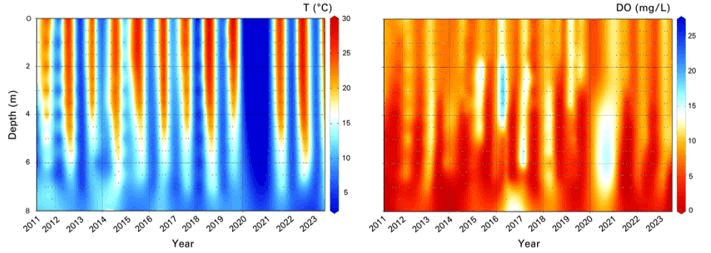
Figure 1: Time-series of temperature (left) and dissolved oxygen (right) along the water column.
Nutrient content (Table 1) showed an opposite trend between N, showing minimum in summer, and P, peaking in the warmest months. Herbicides showed different trends: 2- HydAtr peaked at of 0.1 μg/L between winter and summer of 2017 and in winter 2022, Ter and derivatives (2-HydTer, DesTer) in summer 2021, with a maximum DesTer value of 0.26 μg/L [7]. Met showed a maximum value of 0.32 μg/L in 2017 and a minimum of 0.02 μg/L in 2022.
| Nutrient |
Winter |
Spring |
Spri-Sum |
Summer |
Sum-Fal |
Fall |
| P tot |
21.8 ± 5.0 |
21.3 ± 4.9 |
17.6 ± 8.8 |
26.7 ± 10.2 |
39.9 ± 9.6 |
20.0 ± 3.7 |
| NO2-N |
0.05 ± 0.04 |
0.07 ± 0.04 |
0.09 ± 0.04 |
0.01 ± 0.01 |
0.02 ± 0.01 |
0.08 ± 0.05 |
| NO3-N |
4.84 ± 1.47 |
4.78 ± 1.55 |
4.26 ± 1.07 |
1.19 ± 0.55 |
0.99 ± 0.10 |
4.09 ± 1.30 |
Table 1: Seasonal nutrient content in water samples (mean and SD for the period 2011-2023).
Community composition was different between cold and warm seasons (Figure 2). Cryptophytes dominated most of winter, spring and fall samples, being in some cases substituted by crysophytes and chlorophytes. Summer and some spring and fall samples were dominated by chlorophyceae, cyanobacteria and dinoflagellates.
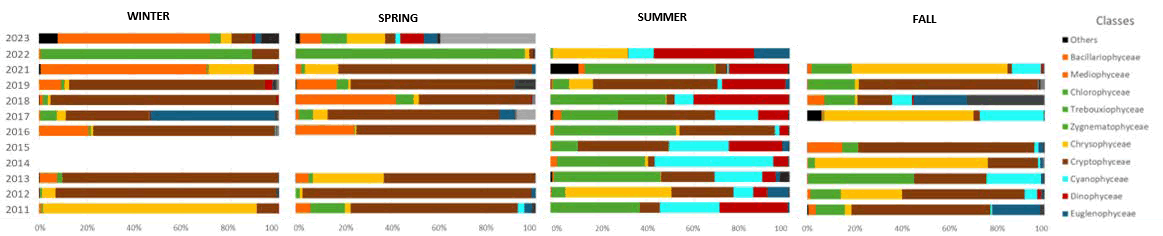
Figure 2: Time-series of phytoplankton community composition across seasonal periods.
The PCA (Figure 3) revealed sample distribution along a temperature gradient on the first axis. Phytoplankton diversity metrics (excluding total abundance) positively correlated with this gradient. Conversely, DO, SO, and CEC showed negative associations with temperature. Nitrite and Nitrate-N were negatively linked to temperature, while P showed the opposite trend. The second PC axis correlated positively with total phytoplankton abundance (BV) and negatively with herbicide concentration, with varying responses along the first axis.
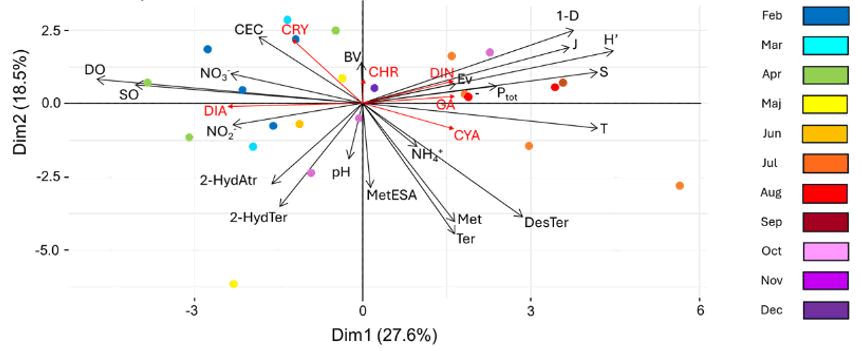
Figure 3: PCA biplot showing samples (dots) spreading in the ecological space of water properties (black vectors). Phytoplankton classes are also shown as supplementary variables (red vectors).
Discussion
Phytoplankton community at the Ragogna lake developed in a nutrient-rich environment, ranging between meso and eutrophic conditions across the 12-years observation period. In these conditions, the expected successional pattern is a cyclic yearly model in which, following seasonal variations, the dominant functional group shifts following the sequence: Diatoms–Chrisophyceae–Dinoflagellates, Cyanophyceae– Diatoms, Zygnematophyceae under meso-eutrophic conditions, while in eutrophic conditions the Diatoms– Chlorophyceae–Cyanophyceae–diatoms pat-tern is expected [8]. At our study site we found important differences from such expected patterns, with cryptophytes largely dominating in winter and spring, and in some cases also in fall, likely related to higher competitiveness at higher nutrient loadings of this groups as compared to diatoms [9]. In summer the observed pattern, with high abundance of Cyanophyceae, Dinophyceae and Chlorophyceae substantially confirmed the expectation. Cryptophytes are known for their sensitivity to pollutants, herbicides in particular. Indeed, they showed minimum abundance in fall and winter 2017, in correspondence to peaks of 2-hydroxyatrazine (0.9–0.12 μg/L) and 2-hydroxyterbuthilazine (0.3–0.4 μg/L), and in winter data of years 2021, 2022, and 2023 (0.8–0.12 μg/L). In such conditions Cryptophytes were differently replaced according to nutrient concentration, respectively by diatoms at low (winter 2022: 0.75 mg/L), by chrisophytes at medium (winter and fall 2017: 2.1–2.8 mg/L) and by Chlorophyceae at high (winter 2021 and 2023: 3.5 mg/L) total N content.
A 2-hydroxyatrazine decreasing trend was expected since its use was banned in Italy since 1990. However, we found a different pattern, with recent peaks. It can be associated to a release from sediment deposits. Indeed, pesticides, as well as P, can adsorb on organic rich matter and being released under anoxic conditions at high temperature. We found summer temperature peaks near the lake bottom that corresponded with the highest P values and suboxic conditions (DO<2 mg/L).
Conclusion
This study highlights the intricate nature of lake ecosystems, where various factors influence the structure and development of phytoplankton communities. While temperature and seasonality have significant effects on phytoplankton diversity, local characteristics also play a crucial role in shaping succession dynamics. Specifically, the interaction between herbicide deposition, thermal conditions, and nutrient levels at the lake bottom is emphasized. Understanding these factors is essential for assessing ecological water quality in lakes, making this study a valuable contribution to the field.
References
- Colizza E, Fanzutti GP, Pugliese N (1989) The diffusion of ostracode fauna in Lake Ragogna (Friuli, Italy). J Integr Biol. 13(1).
[Google Scholar]
- Edler L, Elbrachter M (2010) The Utermohl method for quantitative phytoplankton analysis. Mi-croscopic and molecular methods for quantitative phytoplankton analysis. 110:13-20.
[Google Scholar]
- Carvalho L, Poikane S, Solheim L (2013) Strength and uncertainty of phytoplankton metrics for assessing eutrophication impacts in lakes. Hydrobiologia. 704:127-140.
[Google Scholar]
- Guiry MD, Guiry GM, AlgaeBase (2023) Worldwide electronic publication, National Univer-sity of Ireland, Galway.
- Reynolds CS, Huszar V (2002) Towards a functional classification of the freshwater phytoplankton. J Plankton Res. 24:417-428.
[Google Scholar]
- Knauert S, Boller T, Sigg L (2008) Toxicity of pesticides and their mixture to primary producers. University of Basel.
[Google Scholar]
- Spears BM, Carvalho L, Perkins R (2007) Sediment phosphorus cycling in a large shallow lake: Spatio temporal variation in phosphorus pools and release. Hydrobiologia. 584:37-48.
[Google Scholar]
- Thakkar M, Randhawa V, Wei L (2013) Comparative responses of two species of marine phytoplankton to metolachlor exposure. Aquat Toxicol. 126:198–206.
[Crossref] [Google Scholar] [PubMed]
- Zdorovennova G, Palshin N, Zdorovennov R (2016) The oxygen regime of a shallow lake. Geogr Environ Sustain. 9:47–57.
[Google Scholar]
Citation: Panico SC, Pedretti A, Virgilio D, ncerti G (2025) Interplay Between Climate Change and Anthropogenic Impacts in Shaping Phytoplankton Community in Subalpine Lake: A Case Study from Italy. J Aqua Pollut Toxicol. 9:38.
Copyright: © 2025 Panico SC, et al. This is an open-access article distributed under the terms of the Creative Commons Attribution License, which permits unrestricted use, distribution, and reproduction in any medium, provided the original author and source are credited.