Research Article - (2025) Volume 5, Issue 1
Can ERPs and Neural Oscillations Be Used to Differentiate Skilled and Unskilled Player Performance in an Ecologically Valid Sporting Model?
Mike Winstanley1* and
Barry Drust2
1Department of Psychology, University of Birmingham, Birmingham, UK
2Department of Sport, Exercise and Rehabilitation Sciences, University of Birmingham, Birmingham, UK
*Correspondence:
Mike Winstanley, Department of Psychology, University of Birmingham, Birmingham,
UK,
Email:
Received: 14-Nov-2024, Manuscript No. JCNB-24-21984;
Editor assigned: 18-Nov-2024, Pre QC No. JCNB-24-21984 (R);
Reviewed: 03-Oct-2024, QC No. JCNB-24-21984;
Revised: 13-Mar-2025, Manuscript No. JCNB-24-21984 (R);
Published:
21-Mar-2025, DOI: 10.36648/JCNB.5.1.37
Abstract
This study aimed to identify neural correlates of high performance in ecological valid, sporting tasks and quantify the differences between high skilled and low skilled players. To do this, Esports was chosen to be the sporting model to facilitate clean brain activity recordings whilst playing sport, something that is considerably more challenging with traditional sports. Participants were first separated into a skilled or unskilled group based on their Esports performance using objective classification measures to identify the presence of a higher and lower performing groups. Their brain activity was then recorded as they completed a visuomotor psychophysics task and Esports aimtraining tasks. The first task required discrete movements, the second sequential movements. Results indicated that there are several key differences in the brain activity of skilled players that facilitate a higher level of performance. Firstly, skilled players display enhanced response in time-domain activity of occipital parietal electrodes, displaying significantly higher p100 amplitude (sensor-space) and higher p300 amplitude (source-space). Peak decoding using MVPA, classifying brain activity between skilled or unskilled players, is achieved during the first 300 ms of the response. Furthermore, skilled players modulate visual attention, gated by alpha oscillations, to release the visual system before target onset. As a result, visual information is consciously accessed more readily to be utilized for a motor response. Skilled players show an increase in frontal-midline theta during Esports performance facilitating management of cognitive load and repeated execution of precise movements. Due to the nature of the model, applied implications are suggested for both coaches and athletes of all sports to utilize this research. Specifically, performance improvement of players could be facilitated by identifying deficits in their brain activity and talent identification, by observing the neural correlates reported in developing players. Future research should focus on adapting evoked, rather than induced, brain activity recording during Esports competition.
Keywords
Esports; MVPA; Neural oscillations; Genome; Human
Introduction
Elite sport forces humans to seek the pinnacle of physical and cognitive performance, making it an interesting phenomenon of human behaviour. Understanding how brain activity relates to performing high-skill motor tasks required in sport, is fundamental to developing better training and development strategies. Due to the nature of many traditional sports, recording from the brain has been virtually impossible. This is due to several factors such as: Amplifier dependence, movement (and saccade) artefacts and physical contact with the electrodes. Furthermore, considering the nature of human bipedal movement, it is very difficult to isolate the neural computations behind movement if as many as four limbs are moving at once. If one considers any type of sporting movement, each limb might have a collective but independent contribution. For example, kicking a ball requires not just the leg that kicks it to be moving with precision, but the standing leg to provide stability and arm movements to provide balance. In movements such as these, it becomes more difficult to delineate brain activity related to the movement in question since its origins are unclear. Isolating the contributions of the brain to execute this movement, without the associated noise of balancing movements is difficult and provides a good example of the challenges within sport neuroscience.
Within science, models are ubiquitously used to overcome different challenges with the research focus. In biological sciences, one might use a representational model to overcome the issues with conducting certain experiments on humans. This approach might give significant biological advantages over human models, beyond simply the ethical considerations. For example, zebrafish provide an interesting model for developmental biology due to their transparent embryos or for genetics, drosophila having a simple, manipulatable genome. Lessons, rules, and processes present in these models can then be applied to humans, having utilized the differences present in the model that made the experiments easier.
To build the said model in a sporting context, one must consider two things: Brain activity and sporting ecological validity. However, satisfying both demands is not possible with traditional sport and is where Esports can be helpful. A new sport, Esports combines several different types of video games, played in a competitive way. Esports has recently emerged as the world’s fastest growing sport with worldwide participation at an amateur level, and global intrigue at a professional level. Organisations have emerged to bring together rosters of elite players, travelling the world to compete against each other for large prize pools. At the highest level of competition, players sit at a computer and play their specific game competitively against opposing players, within the various formatting constraints of the sport. This high level of competition is conducted in a strikingly similar way to the standard approach within cognitive electrophysiology, making Esports a useful model to study brain activity, specifically, neural oscillations implicit in high performance within sport. The sport is not played outside, in uncontrollable conditions, does not containing physical contact with other players nor require full body, high velocity movements. Therefore, the data recorded is significantly less noisy than with other, traditional sports. Furthermore, external environmental variables are also heavily controlled, something significantly more difficult in traditional sports. All in-game environmental information is fundamentally limited to what is on the screen, narrowing visual search to a precise, measurable area. Opposition movements can also be precisely controlled, constrained, or made to be precisely reproducible every time. All these external variables are not present or can be precisely controlled in Esports, an advantage not possible with other sports.
Behaviourally, VGPs performed better through greater speed and accuracy than novices in target detection paradigms which was associated with a larger amplitude, target-elicited p300 component in VGPs [1]. Further evidence for both p200 and p300 amplitude increases in parietal networks have been found after video game training, specifically induced by playing FPS [2]. However, the p2/300 components, commonly associated with cognitive workload, show a negative correlation with game difficulty in expert VGPs [3]. From the variety of evidence, attentional ERP components seem to be modulated by player status (game played and expertise) and by the training intervention used. It is important to note, that whilst neuroimaging research on Esports is so far limited, more work has been done on Video Games (VG) play. Since Esports are a competitive format of video game play, the research is still appropriate here. Brain activity within Esports/VGs has so far focused predominately on the role of theta frequency band, showing increases to frontal theta power during VG play compared to rest periods [4]. Theta power increases as a function of rounds progressed and increases prior to the onset of feedback informing that a round has been successful [5]. In an older population, traditionally those who have a limited relationship with VGs but especially Esports, VG play has been shown to significantly increase theta power which was correlated to performance improvements on a plethora of cognitive tests [6]. By giving participants in two different age groups, young and old, a battery of cognitive tests, baseline performance could be calculated. The authors then used a VG intervention, challenging participants with a VG that harness precise movements and spatial tests to achieve a good score in the game. During this period, theta power increased, and subsequently correlated to an increase in performance on cognitive tests in the older population, who were inexperienced with VGs.
Materials and Methods
Participants
For this study, 37 participants (15 male, 12 female) took part in the experiment. 36 of these were students at the University of Birmingham and one was a Marine (UK Armed Forces). Of the participants, 19 were classified as skilled players and 18 were classified as unskilled players based on the methods described above. After reporting Esports playing time based on a self-report questionnaire, populations were determined based on Esports experience only. Players who played videogames, whichever input modality, but not Esports, were determined to be inexperienced. After completing various Esports and psychophysics tasks, their performance on these tasks was used to perform k-means clustering and identify clusters of similarly performing player groups. Silhouette scores determined that two clusters were optimal, and players were classified based on their cluster. Their previous experience was not included as part of the classification process. All participants were right-handed, didn’t wear glasses and had no history of neurological disorders. Crucially, all participants reported some experience with video-games.
Experimental Procedure
All psychophysics experiments were created using SR Research experiment builder to accurately co-register with the eye-tracker and stimulus pc. In each experiment, a fixation cross began the trial by being present for 1000 ms localizing eye fixation to the centre of the screen. After the fixation period was over, the mouse location was set to the centre of the screen and the response target, a visual stimulus, would appear on the screen. The target was a small black square, projected on a white background to maximize contrast. Participants would then have 1000 ms after stimulus onset to move the mouse to the target and click on it, with only clicks registering within the target boundary being registered. The reaction time, calculated from stimulus onset to a successful click, was recorded, as well as the number of failed trials, reported as errors. If the trial was successful, a blank screen was present for 500 ms. If the trial was failed because a successful click wasn’t registered within the 1000 ms this would be recorded as an error and a message reading “Failure, Move Faster!” would appear on the screen in bold red lettering. After 500 ms of this message being present, another trial would begin, denoted by the fixation cross reappearance. Before each block, participants would receive instructions and complete eye-tracker calibration steps. There were three different blocks, with each block using a different target size decreasing by 10 pixels squared each block (30 × 30 pixels to 10 × 10 pixels). All targets remained the same colour throughout and occurred at a set number of locations (20 left and 20 right, 10 centre) (Figure 1).
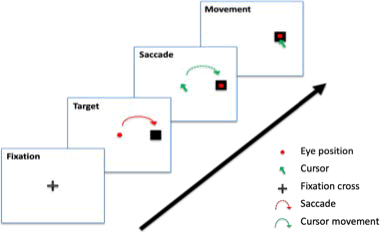
Figure 1: Experimental design for the experiment displaying the fixation period, stimulus onset, eye movement and cursor movement.
Eye-tracking
Eye-movements were recorded using an Eyelink 1000 plus (SR Research), with eye-tracking calibration steps performed before all experimental blocks before the delivery of tasks instructions. To quantify eye-movements during the study, SR research’s data analysis tool, Data Viewer was used. This facilitated the identification of saccade, fixations, and trial reports. Due to the experimental coding being in another data package from SR research, all trials ported over contained the necessary trial condition information such as the target size, location, and calibration reports. To identify eye-movements exclusively during the trial period, a reaction time variable could be initialized which marked the moment of stimulus onset, detected by the time the host pc received the stimulus onset trigger (the same trigger received by the EEG amplifier) to the moment it received the outcome trigger, either success or failure. As such, only eye-movement event-locked to the stimulus onset were included in analysis. Saccades below 1 degree were excluded from analysis.
EEG Recording and Analysis
The data was acquired using a 64-channel EEG (BioSemi) and processed using MNE – python toolbox. The data was subjected to a number of pre-processing and processing steps. Briefly, noisy sensors were first removed and interpolated by RANSAC algorithm. Then the data was down sampled to 200 hz to reduce computation time. After down sampling, events were marked depending on population (skilled or unskilled), event (stimulus onset or response) and outcome (success or failure). From here the data was passed through the AutoReject algorithm to reconstruct and drop extremely noisy epochs before being passed to the ICA algorithm which allowed for artefact detection and removal. Then the data was passed for a final time to AutoReject to reconstruct any remaining noisy epochs and drop any that still didn’t pass the threshold (a lower threshold than the first AutoReject pass). At this point, the now clean data was filtered from 1-30 Hz (high and low-pass) and average referenced. Epochs from this position could finally be averaged together to form evoked objects, or grand average ERPs, per population, event, and outcome.
In the Esports task, induced activity was recorded. To identify game durations, a trigger was sent at the beginning of the video recording elements. This trigger was recorded in the message log of Weblink and could then be used to isolate the time in the video when the task began. By subtracting the offset between when the trigger was received by the eye-tracker, from the task start, this could serve as the initial crop point. Each task lasted for 60s, so the crop end time was calculated as the task start time +60s. Each file was read in individually and cropped according to the trial start and end time.
Time-Domain Analysis
To identify the visual stimulus related component of ERPs, occipital parietal electrodes were grouped and plotted as ERPs, event locked to stimulus onset, depending on the outcome. Stimulus onset events that were followed by events of interest were defined using the function ‘define_target_events’ allowing for new events to be created if a target event follows the original event, within a certain time-window. This allowed stimulus onset events during success trials, and stimulus onset during failure trials, to be identified separately and compared.
Frequency-Domain Analysis
With clean and pre-processed data, Morlet waveform analysis was applied to frequencies of interest. In this experiment, the frequency ranges used were theta (4-7 Hz), alpha (8-12 Hz), low beta (13-21 Hz) and high beta (22-30 Hz), calculating individual frequencies in steps of 1 Hz. To define the number of cycles, the frequency range was divided by 2 and fast Fourier transform was applied. Power for each frequency was then averaged.
Statistical Analysis
Statistical analysis was conducted differently depending on the type of data, behavioral data and outputted measurements of time/frequency elements, were analyzed using Prism (GraphPad). Examples of this are behavioral performance, eye-tracking, ERP measurements and power estimates. Statically analysis of complex time/frequency elements were analyzed using MNE-Python. To establish a statistical relationship between time/frequency elements, outcome, and population, peak measurements of grand averages and averaged power estimates were made. These measurements were then statistically analyzed using a 2-way ANOVA comparing
Population × Outcome, corrected for multiple comparisons using Tukey’s post-hoc test. 1-D cluster-based permutation statistics were calculated for difference waves, testing deviation from zero. An F-value threshold of 6 was used to determine a significant cluster.
Source Localization
To achieve source localization several different techniques were used to estimate both activation and power changes in the source space. To compute all solutions, a forward model was created using the standard template MRI subject fsaverage (FreeSurfer). Using Dynamics Imaging of Coherent Sources (DICSs), a volumetric forward model was created. To do this the template MRI was used to construct Boundary Element Model (BEM) using a three-shell model (brain, inner and outer, skull). To calculate source activations, dynamic Statistical Parameter Mapping (dSPM) was created. This uses the minimum norm or weighted minimum norm inverse operator by normalizing its rows. To calculate event-related source power changes the DICS method was used with the volumetric forward model. Cross-spectral density was calculated for each frequency band using Morlet waveform transformations using a baseline covariance matrix (pre-trial) and an active covariance matrix (during trial), in this case, the baseline was set 1.5-1 s prior to the pre-stimulus fixation cross period, where a blank screen was present after the termination of the outcome message.
Results
The behavioural results indicated that there is not a significant interaction between target size and population with reaction time (F(2,72)=0.3235, p=0.7247), however there is a significant interaction between target size and population with error index (F(2,72)=9.457, p=0.0259). Skilled players displayed faster average reaction times (F(2,36)=19.76, p=0.0911) in relation to unskilled players, although the lack of significant interaction does not justify post-hoc comparisons. The number of failed trials, referred to as errors, was used to create an error index. The likelihood of a player to make an error, was significantly different in skilled players compared to unskilled players (F(2,36)=19.76, p=<0.0001). Tukey’s multiple comparison post-hoc test indicated significant differences at all target sizes, from 1 to 3 (p=0.0005, p=0.0002, p=0.0016, respectively). Skilled players made significantly fewer errors and thus had a significantly small error index than unskilled players across all target sizes. In the correlation analysis there is a significant correlation between the two performance variables across the combined population (p-value=0.0029). There is a strong positive relationship between reaction time and error index (r=0.4647, p=0.0029). Skilled players showed a significantly better behavioural performance by demonstrating a faster reaction time and fewer errors, two variables that are strongly correlated. Eye-tracking results indicate a difference in execution between skilled and unskilled players (EP and NEP). There was a significant interaction between Population and Target size in the Saccade latency (F(5,216)=3.045, p=0.0112. There was also significance in population difference (F(1, 216)=15.24, p=0.0001) and a significant difference across all target sizes (F (5,216)=88.31, p<0.0001). When correcting for multiple comparisons there are significant differences in saccade latencies across with p-values of 0.0032, 0.0059, 0.0394 for sizes 1, 2, 3 respectively. There is not a significant interaction between population and target size in average saccade velocity (F(5,216)=1.824, p=0.1094). There is not a significant difference across populations (F(1,216)=0.2281, p=0.6334) but there is a significant difference across outcomes/target size (F(5,216)=23.47, p<0.0001) (Figure 2).
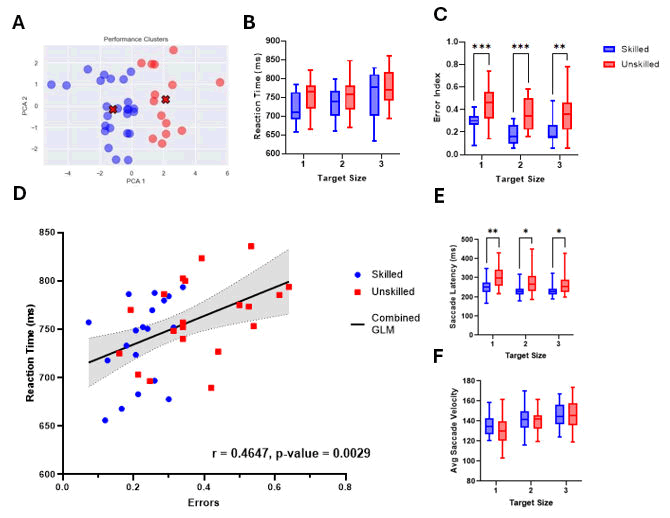
Figure 2: Behavioural and eye-tracking performance across psychophysics tasks. A) The classification output of k-means clustering on Esports performance data, identifying two distinct groups. B) Reaction time psychophysics task depending on target sizes (1=large, 2=medium, 3=large) with skilled players in blue and unskilled players in red. Upper and lower range are shown and box size represents standard deviation. C) Box plot of reaction time depending on target size. Box plot showing error index depending on target size. D) Correlation between reaction time and error index with general linear model plotted in black and error bars coloured in grey. E) Box plots displaying the time to first saccade across populations during the psychophysics task. F) The average saccade velocity of saccades across populations during the psychophysics task. Statistical analysis in box plots is 2-way ANOVA corrected for multiple comparisons using Tukey with significant comparisons marked (*=0.01, **=0.001, ***=0.0001).
Grand average ERP from occipital parietal electrodes shows a number of similarities at the sensor space level. The major difference comes around 100-200 ms after stimulus onset with a much stronger p100 present in skilled players. The difference wave plots and subsequent 1-D cluster permutation statistics, display a significant difference period in skilled vs. unskilled players between 100-150 ms after stimulus onset in successful trials, but no significant difference periods afterwards, although a post threshold, sub significant, peak occurs at 400-450 ms. In the failure trials, an above-threshold, but insignificant peak occurs between 100-150 ms after stimulus onset, but no significant difference is detected comparing skilled and unskilled players. The source amplitude changes are plotted to transform sensor space voltage changes to the source space. Within both populations, differences in source amplitude are present between outcome conditions, with a greater amplitude occurring in successful trials occurring 300 ms after stimulus onset. The peak source amplitude is higher in skilled players compared to unskilled players; however, no detectable differences occur in the failure outcome between populations (Figure 3).
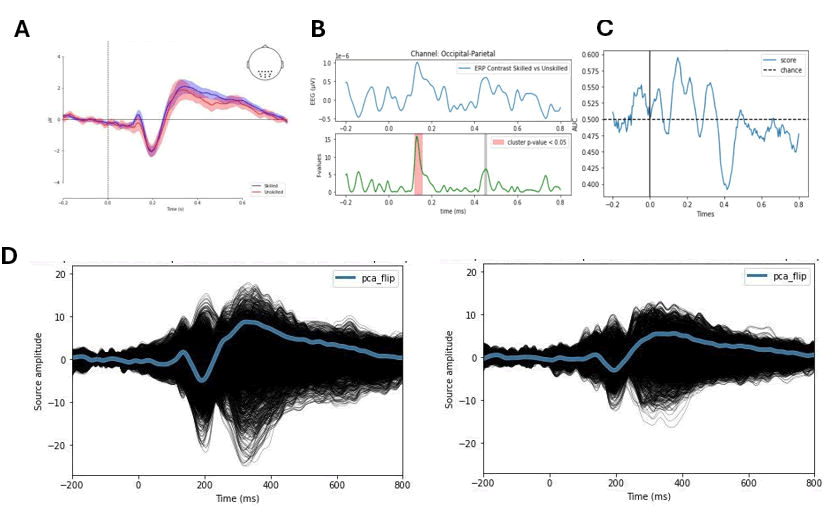
Figure 3: Time domain activity during the stimulus onset period in both the sensor and source space. A) Sensor space ERP from occipital parietal electrodes, skilled players coloured in blue and unskilled players in red. B) Grand average difference wave ERPs between skilled players, unskilled players and between outcomes across populations, corrected for multiple comparisons using cluster permutation test. C) Multi-variate pattern analysis differentiating between skilled and unskilled players during stimulus onset period. Decoding performance is plotted in blue with above 0.5 being above statistical chance of occurring. D) dSPM source amplitude differences between skilled (left) and unskilled players (right) computed with a sign flip across visual cortex labels to avoid signal cancellation when averaging signed values.
To compare neural oscillations during execution of movements, pre-stimulus alpha power and post-stimulus theta power were quantified at time points where they impart the most influence. Pre-stimulus alpha power is quantified in a box plot displaying how skilled players show significantly lower alpha power than unskilled players, analysed through unpaired non-parametric t-tests, Mann- Whitney (p=<0.0001). post-stimulus theta power also showed a significant reduction in skilled players, analysed through unpaired non-parametric t-tests, Mann-Whitney (p=0.0156). Correlational analysis indicated a significant relationship between pre-stimulus alpha power and reaction time (r=0.378, p=0.0395) across all participants and in poststimulus theta power (r=0.2332, p=0.0318). This indicates a strong inverse relationship between pre-stimulus alpha power and post-stimulus theta power with high performance. There is a strong relationship between neural oscillations and performance, displayed by significantly reduced pre-stimulus alpha and significantly reduced post-stimulus theta (Figure 4).
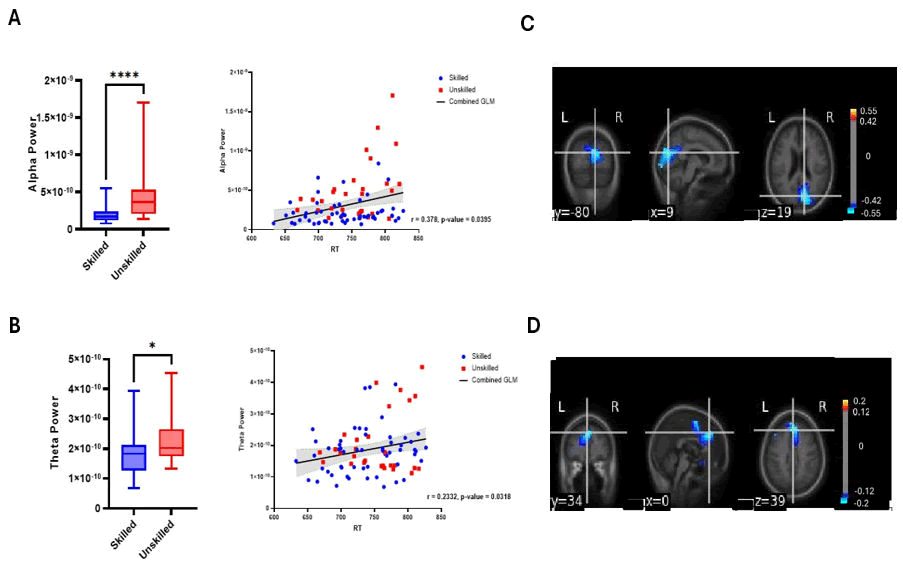
Figure 4: Neural oscillations during pre-stimulus (-0.5–0 s) and post-stimulus (0–0.5 s) phases during psychophysics experiment. A) Alpha power differences in the pre-stimulus phase displaying the raw power difference between skilled and unskilled players and the correlation between theta power and reaction time. B) Theta power differences in the post-stimulus phase displaying the raw power difference between skilled and unskilled players and the correlation between theta power and reaction time. C) DICS source localization of alpha power during the pre-stimulus phase projected onto a template MRI showing the difference between skilled and unskilled players. D) DICS source localization of theta power projected onto a template MRI showing the difference between skilled and unskilled players. Statistical analysis in box plots used unpaired, nonparametric t-tests (Mann-Whitney) after failing normality tests (Kolmogorov-Smirnov test). Significant comparisons marked (*=0.01, **=0.001, ***=0.0001, ****=<0.0001).
Across the multiple tasks testing two different fundamental movements in Esports, flicking and tracking, skilled players performed significantly better than unskilled players. In changing tasks, the interaction between task and population is significant for Score (F(2,64)=3.556, p=0.0343). There was a significant score difference across each task (F(1.059, 42.34)=109.0, p=<0.0001) and across population (F(1, 40)=16.55, p=0.0002). Tukey’s multiple comparison post-hoc test indicated there was a significantly higher score in skilled players across each task (Burstflick, p=<0.0115; Gridshot, p=0.0001; Spidershot, p=0.0001). Time to kill also showed a significant interaction between task and population (F(2, 64)=3.382, p=0.0467). Differences across tasks (F(1.788, 57.21)=58.57, p=<0.0001) and across populations (F(1, 32)=11.16, p=0.0021) were also significant. Tukey’s multiple comparison post-hoc test also indicated that there were significant differences in time to kill across all tasks (Burstflick, p=<0.0499; Gridshot, p=0.0023; Spidershot, p=0.0306). Frontal central theta power increased significantly in active conditions compared to passive conditions (F(0.9344,29.90)=36.87, p=<0.0001) but was not significantly different between participants (F(1,32)=3.373, p=0.0756). By comparing both active and passive conditions and skilled and unskilled groups, a significant difference is revealed (F(1,32)=4.604, p=0.0396) (Tables 1 and 2).
| ANOVA table |
SS |
DF |
F (DFn, DFd) |
P value |
| Task |
1.674e-021 |
2 |
F (2.000, 64.00)=1.132 |
P=0.3289 |
| Active vs. Passive |
2.521e-019 |
1 |
F (0.9344, 29.90)=39.30 |
P<0.0001 |
| Skilled vs. Unskilled |
1.005e-019 |
1 |
F (1, 32)=4.699 |
P=0.0377 |
| Task x Active vs. Passive |
6.155e-021 |
2 |
F (1.740, 55.67)=4.732 |
P=0.0162 |
| Task x Skilled vs. Unskilled |
1.256e-021 |
2 |
F (2, 64)=0.8487 |
P=0.4327 |
| Active vs. Passive x Skilled vs. Unskilled |
4.063e-020 |
1 |
F (1, 32)=6.334 |
P=0.0171 |
| Task x Active vs. Passive x Skilled vs. Unskilled |
3.092e-021 |
2 |
F (2, 64)=2.377 |
P=0.1010 |
Table 1: Summary table from 3-way ANOVA of theta power comparing task × experimental condition × population.
| ANOVA table |
SS |
DF |
F (DFn, DFd) |
P value |
| Task |
1.407e-021 |
2 |
F (2.000, 64.00)=1.242 |
P=0.2957 |
| Active Passive |
3.168e-020 |
1 |
F (0.9266, 29.65)=5.522 |
P=0.0278 |
| Skilled vs. Unskilled |
2.613e-020 |
1 |
F (1, 32)=1.365 |
P=0.2514 |
| Task x Active Passive |
8.617e-022 |
2 |
F (1.964, 62.85)=0.7502 |
P=0.4742 |
| Task x Skilled vs. Unskilled |
8.353e-022 |
2 |
F (2, 64)=0.7374 |
P=0.4824 |
| Active Passive x Skilled vs. Unskilled |
9.350e-021 |
1 |
F (1, 32)=1.630 |
P=0.2109 |
| Task x Active Passive x Skilled vs. Unskilled |
4.721e-022 |
2 |
F (2, 64)=0.4110 |
P=0.6647 |
Table 2: Summary table from 3-way ANOVA of theta power comparing task × experimental condition × population.
Occipital Parietal Alpha Power Signi icantly Differed between Active and Passive
Conditions (F(0.9266,29.65)=5.522, p=0.0278) but didn’t significantly differ between populations (F(1,32)=1.365, p=0.2514). There was not a significant difference by comparing both active and passive conditions and skilled and unskilled groups (F(1,32)=1.630, p=0.2109). In flicking tasks, there are significant differences between theta power levels across populations (F(1,32)=4.745, p=0.0369) but not between tasks (F(1.901,60.83)=0.5502, p=0.5709). Tukey’s multiple comparison post-hoc test indicated significantly higher theta power in two tasks (Burstflick, p=0.0086 and Gridshot, p=0.035) but not in Spidershot (p=0.0919). Occipital-parietal alpha power showed significant differences across population (F(1,32)=4.391, p=0.0441) but not across task (F(1.845, 59.04)=0.7792, p=0.4540). Tukey’s multiple comparison posthoc test indicated significant increases in alpha power in skilled players in two tasks (Gridshot, p=0.0316 and Spidershot, p=0.0360) but not in Burstflick (p=0.0536) although it was statistically trending. Whilst playing an Esports related aim-training task, frontal-central theta power increased significantly in the active conditions (Figure 5).
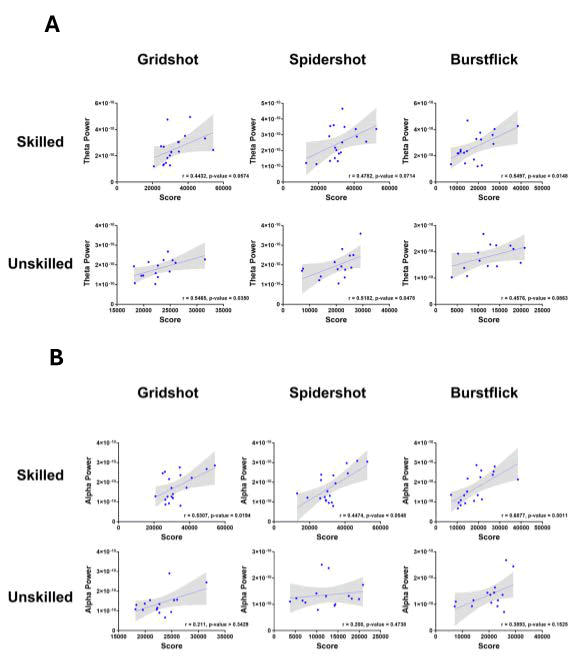
Figure 5: Correlational analysis between neural oscillations and behavioural performance in Esports aiming tasks. A) Correlations between theta power and score across each task in frontal-central sensors in flicking tasks with general linear model plotted in black and error bars coloured in grey. B) Correlations between alpha power and score across each task in frontal-central sensors in flicking tasks with general linear model plotted in black and error bars coloured in grey. R values p values for each correlational are reported.
Correlational analysis revealed significant positive relationship between behavioural performance within each task and theta power. In skilled players this relationship was significant for the tasks: Gridshot, Spidershot and Burstflick. In unskilled players this relationship was strongly positive for Gridshot and Spidershot, but negative for Burstflick with no relationships being significant. In all cases, this slope of the GLM was drastically steeper in skilled players than unskilled players highlighting a much stronger relationship. In frontal central sensors, there was a significantly stronger relationship between theta power and performance, presenting theta power as an indicator of performance in skilled players but not unskilled players. However, by using Fisher’s r to-z approach, there were no significant differences across all correlations (Gridshot: z=0.359, p=0.36; Spidershot z=-0.139, p=0.445; Burstflick: z=0.324, p=0.373). Alpha power was shown to be correlated strongly to performance in skilled players but not in unskilled players. In skilled players, a significant positive correlation was found in the Gridshot and Burstflick tasks and a strong positive correlation was found in Spidershot. In unskilled players, the relationship between alpha power and performance was much weaker, shown by insignificant p-values and smaller correlation coefficients. The strongest relationship was with the Burstflick task, with Gridshot and Spidershot being much weaker (shown by a smaller r value). None of these relationships are significant. Across all players, alpha power seems somewhat correlated to performance, with a stronger correlation in skilled players. However, by using Fisher’s r-to-z approach, there were no significant differences across all skilled vs. unskilled correlations (Gridshot: z=0.612, p=0.27; Spidershot z=-0.087, p=0.465; Burstflick: z=1.133, p=0.129).
Discussion
The present study aimed to establish whether brain activity can be used to differentiate players based on their performance within a sporting model, identifying neural correlates that are driving the higher performance level. It has introduced the use of Esports as a sporting model where unifying principles of how information is extracted and utilized to execute a price movement response can be extrapolated to other sports. By applying cognitive electrophysiological techniques to sport science data, logistical challenges in common practices are overcome, whilst retaining ecological sporting validity. To that end, an ecologically valid methodology was employed by capturing participant performance on a fundamental movement psychophysics task and aim-training tasks within the commercial aim-training software, AimLab.
The tasks used induced fundamental movements required by FPS Esports in a high-volume, fast-movement paradigm. In the psychophysics task, discrete movement responses were made to the onset of simple stimuli (black squares and white background) which had to be complete within a short time period. In the aim-training tasks multiple targets were always present on the screen, with participants freely choosing which one to shoot at first, before switching to the next. This increased the complexity of the task drastically and pushed it towards a higher level of ecological validity, more closely emulating scenarios experienced in Esports. Furthermore, the visual information was 3-dimensional, highly coloured and the targets were dynamic. As such, the study encompasses both discrete and sequential movements.
To identify skilled and unskilled players contained within the recorded population, an objective data-driven approach was utilized. In this method, performance data from all experiments was used to test for the presence of clusters in the data creating separate performance groups. Players that cluster together, perform most similarly. In this way, two groups were formed based on performance alone and increased separation when based on experience alone. To address this problem, there needs to be a way of separating based on performance and finding two populations that have a large difference, but also intrinsic show similar performance profiles. A first issue is, however, the number of performance metrics used, and how to choose which one. A solution to this, is to use PCA analysis to project multi-dimension data on common axis, through dimensionality reduction. PCA was applied to all the performance metrics, achieving dimensionality reduction, and re-projecting the data along a 2-dimensional axis of principal components, retaining information and capturing variance derived from the data. To probe whether experienced players perform better, classification was applied to the un-grouped data. Finally, the data groups were re-classified using k-means clustering to attribute the data items, to the optimal two clusters, determined by silhouette analysis. Intrinsically, the data items within these clusters contain participants whose performance is most similar throughout the data set, but also producing maximum separation to the other cluster.
Two experimental conditions were used in the Esports aiming test, comparing active and passive conditions on the same AimLabs tasks. In passive conditions, participants would watch a video of a professional player complete the same task before playing it themselves. It served to solidify instructions and display the movement speed required to achieve a high score. In active conditions, players would then take part in the task, implementing what they had just observed. Theta power was significantly higher in active conditions compared to passive conditions in frontal-central sensors and alpha power was higher in occipital-parietal sensors however this effect was only present in skilled players. There were no significant differences found in neural oscillations between populations in the passive condition. Theta power in frontal-central sensors was higher in skilled players during execution of fundamental aiming movements. Through correlational analysis, a positive relationship was discovered between theta power and performance, with high power being associated with high scores in skilled players. Although this relationship was directionally the same in unskilled players, the relationship was not significant but was trending in certain tasks. Alpha power was found to be significantly higher in occipital parietal electrodes in skilled players in the tasks, there were no significant differences in alpha power found in unskilled players. Correlational analysis revealed significant relationships between alpha power and performance with a strong, positive and significant relationship, showing high power and high performance, was found.
Time Domain Components and Performance
One of the major neural correlates of performance was displayed as p100, the visually evoked potential research, a positive potential detected in occipital sensors 100 ms after a visual stimulus onset, as an early electrophysiological correlate of target-orientated visual processing [7]. However, by presenting a visual stimulus in different locations in the visual field, significant differences in amplitude and latency in the waveform become apparent [8]. Increases in target size and a participant’s visual acuity also modulate the amplitude and latency of the p100 waveform, with decreases to latency and gradual increases in amplitude [9]. During continuous visual stimulation, steady state visually evoked potential amplitude increases, but time-locked averages decrease. Early-stage visual processing also has a key contribution to latter stage, more complex cognition. This occurs in both explicitly and implicitly vision-based behaviours. A notable explicit vision-based behaviour is face perception. This process begins early, reflected in the p100 wave form as a face-selective response. The p100 (referred to as an M100 using MEG) amplitude correlates with successful characterization of face stimuli, discriminating them against other visual stimuli, but not with successful individual face recognition. Sustained spatial attentional mechanisms are also influenced by visually evoked potentials. By presenting a visual target either to the left or the right visual field immediately preceding a continual visual stimulus (in this case, visual gratings), transient p100 amplitudes were enhanced by sustained attention. Although sustained attention is modulated by a wide variety of factors, not least neural oscillations, p100s served as an early marker of attention in the time domain.
However, many of the studies used in support of this research are simple visual detection tasks, asking participants to report if they had seen a stimulus or not. The present task is not so simple. Participants have 1000 ms during a trial and it would be unlikely to suggest that a stimulus was not detected at all within that period. Ultimately, there is still a debate in the field about whether p300 reflects conscious awareness or unconscious perception in occipital parietal electrodes, since stimuli are perceived even when observers are unaware of the stimuli. P300 theories have been updated to suggest a post-perceptual marker of conscious access not simply conscious perception. Therefore, there are still many steps required by the participants to execute a precise movement in time. Training interventions in older populations, have been created displaying enhanced p300 amplitude which was associated with increased cognitive performance. Skilled players, many of which are experienced in Esports, might display pre-trained enhancements to p300 amplitude which are captured in this study. Whilst this might facilitate an increased visual perception and overall performance, it does not linearly increase reaction time necessarily. The study did not note any differences in the amplitude or latency of p300 between the skilled and unskilled population in the sensor. It is possible to conclude that the visual stimulus more readily enters conscious awareness of skilled players which allows for the utilization of this information to produce a conscious action more frequently. That is, it is not just the amplitude difference of p300, observed in the source-space, that causes the performance difference, but the frequency a high amplitude component is induced which produces the observed performance difference. There could also be further downstream modulations that reflect more complex cognitive/motor, processes and these are only an early indication of conscious perception or awareness. How this information is utilized further is unclear and requires further investigation.
Neural Oscillations and Esports
Within the Esports aiming task, two different neural correlates became apparent, frontal midline theta power, and occipital-parietal alpha power. Both show a strong positive correlation to performance and an increase in active compared to passive conditions. The increased theta power in both participant populations was observed in the frontal midline of the cortex. This theta pattern is associated with activity in the Anterior Cingulate Cortex (ACC) and prefrontal cortex in source localization studies. Theta power localized to the ACC and other frontal structures has a diverse range of functions in complex cognition such as action regulation and monitoring; conflict monitoring, task selection. Theta power is also highly prevalent in the hippocampus and its thus strongly associated to elements of memory. In particular, retention and encoding. However, the present study observes theta power during a highly complex and dynamic visuomotor task. The ACC has strong connections to the motor system and parts of the ACC have been shown to play an essential role in the preparation and readiness, planning and initiation of intentional movements. The present study induces a highly complex array of sequential movements requiring precise motor control, speed and accuracy, under time pressure. The extreme temporal density of movements and the precision requirements of them, go far to explain the upregulation of theta power in both populations. As such, it seems that the extreme difference in performance observed between skilled and unskilled players is at least in some part, coordinated by enhanced theta power facilitating increased information flow in the midbrain to the motor cortex, providing the drive for a high, sustained level of performance.
The observed increase in theta power was to be expected and was correctly predicted, especially its strong relationship to performance. However, the relationship of alpha to performance, increasing in active conditions, was not. A possible explanation for this comes from a key finding within cognitive performance tests in video game players. That is, the ability to task switch, an effect broadly coordinated by attention. Within the neuroscience literature, task switching is commonly associated with a suppression of alpha power and event related desynchronisation in the alpha frequency band prior to movement onset. In the aiming tests, participants must switch between a multitude of competing targets rapidly but also accurately. It might be assumed that, based on the strong field of research on posterior alpha power desynchronisation prior to task switching, that these tasks would be associated with decreased alpha power and an inverse relationship to performance would be found. However, the opposite appears to be true. In tasks where there is a high prevalence of switching between tasks, there is a significant, positive relationship to performance.
There are several possible explanations for this result. Firstly, the literature on task switching using event locked methodologies, whereby decreases in posterior alpha are prestimulus presentation, which in turn predicts task switching. The present study cannot use these methods and as such cannot make a comment on when alpha power was either high or low, just that over the entirety of the experiment, it remained higher in active conditions and showed a strong relationship to performance across both populations. Also, this switch is voluntary, not determined by a performance variable. In the present study, participants must switch target once it has been ‘destroyed’ either by shooting it or remaining within its boundary for a certain period. As such it is not a voluntary switch but determined by what is required by the task. Furthermore, the tasks that involve switching are associated with additional targets present on screen at any one time, or that are followed incredibly quickly based on performance or time. This is to accurately mimic ecologically valid Esports aiming scenarios where multiple targets are presented at one time, or incredibly close together. As such, the observed power increases in alpha, and their significant positive relationships to performance, might in fact reflect increases in attention to inhibit distractor influences (e.g. alternative targets) and focus attention on the present stimulus. This is well documented in the literature. Furthermore, alpha power has been shown to decrease in response to moving images but increase in response to still. Although this does not fully explain the present data, it offers some explanation for why alpha power increased during multi-target sequential movement tests. Unfortunately, with the methodology employed, limited by the constraints of using a commercial aim-trainer, event related dynamics are not possible to isolate. Nor is any time-frequency decomposition. Future studies should focus on this difference by creating multi-target, complex movement tasks, that incorporate both static and moving targets trials, single and multi-target trials signaled by a trigger system.
Conclusion
The present study utilizes a complex visuomotor performance task to isolate the neural correlates of high performance, examining the differences between a skilled Esports population and an unskilled population. It has uncovered several key contributing factors differentiating between skilled and unskilled players. Across both populations, fast reaction times are correlated to a reduced number of errors. That is, fast reaction times are strongly related to a lower error index, suggesting better performing players are both fast and accurate with their responses. Skilled players display enhanced early-stage visual processing displayed by higher amplitude p100 and p300 components in both the sensor and source space facilitating both enhanced visual perception speed and conscious access to task-related sensory information compared to unskilled players. Furthermore, skilled players display significant reductions in pre-stimulus alpha power. As such, skilled players display a reduction in cortical excitability, coordinated by alpha power in occipital parietal regions, which disengages attention of task-irrelevant information. Unskilled players appear to attend greatly to the fixation cross during the fixation period, resulting in significantly longer saccade latencies in successful trials and prevents fast task switching to the target. This is supported by the early-stage differences in response whereby skilled players display a significantly increased p100 amplitude and decoding scores classifying the response differences, peak over this period in successful trials. Skilled players also display recued post- stimulus theta power, perhaps signifying an increased neural efficiency and ability to manage a high cognitive load.
During the performance of high frequency, complex and sequential Esports-related movements, significant differences occur between skilled and unskilled players. Skilled players show a substantial increase in score across all aiming tasks, and faster TTK. These individual movements are intrinsic to performance in Esports competition are tested here in a controlled and ecologically valid way. AimLabs functions as an aim-training software, commercially available but used by professional players to precisely train aspects of these movements, notably the speed and accuracy. In the present study, the enhanced performance of skilled players appears to be coordinated by frontal theta power emerging from frontalcentral regions, presumed to emanate from the anterior cingulate cortex. As such, skilled players appear to achieve a higher performance due to an increase in theta power emanating from the ACC which improves the speed and accuracy of motor output and modulate alpha coordinated attention potentially reflecting an increased ability to actively suppress distractors.
Ultimately, the differences between skilled and unskilled players are identifiable using cognitive electrophysiology and Esports functions as a precise, ecologically valid model to use as a sporting framework.
References
- Appelbaum LG, Cain MS, Darling EF, Mitroff SR (2013) Action video game playing is associated with improved visual sensitivity, but not alterations in visual sensory memory. Atten Percept Psychophys. 75:1161-1167.
[Crossref] [PubMed]
- Li R, Polat U, Makous W, Bavelier D (2009) Enhancing the contrast sensitivity function through action video game training. Nat Neurosci. 12(5):549-551.
[Crossref] [Google Scholar] [PubMed]
- Castel AD, Pratt J, Drummond E (2005) The effects of action video game experience on the time course of inhibition of return and the efficiency of visual search. Acta Psychol. 119(2):217-230.
[Crossref] [Google Scholar] [PubMed]
- Green CS, Bavelier D (2003) Action video game modifies visual selective attention. Nature. 423(6939):534-537.
[Crossref] [Google Scholar] [PubMed]
- Buckley D, Codina C, Bhardwaj P, Pascalis O (2010) Action video game players and deaf observers have larger Goldmann visual fields. Vision Res. 50(5):548-556.
[Crossref] [Google Scholar] [PubMed]
- Valls-Serrano C, de Francisco C, Caballero-López E, Caracuel A (2022) Cognitive flexibility and decision making predicts expertise in the MOBA esport, League of Legends. SAGE Open.12(4).
[Google Scholar]
- Kowal M, Toth AJ, Exton C, Campbell MJ (2018) Different cognitive abilities displayed by action video gamers and non-gamers. Comput Hum Behav. 88:255-262.
[Google Scholar]
- Seya Y, Shinoda H (2016) Experience and training of a first person shooter (FPS) game can enhance useful field of view, working memory, and reaction time. Int J Affect Eng. 15(3):213-222.
[Google Scholar]
- Chisholm JD, Kingstone A (2015) Action video games and improved attentional control: Disentangling selection-and response-based processes. Psychon Bull Rev. 22:1430-1436.
[Crossref] [Google Scholar] [PubMed]
Citation: Winstanley M, Drust B (2025) Can ERPs and Neural Oscillations Be Usesssd to Differentiate Skilled and Unskilled Player Performance in an Ecologically Valid Sporting Model? J Curr Neur Biol. 5:37.
Copyright: © 2025 Winstanley M, et al. This is an open-access article distributed under the terms of the Creative Commons Attribution License, which permits unrestricted use, distribution, and reproduction in any medium, provided the original author and source are credited.